
Patio pressure washing typically costs about $0.10 to $0.50 per square foot, although the final price can vary substantially depending on patio material, surface condition, accessibility, stains, preparation work, and whether the patio contains paver joints. Angi currently reports a typical overall patio project range of about $80 to $500, with an average around $250.
A simple concrete patio with open access can be relatively straightforward to clean. A patio of the same size built with pavers, brick, or natural stone may require more careful cleaning, especially where joint sand, moss, weeds, grease, or delicate finishes are involved.
Square footage is still one of the most useful starting points, especially when comparing the typical pressure washing cost per square foot across different exterior surfaces. But square footage alone does not describe the entire cleaning scope.
This guide compares current U.S. pricing references, estimates patio pressure washing cost by size, explains how different materials affect the job, and shows why two patios with identical square footage can produce very different estimates.
2026 Patio Pressure Washing Cost at a Glance
Current published pricing sources show a fairly wide range for professional patio cleaning.
Angi reports approximately $0.10 to $0.50 per square foot for professional patio pressure washing. Homewyse’s January 2026 model starts at approximately $0.39 to $0.49 per square foot under basic, readily serviceable project conditions. Homewyse also lists $0.42 to $0.52 per square foot for basic concrete pressure washing, which provides another useful benchmark for concrete patios.
These figures should not simply be averaged together. Each source uses different assumptions about job size, labor, minimum charges, materials, preparation, and site conditions.
| Source | Published Rate | Important Context |
|---|---|---|
| Angi | $0.10–$0.50 per sq. ft. | Professional patio pressure washing. Material, prep work, size, and site conditions can affect the final price. |
| Homewyse — Patio | $0.39–$0.49 per sq. ft. | Basic professional patio power washing under favorable, readily serviceable conditions. |
| Homewyse — Concrete | $0.42–$0.52 per sq. ft. | Basic concrete pressure washing and a useful additional reference for concrete patios. |
Published pricing sources use different assumptions. These ranges are comparison benchmarks, not guaranteed quotes for the same project.
The spread matters. At $0.10 per square foot, a 500-square-foot patio would imply only $50. At $0.50 per square foot, the same size would imply $250.
That does not necessarily mean one source is wrong. Smaller projects may encounter minimum service charges, while material, preparation, stains, furniture, access, and joint work can all change the amount of labor involved. Angi explicitly notes that its per-square-foot figures may not include project minimums or additional fees.
Patio Pressure Washing Cost by Size
To make size comparisons easier, WashNumbers uses a transparent planning model rather than presenting one published national average as a guaranteed market price.
For this page, the WashNumbers baseline patio model uses:
- Base rate: $0.40 per sq. ft.
- Modeled minimum charge: $100
- Average condition: 1.00×
- Normal access: 1.00×
- Planning range around the modeled result: ±20%
The $0.40 baseline is a modeling assumption selected within the current published patio pricing ranges. It is not presented as a measured national contractor average.
You can read how WashNumbers separates published pricing data from planning assumptions on our methodology page.
WashNumbers formula
Estimated price = max($100, square footage × $0.40 × condition factor × access factor)
For an average-condition patio with normal access:
| Patio Size | Modeled Estimate | Planning Range | Effective Rate |
|---|---|---|---|
| 100 sq. ft. | $100 minimum | $100–$120 | $1.00/sq. ft. |
| 200 sq. ft. | $100 minimum | $100–$120 | $0.50/sq. ft. |
| 300 sq. ft. | $120 | $100–$144 | $0.40/sq. ft. |
| 400 sq. ft. | $160 | $128–$192 | $0.40/sq. ft. |
| 500 sq. ft. | $200 | $160–$240 | $0.40/sq. ft. |
| 750 sq. ft. | $300 | $240–$360 | $0.40/sq. ft. |
| 1,000 sq. ft. | $400 | $320–$480 | $0.40/sq. ft. |
WashNumbers planning model for an average-condition patio with normal access. These figures are modeling outputs, not contractor quotes or published market averages.
Planning ranges apply ±20% to the modeled result, with the $100 modeled minimum acting as the lower floor for small projects.
Why Small Patios Can Cost More per Square Foot
One useful result of modeling a minimum charge is that the effective cost per square foot increases sharply on very small jobs.
A contractor still has to travel to the property, unload equipment, connect water, prepare the area, perform the cleaning, pack up, and travel to the next job whether the patio is 100 square feet or 500 square feet.
Homewyse’s own patio model includes a balance of two hours of minimum labor, which supports the broader point that small exterior-cleaning jobs cannot always be priced by square footage alone.
Under the WashNumbers example above:
- 100 sq. ft. at the modeled $100 minimum = $1.00/sq. ft. effective
- 200 sq. ft. = $0.50/sq. ft.
- 500 sq. ft. = $0.40/sq. ft.
- 1,000 sq. ft. = $0.40/sq. ft.
This is why multiplying a small patio by the lowest online per-square-foot rate can produce an unrealistically low estimate.
What Does Patio Pressure Washing Cost per Square Foot?
There is no single universal patio pressure washing rate.
Angi’s current range of $0.10–$0.50 per square foot is much broader than Homewyse’s basic $0.39–$0.49 per square foot range. Homewyse’s concrete model is slightly higher at $0.42–$0.52 per square foot.
The important question is therefore not simply, “What is the national price per square foot?” It is:
What scope of work does that rate assume?
A clean, open concrete slab may be close to a straightforward square-footage job. A paver patio with sand loss, algae between joints, furniture, grease stains, landscaping around every edge, and difficult hose access is not.
Patio Pressure Washing Cost by Material
Material affects more than appearance. It can change cleaning technique, pressure selection, chemical use, time spent on stains, and the risk of disturbing joints or damaging the surface.
Angi currently lists approximately $130–$220 for concrete patios and $210–$250 for brick or paver patios in its material comparison. It also notes that brick and paver surfaces may require gentler cleaning than concrete.
These published project ranges do not prove that every paver patio costs more than every concrete patio. They do show why material needs to be part of the estimate.
| Patio Material | Typical Cleaning Consideration | Potential Scope Impact |
|---|---|---|
| Concrete | Large continuous surface that may still require treatment for oil, grease, algae, or embedded staining. | Often relatively straightforward when open and in good condition. |
| Concrete Pavers | Pressure and spray angle must account for paver joints and joint sand. | Cleaning may require additional care and possible joint-sand replacement. |
| Brick | Joints, mortar, age, and surface condition can make aggressive cleaning inappropriate. | More detailed or cautious cleaning may increase labor time. |
| Natural Stone | Stone type, finish, age, and existing sealers should be identified before selecting a cleaning method. | May require a more conservative or specialized approach. |
| Stamped / Decorative Concrete | Existing color, coating, or sealer may affect the appropriate cleaning process. | Extra caution may be required to protect the finish. |
Concrete Patio Pressure Washing Cost
Concrete patios are often among the simpler patio surfaces to estimate because they usually consist of a continuous slab without hundreds of sand-filled joints.
That does not mean every concrete patio is easy.
Oil or grease around grills, heavy algae, rust marks, paint, deep staining, poor drainage, or a deteriorated surface can all increase preparation and cleaning time. Angi specifically notes that preparation such as sweeping and applying degreaser can add labor to a patio-cleaning project.
For homeowners comparing similar concrete surfaces, our driveway pressure washing cost guide provides another useful reference for larger exterior concrete areas.
Paver Patio Pressure Washing Cost
Paver patios deserve separate treatment because the contractor is not cleaning only the visible face of each paver.
There is also a joint system between the units.
Unilock warns that incorrect pressure or nozzle settings can damage pavers or blow joint sand out of the joints. Its maintenance guidance recommends keeping the wand moving, using a fan spray, and directing the stream carefully to reduce sand loss.
If joint sand is removed, the cleaning job may create a second task: replacing it once the surface is dry.
That is an important reason a 500-square-foot paver patio should not automatically be treated as equivalent to 500 square feet of plain concrete.
Brick Patio Pressure Washing Cost
Brick patios also combine surface cleaning with joint considerations.
Angi currently places brick or paver patios above concrete in its published material examples and notes that these materials may require gentler techniques.
Older brick, deteriorating mortar, algae in joints, uneven sections, and heavy organic buildup can make the job more detailed than cleaning a flat concrete slab.
Natural Stone Patio Cleaning
Natural stone is too broad a category for one universal pressure setting or cleaning method.
Flagstone, limestone, slate, and other natural materials can react differently to chemicals, pressure, stains, weathering, and existing sealers.
For that reason, WashNumbers does not assign one invented material multiplier to every natural-stone patio. The appropriate cleaning process should be based on the actual stone and condition of the installation.
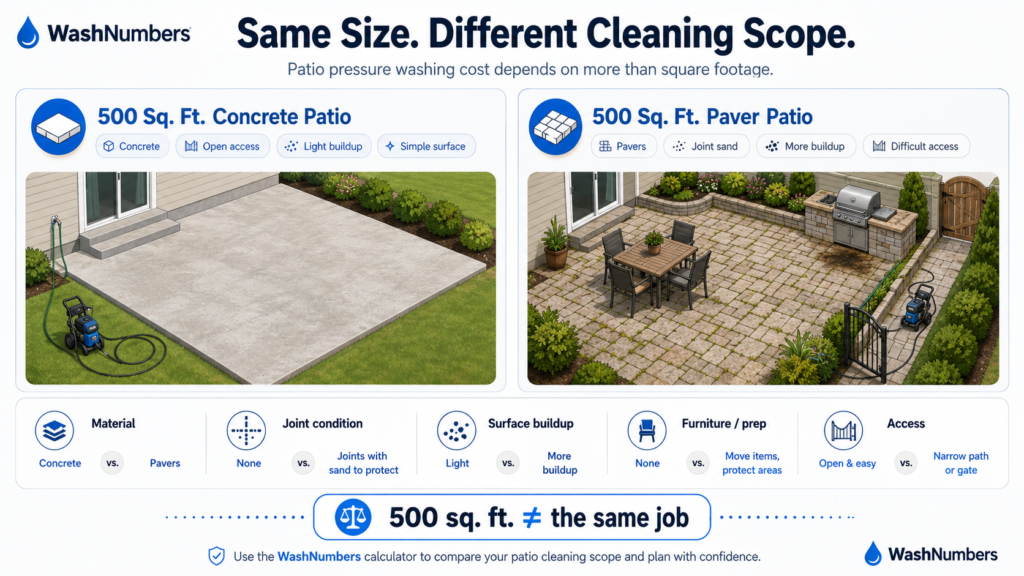
Why Two 500 Sq. Ft. Patios Can Cost Very Different Amounts
Square footage tells you how large the patio is.
It does not tell you how difficult it is to clean.
Consider two hypothetical 500-square-foot patios.
Patio A — Simple Concrete Patio
- 500 sq. ft.
- Plain concrete
- Average dirt buildup
- Open rectangular layout
- Easy hose and equipment access
- No furniture
- No significant grease or rust staining
Using the WashNumbers baseline model:
500 × $0.40 = $200
Patio B — Complex Paver Patio
- 500 sq. ft.
- Concrete pavers
- Heavy organic buildup
- Moss and weeds around joints
- Outdoor furniture to move
- Grill-area grease staining
- Narrow backyard access
- Joint sand requiring protection and inspection
The floor area is still 500 square feet, but the actual cleaning scope is clearly larger.
That is why WashNumbers treats size, condition, access, and surface characteristics as separate variables instead of pretending square footage explains the entire job.
How Paver Joints Can Change the Cleaning Scope
This is one of the most important differences between a paver patio and a solid concrete patio.
Joint sand helps fill and stabilize the spaces between pavers. Unilock advises protecting that sand during cleaning and says that if joints look low after pressure washing or heavy rinsing, clean sand should be swept back into the gaps after the patio dries.
Pressure washing can therefore create three different scenarios:
1. Joints remain intact
The patio is cleaned carefully and little or no joint material is lost.
This is closest to a normal cleaning-only job.
2. Some joint sand is displaced
The patio may still be successfully cleaned, but the joints need inspection and potentially additional sand.
3. Joint restoration is part of the project
This is a different scope from cleaning alone.
Techniseal’s restoration guidance even describes intentionally pressure washing pavers deeply enough to remove joint material before replacing it as part of a restoration process. That is not the same service as a basic maintenance wash.
For pricing purposes, homeowners should therefore ask whether a paver quote includes:
- surface cleaning only,
- replacement of displaced joint sand,
- complete re-sanding,
- polymeric sand,
- or sealing after cleaning.
Those services should not be assumed to be interchangeable.
How Condition Changes Patio Pressure Washing Cost
WashNumbers models surface condition separately from square footage.
For planning purposes, our current patio model uses:
- Light buildup: 0.90×
- Average buildup: 1.00×
- Heavy buildup: 1.15×
These are WashNumbers modeling assumptions, not published contractor averages.
Condition Example for a 500 Sq. Ft. Patio
| Condition | WashNumbers Factor | 500 Sq. Ft. Example |
|---|---|---|
| Light buildup | 0.90× | $180 |
| Average buildup | 1.00× | $200 |
| Heavy buildup | 1.15× | $230 |
Heavy buildup may involve more dwell time, repeated passes, spot treatment, or additional preparation.
A small patio covered in algae or grease can therefore require more work than a larger patio with only loose dirt.
How Access Affects Patio Cleaning Cost
The patio may be behind the house even when the contractor’s vehicle is parked in front.
That distance matters.
WashNumbers currently models access as:
- Easy access: 0.95×
- Normal access: 1.00×
- Difficult access: 1.10×
Again, these are transparent planning assumptions rather than market statistics.
Factors that can make access more difficult include:
- narrow side gates,
- stairs,
- long hose runs,
- equipment that must be carried manually,
- limited parking,
- enclosed courtyards,
- landscaping that restricts movement,
- or a water connection far from the work area.
Other Factors That Affect Patio Pressure Washing Prices
Furniture and Preparation
Outdoor furniture, planters, grills, rugs, toys, and decorative items may need to be moved before cleaning.
Homeowners can sometimes reduce preparation time by clearing the patio before the contractor arrives.
Grease and Oil Stains
A patio used for grilling may contain grease that does not respond like ordinary dirt.
Angi specifically identifies degreasing as an example of preparation that can add labor time.
Moss, Algae, and Organic Growth
Shaded or damp patios can accumulate organic growth, especially around joints and low-drainage areas.
Cleaning may involve treatment in addition to mechanical rinsing.
Drainage
The contractor needs somewhere for dirty water to move.
Low spots, poor drainage, nearby doors, pools, landscaping, or enclosed courtyards can complicate runoff management.
Edges, Steps, and Borders
A 500-square-foot rectangle is generally simpler than 500 square feet divided into multiple levels, steps, curved borders, retaining-wall edges, and narrow sections.
The measured floor area may be identical, but the amount of detail work is not.
Patio Pressure Washing Add-Ons
A basic patio washing quote should not automatically be assumed to include every restoration service.
Potential add-ons can include:
- degreasing or stain treatment,
- furniture moving,
- joint-sand replacement,
- complete paver re-sanding,
- polymeric sand installation,
- sealing,
- cleaning steps or adjoining walkways,
- or treatment of especially difficult stains.
Angi currently estimates patio sealing as an additional $180–$370, depending on material and patio size.
That figure is useful as a published reference, but sealing should be treated as a separate service rather than quietly included in a pressure-washing estimate.
DIY vs. Professional Patio Pressure Washing
DIY can make sense for a durable patio in good condition when the homeowner already owns suitable equipment and understands the surface being cleaned.
However, the equipment cost is not the only consideration.
Angi currently lists approximately $35–$175 per day to rent a pressure washer and roughly $100–$1,000 to purchase the type of equipment described in its patio guide.
More importantly, improper pressure or nozzle selection can damage a surface or remove joint sand. Unilock specifically warns about both risks when pressure washing pavers.
For a simple concrete slab, DIY may be relatively straightforward.
For older masonry, decorative surfaces, heavily stained patios, or pavers with joint concerns, the potential cost of correcting damage should be considered alongside the potential savings.
How to Measure Your Patio for a Cost Estimate
For a rectangular patio:
Length × width = square footage
Example:
20 ft × 25 ft = 500 sq. ft.
For an L-shaped or irregular patio, divide it into smaller rectangles, calculate each section, and add them together.
Example:
- Main section: 20 × 20 = 400 sq. ft.
- Side section: 10 × 10 = 100 sq. ft.
- Total = 500 sq. ft.
Do not automatically include the square footage of a driveway, walkway, pool deck, wall, or steps unless those surfaces are actually being cleaned.
If you want to estimate an entire exterior-cleaning project instead of only the patio, use the WashNumbers Pressure Washing Cost Calculator.
Patio Pressure Washing Cost Examples
The following examples use the WashNumbers planning model, not contractor quotes.
Example 1 — Small Concrete Patio
200 sq. ft. × $0.40 = $80
Because this falls below the modeled $100 minimum:
Planning estimate: $100
This shows why very small patios can have a high effective per-square-foot rate.
Example 2 — 500 Sq. Ft. Average Patio
500 × $0.40 × 1.00 condition × 1.00 access = $200
Typical modeled estimate: $200
Planning range: $160–$240
Example 3 — 500 Sq. Ft. Patio With Heavy Buildup and Difficult Access
500 × $0.40 × 1.15 × 1.10 = $253.00
Typical modeled estimate: about $253
Planning range: about $202–$304
This example demonstrates why two patios with the same square footage can produce meaningfully different estimates.
Example 4 — 750 Sq. Ft. Light-Buildup Patio With Easy Access
750 × $0.40 × 0.90 × 0.95 = $256.50
Typical modeled estimate: about $257
Planning range: about $205–$308
These examples are intended for budgeting and comparison, not as substitutes for local contractor quotes.
Estimate Your Patio Pressure Washing Cost
For a faster estimate, use the WashNumbers Pressure Washing Cost Calculator.
Instead of relying only on one national average, the calculator lets you account for variables such as project size, surface, condition, and access.
For professionals evaluating their own service pricing, see the Pressure Washing Pricing Calculator.
Frequently Asked Questions
How much does it cost to pressure wash a patio?
Current published estimates vary substantially. Angi reports roughly $0.10–$0.50 per square foot and an overall project range of approximately $80–$500, while Homewyse starts around $0.39–$0.49 per square foot for basic patio power washing. The actual price depends on size, material, condition, access, preparation, and contractor minimum charges.
How much does it cost to pressure wash a 500 sq. ft. patio?
Using the WashNumbers baseline planning model, a 500-square-foot patio in average condition with normal access produces an estimate of approximately $200, with a ±20% planning range of roughly $160–$240.
This is a WashNumbers modeling example, not a claimed national average.
Is a paver patio more expensive to pressure wash than concrete?
It can be.
Angi currently lists higher example project costs for brick or paver patios than concrete patios, and manufacturer guidance from Unilock confirms that paver cleaning introduces an additional concern: protecting the joint sand.
The final difference depends on the actual project rather than material alone.
Can pressure washing remove polymeric sand?
Pressure washing can remove or disturb joint material when inappropriate pressure, distance, or spray angle is used. Unilock advises protecting joint sand and replacing it if joints become low after cleaning.
Does patio pressure washing include sealing?
Not automatically.
Cleaning and sealing are separate scopes unless the quote specifically includes both. Angi currently estimates sealing a patio as an additional project costing approximately $180–$370.
Should I move patio furniture before pressure washing?
If practical, yes.
Clearing movable furniture, rugs, toys, and planters can reduce preparation work and give the contractor unobstructed access to the surface.
Is pressure washing safe for every patio?
No single pressure-washing method is appropriate for every patio material and condition.
Pavers, brick, decorative concrete, natural stone, old masonry, damaged surfaces, and existing coatings may all require different treatment. Manufacturer guidance should take priority where available.
Sources
- Angi — How Much Does It Cost to Power Wash a Patio?
- Homewyse — Cost to Power Wash Patio
- Homewyse — Cost to Pressure Wash Concrete
- Unilock — How to Clean Pavers for Lasting Outdoor Spaces
- Unilock — Removing Stains from Pavers
- Techniseal — Guide to Restoring and Rejuvenating Concrete Pavers
Work out your own number
Pressure Washing Cost Calculator
Put in your own square footage and surface instead of using an average.
Cost per Square Foot
What the rate should be before anyone quotes you a total.
Minimum Charge Explained
Why a small job costs the same as a slightly bigger one.
The Pricing Dataset
220 published prices with the source behind every figure.
 Written by Diego Hernández, founder of WashNumbers. Cost models are built from published contractor rates and public price observations. See how we build these numbers.
Last reviewed: August 2026