
Professional pressure washing is often priced by square footage, but there is no single U.S. rate that applies to every driveway, patio, deck, concrete area, or home exterior.
Current pricing sources illustrate the problem. Taskrabbit publishes a broad range of about $0.08 to $0.50 per square foot, Angi uses approximately $0.10 to $0.50 per square foot in its current house-washing cost guide, Homewyse estimates approximately $0.42 to $0.52 per square foot for basic pressure washing under its stated assumptions, and Fixr publishes a broader $0.30 to $0.80 per square foot general range.
Those figures should not simply be averaged together. The sources measure different kinds of projects, use different methodologies, and make different assumptions about surface type, project size, condition, location, and included work.
That difference is the key to using price-per-square-foot information correctly.
Quick answer
- Among the current U.S. sources reviewed for this guide, broad published pressure-washing references extend from roughly $0.08 to $0.80 per square foot, but those endpoints are not directly comparable.
- A driveway has much better surface-specific data: current sources include approximately $0.30–$0.55/sq. ft. from Angi, $0.42–$0.52 from Homewyse, $0.30–$0.40 from Fixr, and $0.08–$0.35 for standard cleaning from HomeGuide.
- Small jobs can have a much higher effective cost per square foot because a contractor may apply a minimum service charge.
- The square footage being cleaned matters. A 2,000-square-foot home does not automatically have 2,000 square feet of exterior siding.
- Material and cleaning method matter as much as size. Some surfaces should not be cleaned using aggressive pressure at all.
If you already know your project size and condition, use the Pressure Washing Cost Calculator for a customized planning estimate rather than relying on one generic square-foot rate.
Pricing references reviewed: August 2026.
2026 Pressure Washing Cost per Square Foot: What Current Sources Say
There is no regulated national pressure-washing price, and current pricing publications do not agree on one universal square-foot rate.
That does not necessarily mean one source is wrong. A rate can change depending on whether the source is describing an easy flat concrete surface, an entire property, a small residential job, a heavily contaminated area, or a project affected by minimum charges.
| Source | Published Range | What the Figure Represents | Why It Matters |
|---|---|---|---|
| Taskrabbit | $0.08–$0.50 / sq. ft. | Broad pressure-washing reference | Varies with cleaning difficulty and buildup. |
| Angi | $0.10–$0.50 / sq. ft. | Residential property and surface context | Shows how surface type affects price. |
| Homewyse | $0.42–$0.52 / sq. ft. | Basic pressure washing under stated assumptions | Useful as a second independent flatwork reference. |
| Fixr | $0.30–$0.80 / sq. ft. | Broad pressure-washing range | Shows how grime and project type can widen pricing. |
The important conclusion is not that pressure washing “costs $0.XX per square foot.”
It is that the surface and scope need to be identified before the rate becomes useful.
For that reason, WashNumbers separates published pricing references from its own planning-model assumptions instead of combining incompatible figures into a false national average.
Pressure Washing Cost per Square Foot by Surface
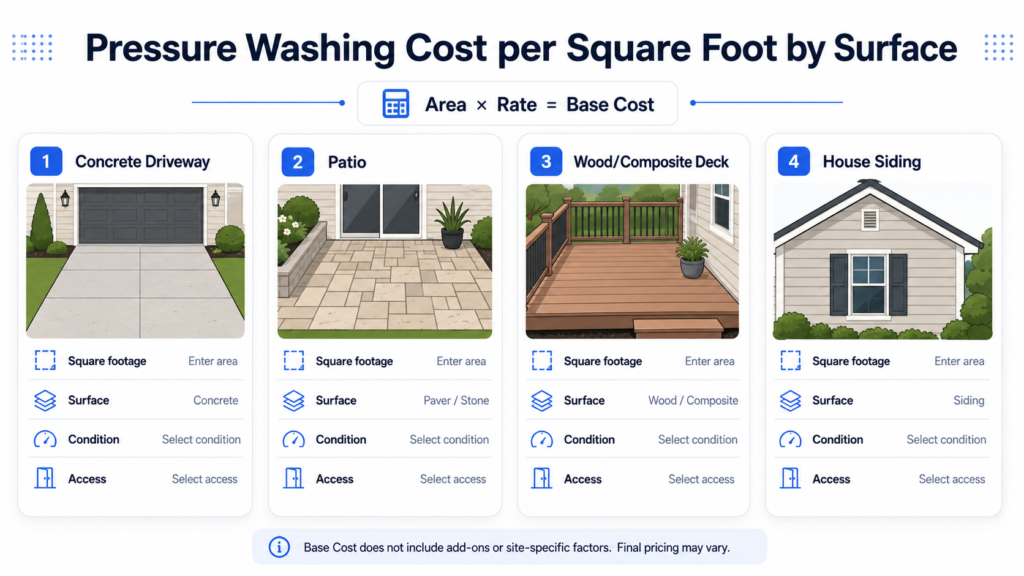
Square-foot pricing is most useful when the cleaned surface can be measured consistently.
Driveways, patios, concrete areas, pool decks, and many decks fit that model relatively well. House exteriors and fences require more care because the relevant cleaning area may not match the property’s floor area or linear measurement.
| Surface | Current Published References | WashNumbers Base Model | Important Pricing Variable |
|---|---|---|---|
| Driveway | $0.08–$0.55 / sq. ft. across reviewed sources | $0.45 / sq. ft. | Size, stains, access, minimum charge |
| Concrete | Homewyse: $0.42–$0.52 / sq. ft. | $0.46 / sq. ft. | Contamination, surface condition, access |
| Patio | Angi: $0.10–$0.50; Homewyse: $0.39–$0.49 | $0.40 / sq. ft. | Material, buildup, preparation |
| Deck | Fixr: $0.30–$0.40; Homewyse: $0.44–$0.54 | $0.49 / sq. ft. | Material, railings, cleaning method |
| Pool deck | Varies by material, scope, and local pricing | $0.45 / sq. ft. | Material, access, surrounding obstacles |
| House exterior | Not directly comparable to flatwork | Separate house model | Property size, stories, wall area, material |
The WashNumbers model values shown in the table are modeling assumptions, not claims about what every U.S. contractor charges.
The current homeowner cost model uses transparent base rates of $0.45 per square foot for driveways, $0.46 for concrete, $0.40 for patios, $0.49 for decks, and $0.45 for pool decks before its condition and accessibility adjustments. These assumptions are documented in the WashNumbers Methodology.
Driveway Pressure Washing Cost per Square Foot
Driveways have some of the clearest current square-foot pricing data.
Angi currently reports approximately $0.30 to $0.55 per square foot. Homewyse currently displays approximately $0.42 to $0.52 per square foot for its basic driveway estimate. Fixr publishes approximately $0.30 to $0.40 per square foot, while HomeGuide publishes approximately $0.08 to $0.35 per square foot for standard driveway cleaning and up to approximately $0.52 per square foot for heavier cleaning or hot-water power washing.
That spread is exactly why one national rate can be misleading.
For more detailed driveway estimates by size, condition, access, and published source, see the Driveway Pressure Washing Cost Guide.
Patio Pressure Washing Cost per Square Foot
Angi currently publishes approximately $0.10 to $0.50 per square foot for patio pressure washing, while Homewyse publishes approximately $0.39 to $0.49 per square foot under its basic January 2026 assumptions.
The difference is significant. It reinforces the need to check what each estimate includes rather than treating either range as a guaranteed local rate.
Material can also matter. Concrete, brick, stone, and pavers may require different treatment, preparation, or pressure.
For a full breakdown of patio pricing by size, material, paver joints, condition, and access, see our Patio Pressure Washing Cost Guide.
Deck Pressure Washing Cost per Square Foot
Deck cleaning requires additional caution because material and manufacturer instructions can affect the cleaning method.
Fixr currently publishes approximately $0.30 to $0.40 per square foot for deck pressure washing, while Homewyse currently publishes approximately $0.44 to $0.54 per square foot for deck power washing. Angi instead emphasizes a total-project range of approximately $100 to $250 in its current 2026 deck guide.
Composite decking may also have manufacturer-specific restrictions. Trex, for example, publishes specific pressure, nozzle, and distance requirements for compatible products and warns that improper pressure washing can damage some decking or affect warranty coverage.
Our dedicated Deck Pressure Washing Cost Guide will go deeper into deck size, material, railings, condition, and cleaning-method differences.
Roof pricing needs extra context because roof cleaning is not automatically the same service as pressure washing. Published rates vary by roof material and cleaning method, and high-pressure washing can be inappropriate for some roofing systems. See our Roof Cleaning Cost Guide for current pricing references by size, roof type, pitch, condition, and method.
Concrete Pressure Washing Cost per Square Foot
Concrete is often well suited to square-foot pricing because large flat areas are relatively straightforward to measure.
Homewyse currently publishes approximately $0.42 to $0.52 per square foot for basic concrete pressure washing.
The WashNumbers homeowner model currently uses a $0.46 per-square-foot base rate for concrete, then treats condition and accessibility as separate transparent variables rather than hiding them inside the base rate.
Sidewalks are usually measurable as flat concrete, but length alone does not define the cleaning area. Width, minimum service charges, gum, stains, curb faces, and commercial foot traffic can all change the final scope. See our Sidewalk Pressure Washing Cost Guide for examples by sidewalk length, width, condition, and access.
Pressure Washing Cost by Project Size
If you already know a square-foot rate, the basic calculation is simple:
Estimated base cost = cleaned surface area × price per square foot
The table below shows the math at three example rates.
These figures are illustrative calculations, not WashNumbers claims about national average prices.
| Area Cleaned | At $0.20 / sq. ft. | At $0.35 / sq. ft. | At $0.50 / sq. ft. |
|---|---|---|---|
| 200 sq. ft. | $40 | $70 | $100 |
| 300 sq. ft. | $60 | $105 | $150 |
| 400 sq. ft. | $80 | $140 | $200 |
| 500 sq. ft. | $100 | $175 | $250 |
| 600 sq. ft. | $120 | $210 | $300 |
| 1,000 sq. ft. | $200 | $350 | $500 |
| 1,500 sq. ft. | $300 | $525 | $750 |
| 2,000 sq. ft. | $400 | $700 | $1,000 |
For example:
1,000 sq. ft. × $0.35 = $350
That does not mean every 1,000-square-foot project should cost $350. The purpose of the table is to let you understand what a quoted rate means in dollar terms.
Why a 600 Sq. Ft. Driveway Can Produce Very Different Estimates
A useful way to understand the weakness of national averages is to apply several current published driveway rates to the same exact 600-square-foot area.
| Reference | Published / Modeled Rate | 600 Sq. Ft. Calculation | Result |
|---|---|---|---|
| Angi | $0.30–$0.55 | 600 × $0.30–$0.55 | $180–$330 |
| Homewyse | $0.42–$0.52 | 600 × $0.42–$0.52 | $252–$312 |
| Fixr | $0.30–$0.40 | 600 × $0.30–$0.40 | $180–$240 |
| WashNumbers model | $0.45 base rate | 600 × $0.45 | $270 typical |
The project does not change between rows. Only the published pricing reference changes.
Using Angi’s current range gives a basic calculation of approximately $180 to $330. Homewyse’s current range produces approximately $252 to $312. Fixr’s current range produces approximately $180 to $240.
The current WashNumbers driveway model starts at $0.45 per square foot, making the base result:
600 × $0.45 = $270
With average condition and normal access, the current WashNumbers calculator produces a typical modeled estimate of $270, with its transparent ±20% planning band producing $216 to $324.
That is not presented as a more “correct” national price.
It is a transparent model built so the user can see exactly where the number came from.
Why Small Jobs Can Cost Much More per Square Foot
Price per square foot becomes less reliable as project size decreases.
A contractor can still incur travel time, setup time, equipment costs, fuel, insurance, administration, and other operating expenses even if the actual surface is small.
Fixr gives a useful real-world example: its driveway guide describes a small 200-square-foot project where a roughly $100 minimum charge may apply even though the normal square-foot calculation would be lower.
WashNumbers independently uses a $100 modeled small-job floor in its homeowner calculator. This is a modeling choice, not a claim that every contractor uses the same minimum.
| Project Size | Modeled Minimum | Effective Cost per Sq. Ft. |
|---|---|---|
| 100 sq. ft. | $100 | $1.00 / sq. ft. |
| 200 sq. ft. | $100 | $0.50 / sq. ft. |
| 300 sq. ft. | $100 | $0.33 / sq. ft. |
| 400 sq. ft. | $100 | $0.25 / sq. ft. |
| 500 sq. ft. | $100 | $0.20 / sq. ft. |
This illustrates an important pricing effect.
At a $100 minimum, a 100-square-foot job has an effective rate of $1.00 per square foot, while a 500-square-foot job has an effective rate of $0.20 per square foot.
Nothing about the cleaning method needs to change for that effective rate to fall. The fixed minimum is simply being spread across more surface area.
How to Measure Square Footage for Pressure Washing
Using the right rate with the wrong measurement still produces the wrong estimate.
Driveways, Patios, Sidewalks and Flat Concrete
For a rectangular surface:
Length × width = square feet
A driveway measuring 30 feet long and 20 feet wide contains:
30 × 20 = 600 sq. ft.
For an irregular driveway or patio, divide the surface into simple rectangles, calculate each section separately, and add them together.
House Siding
Do not automatically multiply the home’s interior floor area by a siding pressure-washing rate.
A 2,000-square-foot home means roughly 2,000 square feet of interior floor area under the relevant property-size convention. It does not tell you the exact exterior wall area.
A better direct surface measurement is to calculate the area of the individual exterior walls:
Wall width × wall height = wall area
Then combine the relevant wall areas.
The Vinyl Siding Institute similarly describes siding area using wall height and width when estimating exterior siding surface.
WashNumbers deliberately handles house-exterior estimates differently from flatwork for this reason. The current house model uses published property-size and story-height information rather than pretending interior floor area equals siding area.
See the House Pressure Washing Cost Guide for the full house-specific model.
Fence Measurements
Fences require an extra measurement step because linear footage only describes length. Fence height and whether one or both sides are cleaned can substantially change the total surface area. See our Fence Pressure Washing Cost Guide for worked examples by length, height, sides, material, and condition.
Fences
For fences, calculate:
Fence length × average height × number of sides cleaned
For example, a fence that is 100 feet long and 6 feet high contains:
100 × 6 = 600 sq. ft. on one side
If both sides are included:
100 × 6 × 2 = 1,200 sq. ft.
That is why a contractor asking only for fence length may still need more information before quoting the job.
Decks
For the main deck floor:
Deck length × deck width = floor area
Railings, stairs, vertical faces, built-in seating, and other detailed surfaces may add work that is not represented by the floor square footage alone.
Every per square foot figure on this page came off a published price list, which is not the same thing as a closing price. If you quote flatwork for a living, the contractor rate survey is where the next version of these numbers comes from.
What Changes the Price per Square Foot?
Project Size and Minimum Charges
Large open areas may allow travel and setup costs to be spread across more square footage. HomeGuide specifically notes that its driveway per-square-foot rate can decrease as total area increases because mobilization and setup are distributed across a larger surface.
Surface Condition
Light dirt, organic growth, heavy algae, grease, oil, rust, paint, and other contamination do not necessarily require the same preparation or cleaning time.
A contractor may charge more when specialized pretreatment, hot water, chemicals, repeated passes, or stain-specific work is required.
Surface Material
Concrete, wood, brick, pavers, stucco, fiber cement, vinyl, and composite materials do not all tolerate the same technique.
The correct cleaning method can matter more than the nominal square-foot price.
Accessibility
Obstacles, steep areas, restricted access, landscaping, stairs, upper stories, limited water access, or the need for specialist equipment can all change the amount of labor involved.
Location
A national price cannot capture every U.S. market. Labor costs, travel distances, business overhead, competition, demand, and contractor pricing strategy differ by location.
Scope of Work
Two quotes with the same square-foot rate are not necessarily equivalent.
One may include pretreatment, post-treatment, stain work, edge cleaning, or cleanup while another covers only the basic wash.
Before comparing prices, confirm that both contractors are quoting the same surface and the same scope.
Pressure Washing vs. Power Washing vs. Soft Washing
These terms are sometimes used loosely in consumer pricing guides, but the cleaning method can matter.
Pressure washing generally describes cleaning with pressurized water. Power washing commonly refers to a similar process that may use heated water. Soft washing generally relies on much lower pressure combined with an appropriate cleaning solution.
The safest method depends on the material.
For example, the Asphalt Roofing Manufacturers Association specifically advises against high-pressure washing on asphalt roofing because it can damage the roofing surface.
James Hardie’s current cleaning guidance similarly advises against using a high-pressure power washer on Hardie siding and instead recommends low-pressure cleaning.
The Vinyl Siding Institute notes that manufacturer restrictions vary and recommends checking the specific manufacturer’s pressure and cleaner requirements before power washing vinyl siding.
This is why a pricing guide should not imply that every exterior surface should simply be “pressure washed” at the same rate.
Why Roof Cleaning Is Not Included in the Main Rate Table
Roof cleaning deserves its own pricing category rather than being treated as ordinary flatwork.
Different roof materials require different methods, and high pressure can be inappropriate for some common roofing systems.
For asphalt shingles specifically, the Asphalt Roofing Manufacturers Association advises against high-pressure washing.
Our upcoming Roof Cleaning Cost Guide will therefore treat roof cleaning as a separate service rather than encouraging homeowners to apply a generic pressure-washing rate to their roof.
When Price per Square Foot Is a Good Metric
Square-foot pricing is most useful when the area is measurable, relatively uniform, and the cleaning scope is clearly defined.
A large driveway, concrete slab, patio, sidewalk, or similar flat surface is a good example.
The metric becomes less useful when a minimum charge controls the job, when the surface contains many detailed features, when difficult stains require specialist treatment, when access dominates the labor requirement, or when the quoted square footage is not actually the surface being cleaned.
Contractors should also avoid treating a national consumer rate as a profitability formula.
A profitable business quote needs to consider labor, direct job costs, equipment, overhead, fees, required margin, and the individual company’s production rate.
For that purpose, use the Pressure Washing Pricing Calculator, which builds a contractor quote from business costs rather than applying a hidden national square-foot multiplier.
Equipment belongs in that same calculation. Two operators quoting the same rate per square foot are not making the same money if one is on 4 GPM with a 16 inch deck and the other is on 8 with a 24, so before you copy anyone’s per foot number, check what setup produced it. Our surface cleaner sizing guide covers what that difference looks like on a driveway.
How to Compare Two Pressure Washing Quotes
When two contractors provide different prices, comparing only the total can be misleading.
First confirm what area each contractor measured. Then confirm the material, whether pretreatment or cleaning chemicals are included, how stain removal is handled, whether both sides or all sections are included, what cleanup is provided, and whether the quote contains a minimum service charge or separate add-ons.
You can then calculate the effective square-foot rate:
Effective rate = quoted project price ÷ cleaned square footage
For example, a $300 quote for 600 square feet equals:
$300 ÷ 600 = $0.50 per sq. ft.
That effective rate makes quotes easier to compare, but it still should not replace checking the actual scope.
These are the numbers homeowners see. The contractor side of these numbers works the other way round, starting from cost and production speed.
A per square foot rate is half a price. The other half is how long the work actually takes, and the two published sources on that disagree by a factor of ten.
Pressure Washing Cost per Square Foot FAQ
How Much Does It Cost to Pressure Wash 500 Square Feet?
At illustrative rates of $0.20, $0.35, and $0.50 per square foot, 500 square feet calculates to $100, $175, or $250.
A real quote can be outside that range depending on the surface, condition, access, location, and contractor minimum.
How Much Does It Cost to Pressure Wash 1,000 Square Feet?
At $0.20 per square foot, the calculation is $200.
At $0.35 per square foot, it is $350.
At $0.50 per square foot, it is $500.
These are mathematical examples rather than a universal 1,000-square-foot price.
How Much Does It Cost to Pressure Wash 2,000 Square Feet?
At example rates of $0.20, $0.35, and $0.50 per square foot, the basic calculations are $400, $700, and $1,000.
Large uniform areas may sometimes achieve a lower effective rate than very small jobs, but condition and scope can still move the quote substantially.
Is $0.50 per Square Foot Expensive for Pressure Washing?
Not automatically.
Current published sources place $0.50 within or near several residential pressure-washing ranges. Whether it is expensive depends on the surface, cleaning method, condition, access, location, size, and services included.
Do Pressure Washing Companies Charge by the Square Foot?
Many contractors use square-foot pricing for measurable surfaces, while others quote a flat project price, hourly rate, minimum charge, or a combination of methods.
Current contractor-facing pricing guidance also describes both hourly and square-foot approaches.
Does the Price per Square Foot Drop on Larger Jobs?
It can.
Fixed costs such as travel and setup are spread across a larger surface, and large open areas can sometimes be cleaned more efficiently. HomeGuide explicitly notes this effect in its current driveway pricing guidance.
It is not guaranteed. Heavy staining, difficult access, specialty treatments, or complex surfaces can offset that efficiency.
WashNumbers Methodology
WashNumbers does not treat one publisher’s rate as the definitive U.S. market price.
We compare multiple current pricing references and document where their figures differ.
When WashNumbers introduces its own rate, adjustment, minimum, or estimate band, it is labeled as a modeling assumption rather than presented as an independent national statistic.
The homeowner Pressure Washing Cost Calculator currently uses transparent surface base rates, condition adjustments, accessibility adjustments, a modeled small-job floor, and an estimate band. The complete formulas and limitations are documented on the WashNumbers Methodology page.
Pricing references for this guide were reviewed in August 2026.
WashNumbers provides educational planning estimates, not contractor bids. For a final project price, compare written quotes based on the actual property, surface condition, and scope of work.
Sources
- Taskrabbit: Pressure Washing Cost Guide
- Angi: How Much Does It Cost to Pressure Wash a House?
- Homewyse: Cost to Pressure Wash per Square Foot
- Fixr: Cost to Pressure Wash a House
- Angi: How Much Does It Cost to Pressure Wash a Driveway?
- Homewyse: Cost to Power Wash a Driveway
- Fixr: Cost to Pressure Wash a Driveway
- HomeGuide: How Much Does It Cost to Pressure Wash a Driveway?
- Angi: How Much Does It Cost to Power Wash a Patio?
- Homewyse: Cost to Power Wash a Patio
- Fixr: Cost to Pressure Wash a Deck
- Homewyse: Cost to Power Wash a Deck
- Trex: Composite Decking Care and Cleaning Guide
- James Hardie: Tips for Cleaning House Siding
- Vinyl Siding Institute: Cleaning and Maintenance Tips
- Asphalt Roofing Manufacturers Association: Algae Discoloration of Roofs
Work out your own number
Pressure Washing Cost Calculator
Put in your own square footage and surface instead of using an average.
Cost per Square Foot
What the rate should be before anyone quotes you a total.
Minimum Charge Explained
Why a small job costs the same as a slightly bigger one.
The Pricing Dataset
220 published prices with the source behind every figure.
 Written by Diego Hernández, founder of WashNumbers. Cost models are built from published contractor rates and public price observations. See how we build these numbers.
Last reviewed: August 2026