
A homeowner asks how long it will take. You say a couple of hours. Six hours later you are coiling hose in the dark and the job made about half what it should have.
That gap is what pressure washing production rates are supposed to close, and almost nobody in this trade publishes them honestly. Manufacturers print coverage claims that fall apart the moment you check the walking speed they imply. The big cost guides give you one sentence about two hours and move on. The contractors who actually know their numbers posted them in forum threads that Google buried ten years ago.
So here is the collected version of pressure washing production rates, with every source named and the weak numbers flagged as weak.
Pressure washing production rate calculator
Spray time and job time, kept apart on purpose.
Spray time is not job time, and that is where most estimates die
Production rates also assume the machine is making the pressure it is rated for. A worn or oversized tip quietly takes 20 to 35 percent off that, and every figure on this page moves with it. Worth ruling out with the nozzle sizing guide before you blame the crew.
The single most expensive mistake in this trade is multiplying square footage by a spray rate and calling it a job.
A 2,000 square foot single-storey house takes somewhere between twenty and sixty minutes of actual spraying. It takes two to four hours as a job. Setup, protecting plants and fixtures, dwell, rinse, teardown and cleanup eat the rest, and none of it is optional.
Quoting from the spray number alone will underestimate the job, often badly. In the examples on this page, setup, dwell, rinsing, travel and teardown push total job time to several times the active spraying, and that gap is where the money goes. That is why the pressure washing production rates below are split into spray time and job time, and why the calculator gives you both.
Flatwork pressure washing production rates, straight from contractors
These come from working contractors posting on ProPowerWash and Pressure Washing Resource. Self-reported, mostly commercial, and mostly from threads dating to roughly 2011 to 2016. None of it was collected this year, and equipment has moved since: eight GPM was a serious rig then and is ordinary now, which is one reason to read the top of the range as a ceiling rather than a normal day. Nobody audited any of it. But the figures cluster, and the clustering is the useful part.
| Setup | Reported rate | Notes |
|---|---|---|
| 4 GPM, 20 in surface cleaner | 1,500 sq ft/hr | Clean flatwork, no gum |
| 5.5 GPM, 3,000 PSI, one operator | 2,260 sq ft/hr | 18,090 sq ft over an 8 hour day |
| Unstated, maintenance clean | 2,500 to 3,500 sq ft/hr | Two contractors, same range |
| Unstated, first clean vs maintenance | 3,000 to 4,500 sq ft/hr | Higher figure is repeat work |
| 8+ GPM hot water, 24 to 48 in decks | 3,000 to 10,000 sq ft/hr | Per man, wide range by site |
| Restaurant flatwork with gum | 1,000 to 1,500 sq ft/hr | Chemical, dwell, done properly |
| Two 20 in cleaners, night work | 7,000 to 10,000 sq ft/hr | Open lots, crew, not residential |
For one operator on residential and light commercial flatwork, credible pressure washing production rates land between 1,500 and 3,500 square feet an hour. Four GPM with a 20 inch cleaner sits at the bottom. Eight GPM with a large deck sits at the top. Anything above that is a big rig with a helper working an open parking deck at night, and it has no business in a residential estimate.
Those pressure washing production rates are also where per square foot pricing quietly lies to you, because a rate built on 3,000 sq ft an hour prices a job you will actually do at 1,500. Every figure in that table is trigger time. To turn an hourly rate into a price per square foot you need the job-hour version instead, which lands near half, and that is the number the pricing guide uses.
One number worth keeping in your head: the wand. Kärcher puts a surface cleaner at five times faster than a standard nozzle, and J. Racenstein describes a four hour wand driveway finishing in under an hour with the right deck. Four to five times is the defensible range. The manufacturers claiming ten to twenty times are comparing a large deck against a zero degree tip with no overlap, which is not a job anyone has ever done.
Why manufacturer coverage figures are not pressure washing production rates
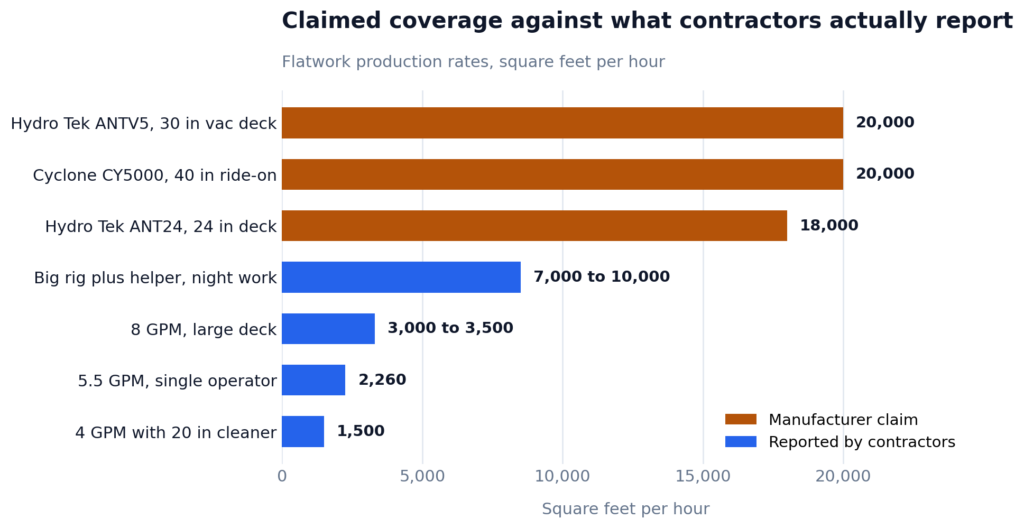
Three manufacturers publish an actual square feet per hour number. Everyone else publishes diameter, GPM and PSI and stays quiet.
Hydro Tek claims 18,000 square feet an hour for the ANT24 and 20,000 for the ANTV5. Cyclone claims 20,000 for the CY5000.
The walking speed check
Back-solve them and two of the three fall over.
The ANT24 has a 24 inch path. Eighteen thousand square feet an hour means 9,000 linear feet an hour, which is 150 feet a minute, which is 1.7 miles an hour. With zero pass overlap, zero turns, zero repositioning and no edging.
The ANTV5 is worse. It is a vacuum recovery unit, which in practice runs slower than a free draining deck, and it is claimed faster.
The Cyclone figure is the only one that survives, at about 1.1 miles an hour, and that is because it is a ride-on machine with a 360 gallon tank. It does not belong in the same table as a walk-behind.
Real overlap is ten to twenty percent, and a residential driveway is mostly turns. Treat every manufacturer figure as a single pass ceiling, not one of the pressure washing production rates you can plan a day around.
House washing: what the clock really looks like
Published pressure washing production rates for house washing are thinner still. The best source is a single thread where operators posted their own times by house size and storey, and stated explicitly that setup and breakdown were excluded.
| House size | Storeys | Spray time, solo | Best case |
|---|---|---|---|
| 1,200 to 2,000 sq ft | 1 | 30 to 45 min | 20 min |
| 2,000 to 2,500 sq ft | 1 | 45 to 60 min | 35 min |
| 2,500 to 3,500 sq ft | 2 | 1 hr to 1 hr 15 | 45 min |
| 3,500 to 5,000 sq ft | 2, with balconies | 1 hr 15 to 2 hr | 1 hr |
| Two-car driveway | - | 15 to 20 min | 15 min |
Larry Millette works alone with two 4 GPM machines and says a helper cuts those times at least in half. Russ Spence posts best case cleaning time only. John Orr, running a one person operation including gutters and a wax rinse, gives the figure that matters most: one hour per 1,000 square feet, arrival to departure.
Put the two together and you get the shape of the day.
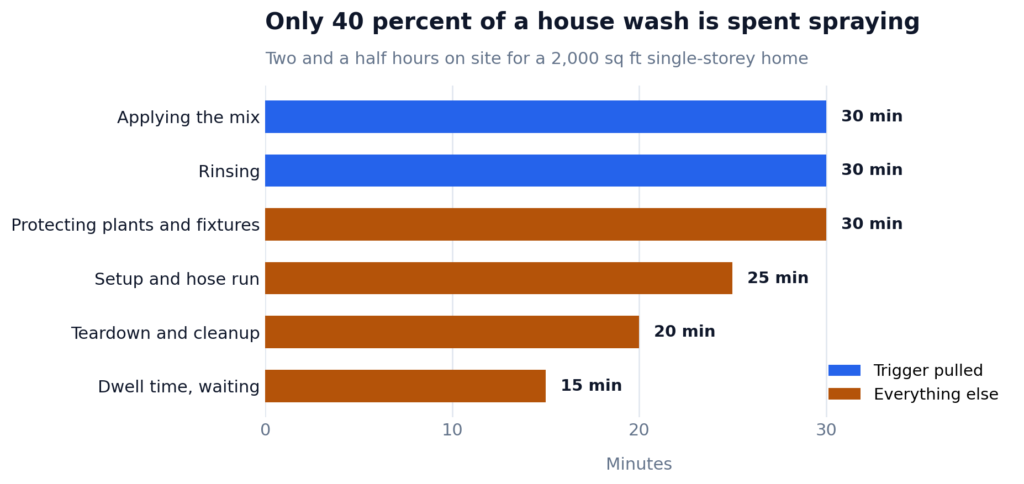
Two storeys is the multiplier everyone underestimates. Ragin Cajun Softwash puts it at thirty to fifty percent more labour time, and Klein's published ranges imply closer to double. The calculator uses 1.4, which sits between them.
The cost side of a house wash only starts making sense once the pressure washing production rates behind it are on the table.
Roof soft washing, and why this number is derived
Nobody publishes roof soft washing among their pressure washing production rates. Not one primary source gives square feet per hour.
What exists is time per roof. SoftWash Technologies says an experienced two person crew finishes a straightforward roof in about two to three hours. Lucid Bots says the same and adds that a 2,000 square foot house carries roughly 2,400 to 2,800 square feet of roof surface, with ten to fifteen minutes of dwell.
Divide one by the other and you get somewhere around 950 to 1,100 square feet an hour. That is arithmetic, not a measurement, and the calculator says so on the output. If somebody hands you a roof production rate without showing that division, ask where it came from.
What actually multiplies the time
These are the factors that move pressure washing production rates in the real world, and only the ones with a published figure behind them made the table.
| Factor | Effect on time | Where it comes from |
|---|---|---|
| Second storey | 30 to 50 percent more labour | Contractor, stated directly |
| Second storey | 1.7 to 2.0 times | Implied by published job ranges |
| Heavy organic or algae growth | Adds 30 to 60 min | Pre-treatment and dwell |
| Stucco or painted wood vs vinyl | Adds 30 to 45 min | Substrate handling |
| Gum and heavy soiling, flatwork | 2 to 3 times slower | Drops rate to 1,000 to 1,500 |
| Soft wash dwell | 10 to 20 min per elevation | Waiting, not spraying |
| Roof dwell | 10 to 15 min, 20 with lichen | Heavy growth at the top end |
| No water on site | 4 GPM burns 240 gal/hr | 200 gal tank is two house washes |
| Setup and teardown per stop | 12 to 25 min | Machine and hoses only |
| Setup with plant protection | 50 to 90 min | Soft wash scope |
Four things are missing from that table and their absence is deliberate. Oil stain removal, rust staining, restricted access and post-treatment sealing have no published time figures anywhere. None. Every number you will see for those is somebody's guess dressed up as data, so this page leaves them as flags rather than multipliers.
Sizing a surface cleaner, where the rules disagree
If your real world pressure washing production rates come in below the table above, the deck is the first thing to check. An oversized cleaner on an undersized machine starves the spray bar and cleans more slowly than a smaller one running properly, and one documented case gained about thirty percent going from 36 inches down to 20 on a 4 GPM machine.
The four published sizing rules disagree with each other by a factor of two at 4 GPM, and the specification that would settle it is not printed on any spec sheet. We went through all four, and what manufacturers actually publish, in how to size a surface cleaner to your flow.
What we could not find
Honesty about the gaps is the only reason to trust the rest, so here is what is missing from the published pressure washing production rates.
There is no manufacturer table of production by diameter and GPM. It does not exist. Every version circulating online is derived from path width and an assumed walking speed, including the arithmetic on this page.
The contractor figures are self-reported, mostly a decade old, and almost none of them state both GPM and deck size, so the variance cannot be split cleanly between equipment and site conditions.
Setup and teardown figures disagree by a factor of four, because different sources scope the word differently. Twelve to twenty five minutes per stop covers hoses and machine. Fifty to ninety minutes covers plant and fixture protection on a soft wash.
That is the honest state of published pressure washing production rates in 2026, and it is thin. Which is why we are collecting the real ones.
Frequently asked questions
What are realistic pressure washing production rates for flatwork?
For one operator with a surface cleaner, 1,500 to 3,500 square feet an hour. Four GPM with a 20 inch deck sits near 1,500. Eight GPM with a large deck reaches 3,000 to 3,500. Anything higher involves a helper, a big rig, or an open parking deck. Those pressure washing production rates assume a surface cleaner, not a wand.
How long does it take to pressure wash a two-car driveway?
Fifteen to twenty minutes of spraying including the rinse, per two independent contractor sources. That matches the flatwork pressure washing production rates above once you account for turns and edging. Add setup, teardown and travel and the stop is closer to forty five to ninety minutes.
How long does a 2,000 square foot house wash take?
Twenty to sixty minutes of spraying. Two to four hours as a job. The most useful published figure is one hour per 1,000 square feet from arrival to departure, for a solo operator.
Why are manufacturer coverage claims so much higher than real rates?
Because they measure a single uninterrupted pass with no overlap and no turns. Back-solved, two of the three published claims imply walking at 1.7 to 1.9 miles an hour while cleaning. Real driveways are mostly turning around.
Does a bigger surface cleaner always mean faster?
No. An oversized deck on an undersized machine starves and slows down. One documented case gained roughly thirty percent by going from 36 inches to 20 on a 4 GPM machine.
How much does heavy staining slow a job down?
On flatwork, gum and heavy organic staining drop the rate to 1,000 to 1,500 square feet an hour against a 2,500 to 3,500 baseline. On a house wash, expect thirty to sixty extra minutes for pre-treatment and dwell.
Should I quote from spray time or job time?
Job time, always. Spray time is roughly a third of the clock on a house wash. Quoting from it is the fastest way to work a full day for half the money, and it is why minimum charges exist.
Help fix the thinnest data in this trade
Every one of the pressure washing production rates on this page is either self-reported on a forum a decade ago or derived from arithmetic. That is the best publicly available, and it is not good enough.
We are collecting real rates directly from working US contractors and publishing state averages. Seven questions, about ninety seconds, individual pricing never published, and contributors get the state breakdown before it goes public.
Add your numbers to the 2026 rate survey
Production rate is what decides how quickly a new setup pays for itself. At the midpoint prices in our dataset, a tailgate rig clears its cost in fifteen housewashes and a trailer build takes seventy-eight. The full arithmetic, including insurance and the lines most guides leave out, is in what it costs to start a pressure washing business.
Tools for your business
Contractor Pricing Calculator
Build a quote that still leaves a margin after chemicals and drive time.
Production Rate Calculator
The hours a job takes, before you can price it.
Startup Cost Calculator
What a rig costs to build and how many jobs pay it back.
Add Your Rates to the Survey
Seven questions. You get the state-by-state results first.
 Written by Diego Hernández, founder of WashNumbers. Cost models are built from published contractor rates and public price observations. See how we build these numbers.
Last reviewed: September 2026