
GAF, one of the big shingle manufacturers, tells homeowners not to pressure wash their roofs. Their guidance on moss removal says it plainly: the pressure strips granules off the shingles and lifts them.
What a roof clean actually sells for in 2026
Median of every published price we could find, computed from the WashNumbers dataset. Accessed August 2026.
Whole roof, per job
| Middle half of the market | $450 to $700 |
| Full spread | $299 to $1250 |
| Figures behind it | 21 prices, 12 sources |
By area, per square foot
| Middle half of the market | $0.36 to $0.48 |
| Full spread | $0.25 to $0.75 |
| Figures behind it | 8 prices, 4 sources |
This is our own figure, not a quote from one publisher. Check every observation behind it.
So the first thing to settle about roof cleaning cost is not the price. It is the method, because a good share of the quotes you get will be for a service your roof manufacturer advises against.
Angi puts professional roof cleaning at $296 to $626 for most homes. Homewyse works per square foot instead: $0.24 to $0.45 for general cleaning, $0.37 to $0.47 for shingles, $0.51 to $0.63 for pressure washing tile. Those are three different jobs, not three estimates of the same one.
For the rates on other surfaces, the pressure washing cost per square foot guide puts them side by side.
What roof cleaning cost looks like in 2026
Current pricing sources describe several different types of roof-cleaning work.
Angi reports approximately $296–$626 for professional roof cleaning depending on roof size and cleaning method. Its separate pressure-cleaning guide reports approximately $200–$1,200, or around $0.20–$0.60 per square foot, for pressure-cleaning projects where that approach is suitable.
Homewyse currently estimates basic general roof cleaning at $0.24–$0.45 per square foot, shingle cleaning at $0.37–$0.47, and tile-roof pressure washing at approximately $0.51–$0.63.
These numbers should not be averaged blindly because they do not necessarily describe identical roofs or cleaning methods.
| Source | Published Cost | What It Represents |
|---|---|---|
| Angi: Roof Cleaning | $296–$626 per project | General professional roof cleaning, with size and cleaning method among the main variables. |
| Angi: Pressure Cleaning | $0.20–$0.60/sq. ft. | Pressure-cleaning projects where the roof type and condition allow an appropriate pressure-based method. |
| Homewyse: Roof Cleaning | $0.24–$0.45/sq. ft. | Basic general roof-cleaning conditions. |
| Homewyse: Shingles | $0.37–$0.47/sq. ft. | Basic roof-shingle cleaning. |
| Homewyse: Tile Roof | $0.51–$0.63/sq. ft. | Basic tile-roof pressure washing under Homewyse’s assumptions. |
These published ranges describe different cleaning methods and roof types. They are comparison benchmarks, not interchangeable prices for the same project.
The differences between those rates are useful rather than inconvenient.
They demonstrate why a homeowner should ask what cleaning method, roof material, and scope are actually included in an estimate instead of treating every roof-cleaning price as the same service.
- Those four published references, side by side:
- General roof cleaning: $0.24–$0.45/sq. ft.
- Roof-shingle cleaning: $0.37–$0.47/sq. ft.
- Angi pressure cleaning: $0.20–$0.60/sq. ft.
- Tile-roof pressure washing: $0.51–$0.63/sq. ft.
Roof Cleaning Cost by Size
Square footage remains useful for planning, but WashNumbers does not use one universal roof rate for every material.
Instead, the table below applies Homewyse’s current $0.24–$0.45/sq. ft. general roof-cleaning reference to several roof sizes. This is a mathematical comparison of a published range, not a claim that every roof of that size should cost exactly this amount.
| Roof Area | At $0.24/sq. ft. | At $0.45/sq. ft. |
|---|---|---|
| 1,000 sq. ft. | $240 | $450 |
| 1,500 sq. ft. | $360 | $675 |
| 2,000 sq. ft. | $480 | $900 |
| 2,500 sq. ft. | $600 | $1,125 |
| 3,000 sq. ft. | $720 | $1,350 |
Calculated from Homewyse’s January 2026 general roof-cleaning reference of $0.24–$0.45 per square foot. Actual projects may differ because of minimum charges, roof type, pitch, method, condition, and access.
This also explains why broad project averages and per-square-foot calculations do not always line up perfectly.
A small easy-access roof may encounter minimum labor and travel charges, while a large or difficult roof may be influenced more strongly by actual cleaning area and access conditions.
For broader surface comparisons, see our pressure washing cost per square foot guide.
Cleaning a roof is not pressure washing it
This distinction is crucial.
“Roof cleaning” describes the desired outcome.
“Pressure washing” describes one possible cleaning method.
Those are not interchangeable terms.
A pressure washer that may be suitable for one roofing system can be inappropriate for another. For asphalt shingles in particular, major manufacturers specifically warn against high-pressure washing. GAF says pressure washers can cause shingles to lose protective granules and lift, and its technical guidance says not to power wash shingles for algae cleaning.
Asphalt Shingles
Asphalt shingles should not be treated like concrete.
GAF advises against pressure washing shingles because excessive pressure can remove granules and damage the roofing system. Owens Corning similarly provides roof-maintenance guidance centered around appropriate cleaning and maintenance rather than treating the roof as a hard pressure-washing surface.
For algae or moss problems, a low-pressure treatment or manufacturer-approved process is generally more appropriate than blasting the roof with high pressure.
Concrete Tile
Concrete tile is different.
The Tile Roofing Industry Alliance states that concrete tile is very low maintenance and that professional low-intensity pressure washing can be performed if desired.
That does not mean maximum pressure should be used or that every tile roof should automatically be pressure washed.
Tile condition, installation, accessibility, and manufacturer guidance still matter.
Clay Tile
TRI describes clay tile with matte or glazed ceramic finishes as essentially maintenance-free.
That is another reason WashNumbers does not recommend one generic cleaning procedure for every “tile roof.” Concrete and clay should not automatically be treated as identical materials.
Metal Roofing
Metal roofs can also vary by coating and manufacturer.
Cleaning products, tools, and allowable methods may differ between systems, so manufacturer-specific maintenance instructions should take priority over generic internet advice.
A shingle roof is normally treated at two to three percent sodium hypochlorite, and you can work out that mix here if you want to know what a contractor is putting on your roof.
| Roof Type | Main Cleaning Consideration | Pressure-Washing Context |
|---|---|---|
| Asphalt shingles | Protect the shingle surface and granules. | Major shingle manufacturers warn against high-pressure power washing. |
| Concrete tile | Tile condition, walking access, biological growth, and installation matter. | TRI states professional low-intensity pressure washing may be performed if desired. |
| Clay tile | Generally low-maintenance; specific finish and condition should be considered. | Do not assume the same procedure used for concrete tile applies automatically. |
| Metal | Coatings and manufacturer requirements vary. | Follow the roofing manufacturer’s cleaning instructions. |
| Wood shake | Age, biological growth, and wood condition can significantly affect safe treatment. | Aggressive pressure can be inappropriate for weathered material. |
| Slate | Fragility, age, access, and individual tile condition are important. | Specialized cleaning may be more appropriate than generic pressure washing. |
This table is intentionally conservative.
WashNumbers does not assign a universal PSI number or cleaning method to every roof material because manufacturer requirements and actual roof condition should take priority.
What each roof material costs to clean
Roof type can affect both the cleaning method and the amount of labor involved.
Asphalt Shingle Roof Cleaning Cost
Homewyse currently lists basic roof-shingle cleaning at approximately $0.37–$0.47 per square foot.
For a 2,000-square-foot shingle roof, applying that published reference mathematically gives approximately:
2,000 × $0.37 = $740
to
2,000 × $0.47 = $940
This is a comparison based on Homewyse’s published rate, not a guaranteed quote.
Because high-pressure washing can damage asphalt shingles, homeowners should also confirm which cleaning method is included, not only the price.
Concrete Tile Roof Cleaning Cost
Homewyse currently lists basic tile-roof pressure washing at approximately $0.51–$0.63 per square foot.
For a 2,000-square-foot tile roof, that mathematically corresponds to approximately:
$1,020–$1,260
under those published assumptions.
TRI confirms that professional low-intensity pressure washing can be appropriate for concrete tile, but that should not be interpreted as permission for indiscriminate high-pressure cleaning.
Clay Tile Roof Cleaning Cost
Clay tile requires a material-specific approach.
Because clay tile can differ significantly in finish, age, installation, and fragility, WashNumbers does not assign an unsupported universal cost multiplier.
A contractor may need to account for safe access and tile protection in addition to the cleaning itself.
Metal Roof Cleaning Cost
Metal roof cleaning cost depends on roof size, coating, slope, access, staining, and the manufacturer’s approved maintenance process.
Rather than assuming metal is always cheaper or more expensive, homeowners should compare quotes based on the actual scope and approved cleaning method.
Your roof is bigger than your house
This is one of the easiest mistakes to make when estimating roof cleaning.
A 2,000-square-foot home does not automatically have a 2,000-square-foot roof.
Home floor area measures interior living space.
Roof area depends on factors such as:
- building footprint,
- number of stories,
- roof pitch,
- garage coverage,
- porches,
- overhangs,
- dormers,
- valleys,
- and roof geometry.
For example, two 2,000-square-foot homes could have very different roof areas if one is a two-story compact house and the other is a wide single-story home.
When possible, obtain the actual roof area rather than substituting interior floor area.
What pitch and access actually change
Pitch affects more than roof area.
A steep roof can also change how safely and efficiently the contractor can work.
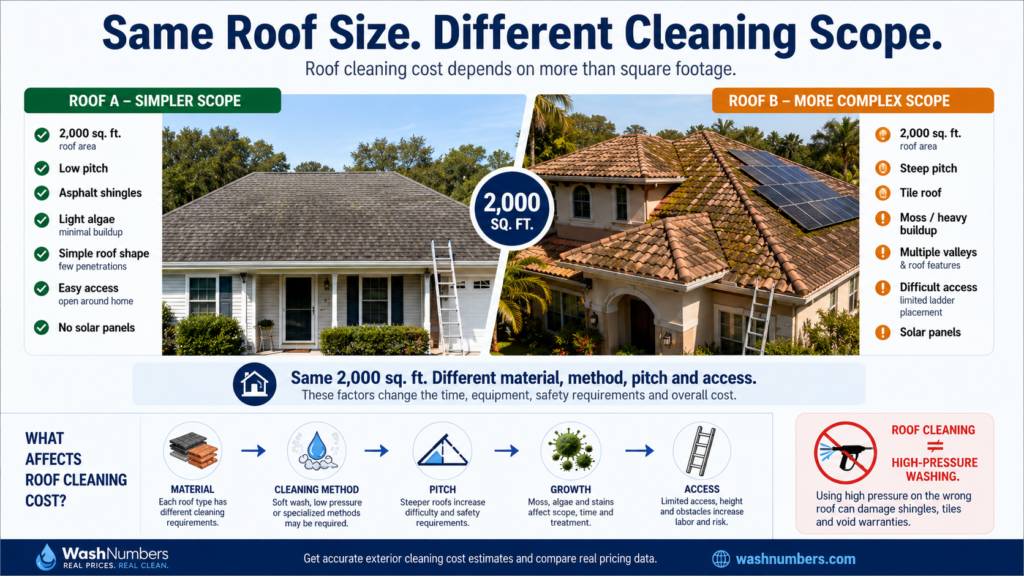
Imagine two roofs with the same measured surface area:
Roof A
- 2,000 sq. ft.
- low pitch
- simple two-plane design
- easy ladder positioning
- light algae
Roof B
- 2,000 sq. ft.
- steep pitch
- multiple valleys
- dormers
- limited ladder positioning
- heavier moss growth
The square footage is identical.
The cleaning scope is not.
That is why WashNumbers treats roof size as one variable rather than the complete estimate.
Pitch and access are usually the same problem wearing two hats. The roof that is steep is also the roof where the ladder only goes in one place.
Moss is not algae
Not all roof discoloration is the same.
Owens Corning notes that algae can cause characteristic dark or brown streaks on asphalt shingles.
Moss is different because it can form thicker biological growth on and between roof materials.
GAF specifically warns homeowners not to remove moss from shingles using a pressure washer because the force can cause granule loss and lift shingles.
The amount and type of biological growth can affect:
- treatment selection,
- dwell time,
- number of applications,
- rinsing method,
- cleanup,
- and whether immediate visual removal is appropriate.
A roof with faint algae staining should therefore not automatically be priced or treated the same as a roof with substantial moss growth.
Access is especially important for roof work because it can directly affect both labor and safety.
Potential complications include:
- two- or three-story rooflines,
- steep slopes,
- limited ladder locations,
- pools or landscaping around the house,
- narrow side yards,
- roof valleys,
- dormers,
- fragile tile,
- solar panels,
- and sections that are difficult to reach from the ground.
A simple one-story roof with open perimeter access is a different project from a steep roof surrounded by obstacles.
Solar panels, gutters, valleys and repairs
Roof Complexity
Valleys, hips, dormers, chimneys, skylights, and multiple roof levels can create more detailed work than a simple two-plane roof.
Gutters
Roof cleaning and gutter cleaning are separate services unless the quote specifically includes both.
However, homeowners may choose to schedule them together.
Solar Panels
Solar panels can restrict access to parts of the roof and create areas where debris accumulates.
They should not simply be treated as ordinary roof surface.
Nearby Landscaping
Cleaning solutions and runoff may require protection of plants, furniture, siding, pools, or other surrounding surfaces.
Repairs
Loose shingles, broken tiles, leaks, damaged flashing, or other roof defects may need attention before or separately from cleaning.
Cleaning does not replace roof repair.
Why this is the one surface we tell you not to DIY
Roof cleaning is different from DIY cleaning at ground level.
There are two separate risks:
surface damage and working at height.
High-pressure cleaning can damage certain roofing materials, particularly asphalt shingles. GAF specifically warns against using pressure washers on shingles for moss and algae treatment.
There is also the obvious risk associated with ladders, wet roofing surfaces, steep slopes, and fragile materials.
For that reason, WashNumbers does not recommend treating roof cleaning as a straightforward DIY pressure-washing project.
Homeowners who do perform roof maintenance should follow the specific roofing manufacturer’s instructions and avoid procedures that could damage the roof or create unsafe working conditions.
Four worked examples
The following examples are planning comparisons, not contractor quotes.
Example 1: 1,500 Sq. Ft. General Roof Cleaning
Using Homewyse’s published general cleaning range:
1,500 × $0.24 = $360
1,500 × $0.45 = $675
Published-range comparison:
$360–$675
Actual pricing may differ depending on material and scope.
Example 2: 2,000 Sq. Ft. Shingle Roof
Using Homewyse’s shingle-cleaning reference:
2,000 × $0.37 = $740
2,000 × $0.47 = $940
Published-range comparison:
$740–$940
This does not imply pressure washing should be used on the shingles.
Example 3: 2,000 Sq. Ft. Tile Roof
Using Homewyse’s tile-roof pressure-washing reference:
2,000 × $0.51 = $1,020
2,000 × $0.63 = $1,260
Published-range comparison:
$1,020–$1,260
The appropriate cleaning method still depends on the actual tile roof.
Example 4: Why Size Alone Is Incomplete
Suppose two roofs are both 2,000 sq. ft.
One is low-pitch, easily accessible, and lightly stained.
The other has steep sections, multiple valleys, moss, and limited access.
Using identical square footage does not capture those differences.
The contractor quote may therefore differ even before the roofing material itself is considered.
Estimate Your Exterior Cleaning Cost
For other exterior surfaces around the property, use the WashNumbers Pressure Washing Cost Calculator.
You can also compare:
- House Pressure Washing Cost
- Driveway Pressure Washing Cost
- Deck Pressure Washing Cost
- Patio Pressure Washing Cost
- Fence Pressure Washing Cost
For details on how WashNumbers uses published pricing information and modeling assumptions, see our methodology.
Frequently Asked Questions
How much does roof cleaning cost?
Angi currently reports approximately $296–$626 for professional roof cleaning, although prices vary with roof size, material, cleaning method, and other project conditions.
How much does roof cleaning cost per square foot?
Homewyse currently lists basic general roof cleaning at approximately $0.24–$0.45 per square foot. More specific services differ, including shingle cleaning at roughly $0.37–$0.47 and tile-roof pressure washing at approximately $0.51–$0.63.
Can you pressure wash asphalt shingles?
High-pressure washing is generally not recommended for asphalt shingles.
GAF warns that pressure washers can remove protective granules and lift shingles, and its technical guidance says not to power wash shingles for algae cleaning.
Can concrete tile roofs be pressure washed?
The Tile Roofing Industry Alliance states that professional low-intensity pressure washing can be performed on concrete tile if desired. The appropriate process still depends on the actual roof and manufacturer guidance.
Does a steep roof cost more to clean?
It can.
Pitch can increase working difficulty and may also affect actual roof surface area. Accessibility, roof design, and the cleaning method can all influence the final quote.
Is roof square footage the same as house square footage?
No.
Interior living area and roof surface area measure different things. Roof size depends on the home’s footprint, pitch, roof design, overhangs, garage coverage, and other architectural features.
Does moss increase roof cleaning cost?
It can increase the cleaning scope because moss is different from light surface dirt or algae staining.
The correct treatment also depends on roofing material. For asphalt shingles, GAF specifically advises against removing moss with high-pressure washing.
Is roof cleaning included with house pressure washing?
Not automatically.
House washing and roof cleaning are different services and may require completely different equipment and cleaning methods. Confirm exactly what a contractor quote includes.
Sources
- Angi: How Much Does Roof Cleaning Cost?
- Angi: How Much Does Pressure Cleaning a Roof Cost?
- Homewyse: Cost to Clean Roof
- Homewyse: Cost to Clean Roof Shingles
- Homewyse: Cost to Pressure Wash Tile Roof
- GAF: Moss Removal: How to Remove Moss on Roof Shingles
- GAF: Blue-Green Algae Staining on Shingled Roof Surfaces
- Owens Corning: Cleaning Roof Shingles & Maintenance Tips
- Tile Roofing Industry Alliance: Tile Roof FAQs
Work out your own number
Pressure Washing Cost Calculator
Put in your own square footage and surface instead of using an average.
Cost per Square Foot
What the rate should be before anyone quotes you a total.
Minimum Charge Explained
Why a small job costs the same as a slightly bigger one.
The Pricing Dataset
220 published prices with the source behind every figure.
Written by Diego Hernández, founder of WashNumbers. Cost models are built from published contractor rates and public price observations. See how we build these numbers.
Last reviewed: October 2026