
Two weeks after the job the customer calls. The gutters still look grey, she says, and when are you coming back to finish. You never quoted gutters. You know you never quoted gutters. But what you sent her was a text message with a number in it, so there is nothing to point at, and on Saturday you are going to go back and whiten forty feet of gutter for free.
That callback is the only reason the format of the document matters. Everything else is decoration.
Search for a pressure washing estimate template and you get a generic invoice with the word “pressure” dropped into the header. Logo box, line items, total, thanks for your business. Not one of them handles the four things that actually turn into arguments on this work: what surface, how much of it, who supplies the water, and what you are explicitly not touching.
So here is the pressure washing estimate template I would actually send, line by line, with the section almost all of them skip.
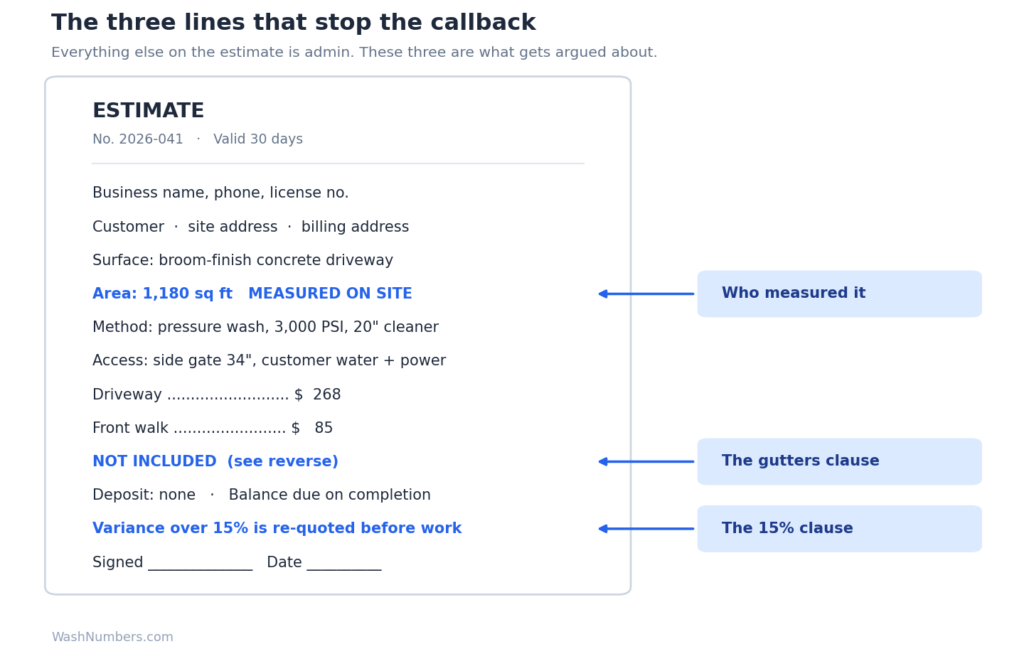
What belongs on a pressure washing estimate template
Twelve lines. That is the whole thing. A pressure washing estimate template longer than one page is a template written by somebody who has never had to explain one over the phone.
| Line | What it says | What it prevents |
|---|---|---|
| Your business | Legal name, phone, email, license or registration number where your state asks for one | Reading as a guy with a truck |
| Customer and site | Both addresses, because the billing address is often not the job | Turning up at a rental the owner has never seen |
| Number and date | Sequential estimate number, date issued | Two versions of the same quote in circulation |
| Surface, named | “Broom-finish concrete driveway”, not “driveway” | Blowing out paver joints on your own time |
| Area | Square footage, and whether you measured it or they told you | The 1,000 that turns out to be 1,600 |
| Method | Pressure wash, soft wash or both, and which surface gets which | The customer expecting 3,000 PSI on their siding |
| Access and utilities | Whose water, whose power, gate width, where you park | A locked gate and a spigot shut off at the street |
| Price, itemised | One line per surface, not one number for the whole job | Losing the full ticket when they drop one item |
| Exclusions | The block in the next table | The gutters call |
| Validity | 30 days | Being held in September to a price written in April |
| Deposit and terms | Amount if any, and when the balance is due | “Payment upon receipt” quietly meaning thirty days |
| Signature | Both parties, or a written accept-by-email line | Having nothing to point at |
Three of those deserve more than a table row, because they are the ones a generic pressure washing estimate template gets wrong.
The surface, named specifically. “Driveway” is not a surface. Broom-finished concrete, stamped concrete, exposed aggregate, pavers with sand joints and asphalt all clean differently and three of them can be damaged by a pressure you would use safely on the first. Naming it on the estimate is how you avoid rebedding somebody’s paver joints on your own time.
Square footage, and where the number came from. More on this below, because it is where most disputes start.
The water source. If the customer’s spigot puts out four gallons a minute and you brought a buffer tank sized for eight, that is your problem and you should have checked. If they turned the water off at the street because they are away, that is theirs. The line costs you nine words and settles the argument before it happens.
What a pressure washing estimate template has to exclude
A pressure washing estimate template that only lists what you are doing is half a document. The half that saves you money lists what you are not.
| Not included | The one line you give the customer |
|---|---|
| Oil and transmission stains | Water does not lift oil that has soaked into porous concrete. Degreasing is a separate treatment and does not always fully clear. |
| Rust and fertiliser staining | Needs oxalic acid or a dedicated rust remover, priced per stain after inspection. |
| Paint overspray, tyre marks, adhesive | Chemical removal rather than pressure, and the substrate decides whether it works at all. |
| Re-sanding pavers, sealing | Cleaning takes joint sand out. Putting it back is a separate quote. |
| Anything above your working height | State your limit. Ladder and lift work is a different job and different insurance. |
| Pre-existing damage | Spalling, cracks, failed grout and loose siding are noted before work, not caused by it. |
| Gutter interiors and gutter whitening | Exterior rinse only unless it appears as its own priced line above. |
| Window cleaning | Rinsed in passing, not cleaned. Say so before they ask. |
I would put that block on every estimate regardless of the job. It reads as professional rather than defensive, because it explains rather than just disclaims: you are not refusing to remove the oil stain, you are telling them upfront that a fifteen-year-old oil stain in porous concrete does not come out with water and that anyone promising otherwise is going to underdeliver.
One more belongs on commercial work and almost never on residential: where the wash water goes. Letting it run into a storm drain is a discharge question under the EPA’s stormwater program, and if a site needs containment or recovery that is a priced line on the estimate, not something you find out about on the morning.
The rust one earns its place on its own. Rust from a fertiliser spreader or a well sprinkler needs oxalic or a dedicated rust remover, it is a separate visit and a separate price, and every contractor I have read on this has a story about the driveway where they discovered it after quoting.
Measured, or stated?
Here is the line that decides whether your pressure washing estimate template is worth anything.
Somebody tells you their driveway is a thousand square feet. You quote on a thousand square feet. You turn up and it is sixteen hundred and it wraps around to a side path they did not mention.
Two ways to handle it, and only one of them works.
The version that does not work is quoting a flat price on a stated number and eating the difference. The version that works is one clause: price based on the measurement above, taken on site / provided by the customer; a variance of more than 15% is re-quoted before work begins. Tick which one applies. If you measured it yourself, you own the number. If they gave it to you over the phone, they do.
That single clause is the difference between an estimate and a guess, and it is missing from every free pressure washing estimate template I have looked at.
Putting a number on it
A pressure washing estimate template gives you the shape of the document. The document is the easy part. What goes in the price column is the part people get wrong, and quoting from spray time rather than job time is the fastest route to working a full day for half the money. We went through that in detail in our breakdown of how long this work actually takes.
For reference, these are the ranges in our published dataset of 220 public price observations. They are what other people advertise, not what you should charge, and the difference matters.
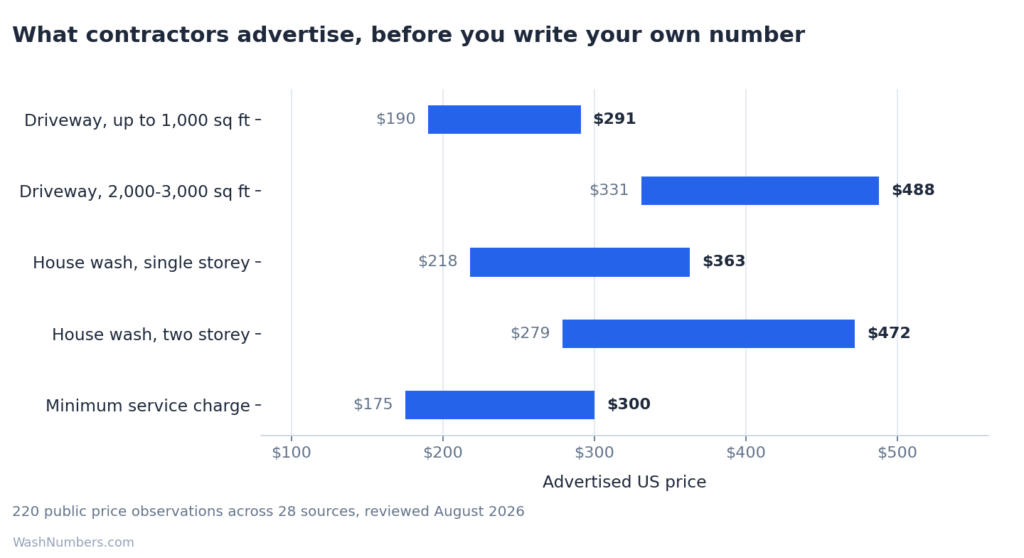
| Service | Published range | Basis |
|---|---|---|
| House washing | $150 to $800, midpoint $439 | 23 comparable direct-provider ranges |
| Driveway or open concrete | $90 to $350, midpoint $202 | 15 comparable direct-provider ranges |
| Roof cleaning | $250 to $1,500, midpoint $574 | 13 comparable direct-provider ranges |
| Deck or patio | $70 to $550, midpoint $240 | 12 comparable direct-provider ranges |
| Fence cleaning | $70 to $250, midpoint $149 | 4 comparable direct-provider ranges |
| Minimum service charge | $175 to $300 | Observed, roughly two hours of the contractor’s rate |
| Published hourly rates | $50 to $150 | Industry sources, wide enough to be close to useless |
| Model rate per square foot, by surface | $0.40 to $0.49 | WashNumbers model, not an advertised price |
Two things about using those. First, the minimum charge line is not optional padding, it is the number that makes a small job cover the drive out and the setup, and there is a longer argument for it in why minimum charges exist. Second, if you are pricing by the square foot, our per square foot breakdown has the flatwork numbers split by surface type rather than lumped together.
Deposit, validity and the fine print that is actually short
Three lines on the pressure washing estimate template, none of them longer than a sentence.
Validity. Thirty days. Chemical and fuel prices move and a quote you wrote in April should not be binding in September.
Deposit. For residential work under a thousand dollars, most solo operators do not take one and get paid on completion. Above that, or on anything commercial, a 25% deposit is standard and it is not rude to ask.
Payment terms. Due on completion, or net 15 for commercial. Write which. “Payment upon receipt” means nothing and everyone treats it as thirty days.
Skip the liability paragraph. If you need indemnity language you need a contract, and a contract is a different document from a pressure washing estimate template. Trying to make the estimate do both is how you end up with a two-page PDF that customers do not read and do not sign.
Copy this pressure washing estimate template
Everything above, assembled. Take it, put your own header on it, and delete the lines that do not apply to your work.
| Field | What you write |
|---|---|
| Header | ESTIMATE · No. [0000] · Date [date] · Valid 30 days |
| From | [Business name] · [phone] · [email] · [license no. if required] |
| For | [Customer] · Site: [address] · Billing: [address if different] |
| Scope | [Surface, named] · [X] sq ft, measured on site / provided by customer · Method: [pressure wash / soft wash] |
| Site notes | Water and power supplied by customer. Gate access [X]”. Vehicle parked [where]. |
| Pricing | [Surface 1] — $[X] · [Surface 2] — $[X] · Total $[X] plus tax where applicable |
| Not included | [Paste the exclusions block] |
| Variance | Price is based on the area stated above. A variance greater than 15% will be re-quoted before work begins. |
| Terms | Deposit [none / 25%]. Balance due [on completion / net 15]. Estimate valid 30 days from the date above. |
| Acceptance | Accepted by ______________ Date __________, or by written confirmation to [email]. |
Two notes on the format. Send it as a PDF, not a document file, because a Word file arrives on a phone looking like nothing and a PDF looks the same everywhere. And put the number in the email body as well as in the attachment, because a meaningful share of customers never open the attachment and you want the price in front of them either way.
When the template stops being enough
At roughly twenty jobs a month a pressure washing estimate template stops paying for itself. You start losing track of which quote went out when, nobody follows up on the ones that went quiet, and you are rebuilding the same document from scratch every morning.
That is the point to move to something that stores customers and turns an accepted estimate into an invoice without retyping. Jobber, Housecall Pro and Markate all do it and all cost real money monthly, which is a line you should be putting in your overhead before you sign up, not after. We costed that alongside the rest of the gear in our rundown of what a setup costs to build.
Below that volume the software is a subscription you are paying to avoid a five-minute job, and a pressure washing estimate template you have saved as a PDF export does the same work for nothing.
Frequently asked questions
What should a pressure washing estimate template include?
Twelve lines: your business details, the customer and site address, the date, the surface named specifically, square footage with its source, the method, the price, the exclusions, validity, deposit, payment terms and a signature line. The exclusions block is the one most templates leave out and the one that prevents the callback.
Is an estimate legally binding?
An estimate is a good-faith figure, a quote is generally treated as a fixed price. Which word you put at the top of the document matters, so pick one deliberately. Neither is a substitute for a contract on a large commercial job.
Should I put my prices on the estimate broken down by line?
Broken down, on anything with more than one surface. A single number invites haggling over the whole job. Itemised, the customer drops the driveway and keeps the house wash, and you keep most of the ticket.
How long should a pressure washing estimate stay valid?
Thirty days is standard and defensible. Chemical costs and fuel move enough over a season that an open-ended quote is a liability, and a validity window also creates a reason for the customer to decide.
What do I do if the square footage is wrong when I arrive?
Nothing, if you wrote the variance clause. Show them the measurement on the estimate, show them the actual, and re-quote before you pull a hose off the reel. Doing the extra and invoicing for it afterwards is how you end up not getting paid for the extra.
Do I need to list the chemicals I am using?
Not by trade name. “Sodium hypochlorite solution, diluted for the surface” covers a soft wash without handing a competitor your mix or worrying a customer who googles a brand name. If they ask specifically, tell them, and be ready to talk about plants.
Where can I get a free pressure washing estimate template?
The one in the table above is free and you can rebuild it in a word processor in ten minutes. Be careful with the ones bundled by software vendors as a lead magnet: most are generic service invoices, and none of the four I checked included an exclusions block or a square-footage variance clause.
Should I charge for the estimate itself?
Not for residential work you can price from the driveway in ten minutes. For a commercial site that needs a walkthrough, a measurement and a written scope, charging a site survey fee and crediting it against the job is reasonable and filters out the people collecting three quotes for a budget exercise.
Add your numbers to the benchmark
A pressure washing estimate template only helps once the number you put in it is right, and the prices in that table are public advertised rates collected from 28 sources. They tell you what other contractors are willing to say in public. They do not tell you what anyone is actually getting paid, and nobody in this trade publishes that.
We are building the first one from figures given directly by working US contractors. Seven questions, answered in ranges, no business named and no individual price ever published. Contributors get the state-by-state breakdown a week before it goes public.
Add your numbers to the 2026 pricing survey
Tools for your business
Contractor Pricing Calculator
Build a quote that still leaves a margin after chemicals and drive time.
Production Rate Calculator
The hours a job takes, before you can price it.
Startup Cost Calculator
What a rig costs to build and how many jobs pay it back.
Add Your Rates to the Survey
Seven questions. You get the state-by-state results first.
 Written by Diego Hernández, founder of WashNumbers. Cost models are built from published contractor rates and public price observations. See how we build these numbers.
Last reviewed: August 2026