
Nobody quotes a housewash thinking about liability. You think about it the afternoon a lance clips a window seal on a second storey, or the day a property manager asks for a certificate before you can even bid. That is when pressure washing insurance cost stops being a line in a spreadsheet and becomes the thing standing between you and getting paid.
Here is what pressure washing insurance cost runs in 2026, where the published numbers come from, and why the quote you get back is almost always higher than any average you will read.
What pressure washing insurance cost looks like in 2026
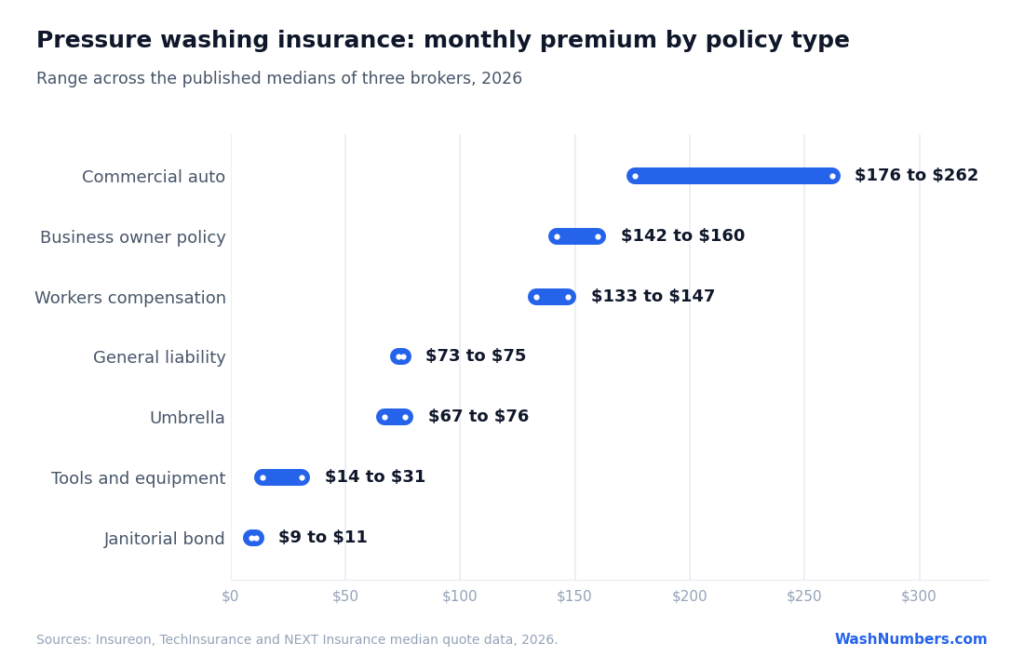
Three brokers publish median pricing for pressure washing businesses out of their own quote data: Insureon, TechInsurance and NEXT Insurance. This is not independent research. It is what their applicants were charged, and that is exactly why it is worth reading.
| Policy | Insureon | TechInsurance | NEXT | Annual, at the median |
|---|---|---|---|---|
| General liability | $73/mo | $75/mo | $75/mo | $879 to $900 |
| Business owner’s policy | $142/mo | $160/mo | Not published | $1,699 to $1,924 |
| Workers compensation | $147/mo | $133/mo | Not published | $1,601 to $1,761 |
| Commercial auto | $262/mo | $176/mo | Not published | $2,116 to $3,143 |
| Tools and equipment | Not published | $14/mo | $31/mo | $168 to $372 |
| Umbrella | $76/mo | $67/mo | Not published | $801 to $906 |
| Janitorial bond | $9/mo | $11/mo | Not published | $112 to $126 |
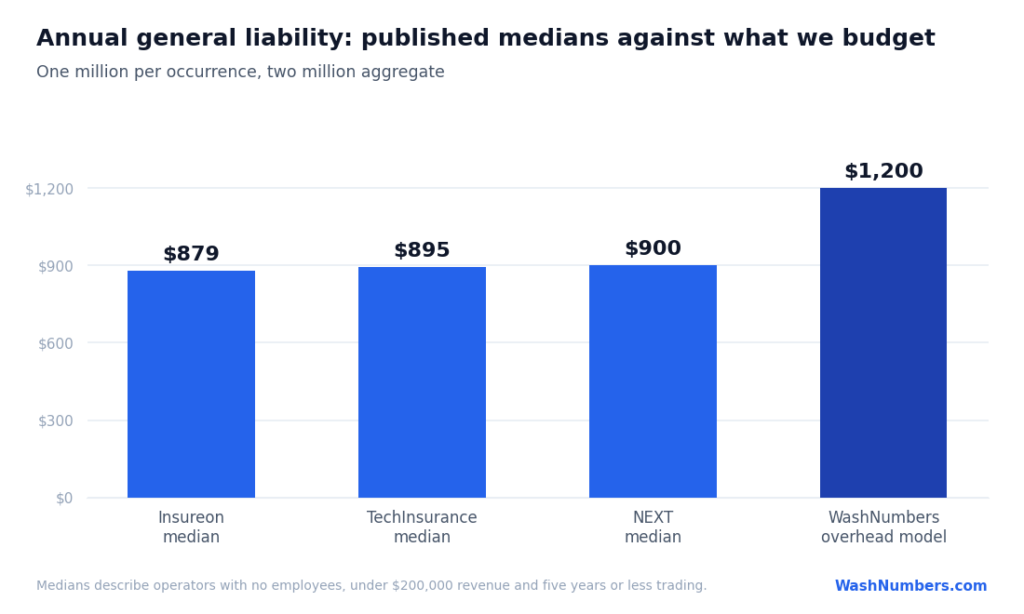
The three agree on general liability more closely than you would expect: $73, $75 and $75 a month. Call it $880 to $900 a year for a one million per occurrence, two million aggregate policy with a $500 deductible.
That agreement matters. Three different books of business, three underwriting appetites, one number. It is the closest thing this trade has to a benchmark for pressure washing insurance cost, and it is still only a starting point.
Why your pressure washing insurance cost will be higher than the median
Read the small print under those medians and the profile appears. Insureon says its figures come from owners with fewer than five employees, revenue between roughly $50,000 and $200,000, and five years or less in business. NEXT anchors its $75 to a general liability minimum premium in Texas.
That is a solo operator doing residential flatwork in a cheap state. If that is you, the median is your number. If it is not, treat it as a floor.
| What changes | What it does to the price | Why |
|---|---|---|
| Roof work | Moves you out of the base class | Falls and granule damage are the claims this trade actually files |
| Your first employee | Adds $133 to $147 a month | Workers compensation, mandatory in most states |
| Commercial contracts | Adds endorsements, sometimes an umbrella | Additional insured wording and higher required limits |
| A towed trailer | Raises commercial auto and equipment cover | The rig is often worth more than the truck pulling it |
| Your state | Changes the base rate entirely | NEXT anchors its $75 figure to a Texas minimum premium |
| Revenue above $200,000 | Puts you outside the published profile | The medians describe businesses under that line |
| One claim | Resets the renewal | A single water intrusion claim follows you for years |
None of this is an argument for shopping harder. It is an argument for budgeting above the median before you set your rate, because a policy priced for a driveway guy will not cover the roof you took last month.
The policies, in the order you actually need them
Most guides list eight coverages and leave you to work out the priority. That is backwards for a new operator with limited cash, because the bulk of your pressure washing insurance cost in year one sits in three of them.
| Policy | When you actually need it | Typical monthly |
|---|---|---|
| General liability | Day one, before the first paid job | $73 to $75 |
| Tools and equipment | As soon as the rig costs more than you could replace in cash | $14 to $31 |
| Commercial auto | The day the truck is used for work | $176 to $262 |
| Workers compensation | First employee, and in some states the first subcontractor | $133 to $147 |
| Umbrella | When a contract asks for limits above two million | $67 to $76 |
| Business owner’s policy | When you have premises or stock as well as liability | $142 to $160 |
| Janitorial bond | Only when a client asks for it | $9 to $11 |
General liability is the one that gets you on the job. It is what a homeowner means when they ask if you are insured, and what a property manager means when they ask for a certificate. Nothing else on the list opens doors the same way.
Tools and equipment coverage surprises people. A $31 monthly policy against a $4,000 machine sitting in an open trailer is not a hard sum. Most general liability policies exclude your own equipment entirely, which operators tend to discover after the theft rather than before.
Commercial auto is the line that wrecks budgets. At $176 to $262 a month it is often bigger than the liability policy everybody worries about, and a personal auto policy will deny a claim on a truck that was working when it happened. That is not a grey area, it is the whole reason commercial auto exists.
The certificate is the product
On residential work the policy is the point. On commercial work the paperwork is.
A property manager does not read your policy. They ask for a certificate of insurance, they check the limits, and more and more of them ask to be named as additional insured on the endorsement. No certificate, no bid, and the conversation ends before your price ever comes up.
Two practical things follow from that.
Additional insured endorsements are usually a small charge, sometimes free on a per project basis and sometimes a few hundred dollars a year for a blanket version. Ask what yours costs before you need it, because a client wanting it on Friday for a Monday start is a bad moment to find out.
Limits act as a filter. Plenty of commercial contracts specify one million per occurrence and two million aggregate as a minimum, which the median policies above already carry. Some specify more, and that is the point where an umbrella at $67 to $76 a month stops being optional. The rest of what changes when you move from houses to properties is in our guide to what commercial work actually costs.
Workers compensation: when it stops being optional
The moment you hire anybody, this becomes the largest single item in your pressure washing insurance cost at $133 to $147 a month, and in most states it stops being a choice.
Requirements vary enough that no national figure means anything. Some states require coverage from the first employee, others from the third or the fifth, and the treatment of subcontractors differs again. The US Department of Labor keeps a directory of state workers compensation officials, and that is the source worth checking, because the rules are set at state level and they change.
One trap worth naming. Calling a helper a subcontractor does not remove the obligation in most states. If they use your machine, follow your schedule and work under your direction, the state is likely to treat them as an employee whatever the invoice says. That gets expensive after an injury, not before it.
What we budget for pressure washing insurance cost, and why it is higher
Our own overhead model uses $1,200 a year for general liability, not the $880 to $900 the brokers publish.
That is deliberate, and the reasoning matters more than the number. A median is the middle of a set of quotes, which means half the applicants paid more than it. Add roof work and it moves. Add a second person and workers compensation appears. Add a commercial client and you are paying for endorsements. Budget the median, price your hourly rate off it, and every one of those events comes out of your margin instead of the customer’s invoice.
The startup model goes further and uses $895, $3,011 and $5,413 for the three rig levels, because a hot water trailer towed behind a truck is not insured like a tailgate setup. The full breakdown sits in what it costs to build a rig from scratch.
If you are working out what to charge, the insurance line belongs in overhead before you divide by billable hours. Our guide to working out an hourly rate from your own costs shows where it sits, and what happens to the rate when you get that line wrong.
Five mistakes that cost real money
Quoting from the median and pricing your rate off it. The published pressure washing insurance cost is an applicant average, not your premium. Get an actual quote before you commit to a rate you will live with for a year.
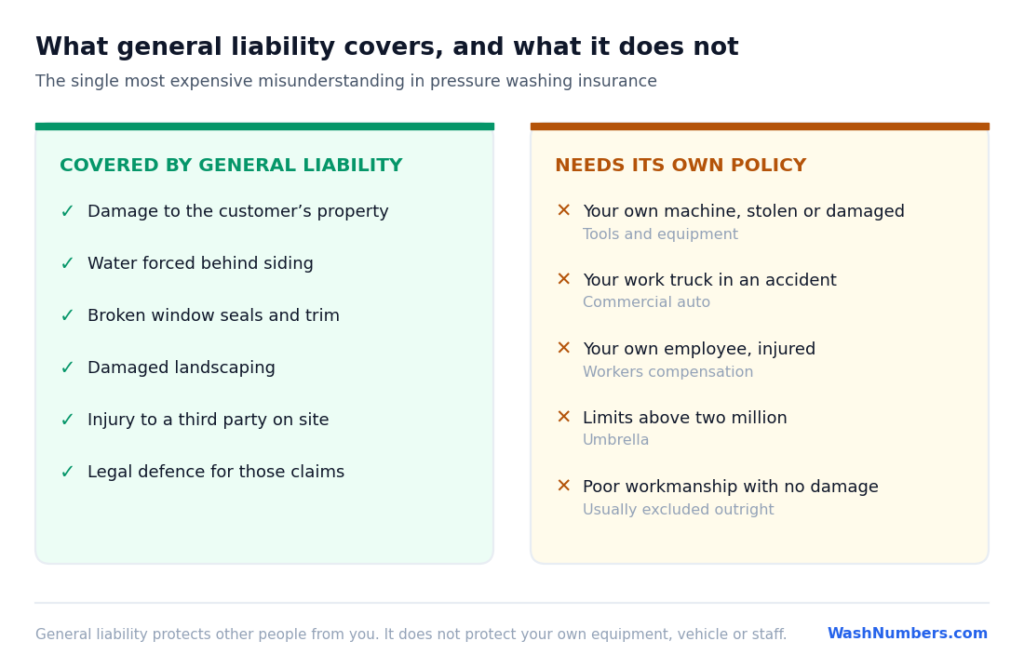
Assuming general liability covers your machine. It almost never does. Equipment is a separate line and it is cheap.
Running a work truck on a personal auto policy. The claim gets denied at exactly the moment you need it paid.
Letting the certificate lapse mid contract. Your carrier sends the expiry notice to the client too, and some commercial contracts treat a lapse as a breach.
Calling employees subcontractors to dodge workers compensation. The state decides that classification, not you, and it decides it after somebody is hurt.
When to talk to a broker instead of a website
Buying online is fine for a solo residential operator with one truck and no employees. That is exactly what the direct writers are built for, and it is why their pricing is competitive.
Talk to an independent broker when any of these is true: you do roofs, you have employees, you want commercial contracts, you own a trailer worth more than the truck, or a contract has handed you limits and endorsement wording you do not recognise. A broker shops several carriers and reads the exclusions, and at that stage the difference is not the premium.
This page reports published pricing and general requirements. It is not insurance advice, we do not sell policies, and nothing here replaces a quote and a policy document you have actually read.
Before you buy anything
Get three quotes at the same limits or you are comparing nothing, because pressure washing insurance cost only means something when the coverage behind it is identical. Ask each one what happens if you take a shingle roof, whether your equipment is covered off the truck, and what an additional insured endorsement costs. Then put the real number into your overhead and rebuild your hourly rate around it.
Pressure washing insurance cost is not the line that decides whether the business works. It is the line that decides whether one bad afternoon ends it.
Questions about pressure washing insurance cost
How much is pressure washing insurance cost per month for a solo operator?
Published medians put general liability between $73 and $75 a month, which is $880 to $900 a year at one million per occurrence and two million aggregate. That figure describes an operator with no employees, under $200,000 of revenue and residential work. Roofs, employees or commercial contracts all move it up.
Do I legally need insurance to pressure wash?
General liability is rarely required by law for residential work, but it is required by almost every commercial client and by many municipal licensing offices. Workers compensation is different: once you have employees it is mandatory in most states, and the threshold varies by state. Budget for it as part of your pressure washing insurance cost from the first hire, not from the first claim.
Does general liability cover damage I do to the customer’s property?
That is what it is for. Broken window seals, water forced behind siding, damaged landscaping and stripped shingle granules are the claims this trade actually files. What it does not cover is your own equipment, or poor workmanship claims where nothing was physically damaged.
Is my pressure washer covered if it is stolen from the truck?
Not by general liability. You need tools and equipment coverage, which runs about $14 to $31 a month depending on whether you buy it standalone or inside a wider policy. For a rig worth several thousand dollars it is the cheapest part of your pressure washing insurance cost.
What is an additional insured endorsement and why do clients ask for it?
It extends your liability policy to cover the client for claims arising from your work. Commercial property managers ask for it so that a claim on their site lands on your policy rather than theirs. It usually adds little to your pressure washing insurance cost, and no certificate means no contract.
Why is my quote higher than the pressure washing insurance cost I read online?
Because published figures are medians from a specific applicant profile: small, residential, few years trading. Your state, your revenue, roof work, employees, a towed trailer and the limits your contracts demand all push a real quote above that middle.
Can I put insurance in my hourly rate?
You should. Insurance belongs in annual overhead, divided across your billable hours like every other fixed cost. The contractor pricing calculator does that division for you and shows what the rate has to be once it is included.
How often should I re-shop the policy?
Once a year, and any time the business changes shape: first employee, first roof, first commercial contract, a new truck or a trailer. Each of those resets your pressure washing insurance cost. Those are the events that change what you should be paying, and carriers do not volunteer a lower price when your risk drops.
Get the rest of the number right
Pressure washing insurance cost is one line of the overhead that decides your hourly rate. The rest of it, and the arithmetic that turns it into a price per square foot, is in the guide to what to charge. If you are still building the rig, the startup cost calculator adds insurance to equipment and tells you how many jobs pay it all back.
Both are free, there is nothing to sign up for, and every assumption behind them is published.
Tools for your business
Contractor Pricing Calculator
Build a quote that still leaves a margin after chemicals and drive time.
Production Rate Calculator
The hours a job takes, before you can price it.
Startup Cost Calculator
What a rig costs to build and how many jobs pay it back.
Add Your Rates to the Survey
Seven questions. You get the state-by-state results first.
 Written by Diego Hernández, founder of WashNumbers. Cost models are built from published contractor rates and public price observations. See how we build these numbers.
Last reviewed: September 2026