
Professional deck pressure washing typically costs around $100 to $250 according to current U.S. pricing references, but deck size alone does not explain the final quote.
Material, railings, stairs, buildup, access, the underside of an elevated deck, and—most importantly—the cleaning method can all change the scope of the job.
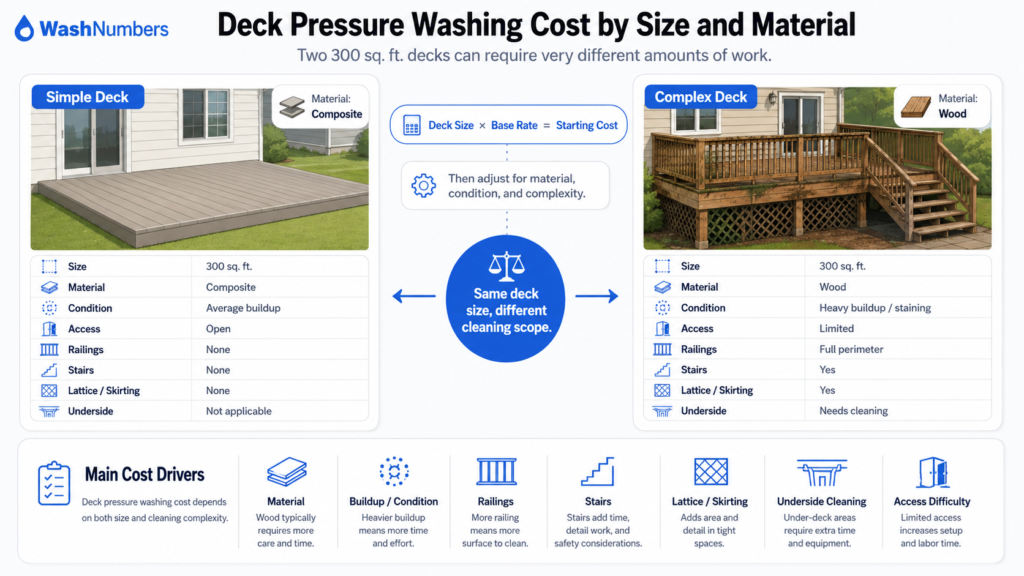
A 300-square-foot ground-level deck with no railings is not the same cleaning project as a 300-square-foot elevated deck surrounded by balusters and stairs.
That distinction matters because many published deck-cost guides use only the floor square footage.
Quick answer
- Angi currently reports approximately $100–$250 for professional deck pressure washing, with about $150 as its typical figure.
- Homewyse currently estimates approximately $0.46–$0.57 per square foot under its basic-project assumptions.
- Fixr publishes approximately $100–$200, with around $145 as its national average reference and approximately $0.30–$0.40 per square foot.
- The WashNumbers homeowner model currently uses $0.49 per square foot as a transparent deck base-rate assumption before condition, access, the modeled minimum, and the estimate band are applied.
- Railings, stairs, lattice, detailed surfaces, and the underside of an elevated deck may substantially increase the amount of work even when the deck floor area stays the same.
- High pressure is not appropriate for every deck material. Manufacturer instructions should take priority over any generic pressure-washing recommendation.
For an estimate based on your own deck size, condition, and access, use the Pressure Washing Cost Calculator.
Pricing references reviewed: August 2026.
2026 Deck Pressure Washing Cost at a Glance
Current pricing references do not produce one universal deck-cleaning price.
That does not necessarily mean the sources contradict one another. Their numbers can represent different deck sizes, project assumptions, local markets, labor structures, and cleaning scopes.
| Source | Published Cost | Pricing Basis | Source Timing |
|---|---|---|---|
| Angi | $100–$250 | Professional deck pressure washing; about $150 typical | Updated Aug. 3, 2026 |
| Homewyse | $0.46–$0.57 / sq. ft. | Basic work under favorable stated conditions | January 2026 estimate |
| Fixr | $100–$200 | $145 national-average reference; also lists $0.30–$0.40/sq. ft. | Updated Jan. 31, 2025 |
| HomeGuide | $120–$240 | About $0.35/sq. ft. plus separate feature references | Older editorial reference |
| WashNumbers model | $0.49 / sq. ft. base | Transparent modeling assumption before condition and access adjustments | Reviewed Aug. 2026 |
WashNumbers does not average these figures together and label the result a national price.
Instead, the published numbers are used as context, while any WashNumbers-specific rate or adjustment is clearly identified as a modeling assumption.
This distinction is explained in the WashNumbers Methodology.
Deck Pressure Washing Cost by Size
Deck floor area is still a useful starting point when the deck is relatively simple.
The WashNumbers homeowner model currently begins with:
Base deck cost = deck floor area × $0.49 per sq. ft.
For average buildup and normal access, the condition and accessibility multipliers remain at 1.00×.
The model then applies a $100 small-job floor when necessary and shows a planning range of ±20% around the typical modeled estimate.
| Deck Floor Area | Base Calculation | Typical Modeled Estimate | Planning Range |
|---|---|---|---|
| 100 sq. ft. | 100 × $0.49 = $49 | $100* | $100–$120 |
| 200 sq. ft. | 200 × $0.49 = $98 | $100* | $100–$120 |
| 300 sq. ft. | 300 × $0.49 = $147 | $147 | $118–$176 |
| 400 sq. ft. | 400 × $0.49 = $196 | $196 | $157–$235 |
| 500 sq. ft. | 500 × $0.49 = $245 | $245 | $196–$294 |
| 700 sq. ft. | 700 × $0.49 = $343 | $343 | $274–$412 |
| 1,000 sq. ft. | 1,000 × $0.49 = $490 | $490 | $392–$588 |
These are WashNumbers planning estimates, not reported national averages or guaranteed contractor quotes.
For comparison, Angi currently publishes approximately $100 for 300 square feet, $200–$300 for 700 square feet, and $300–$400 for 1,000 square feet.
Those published examples let us calculate something useful that is not immediately obvious from the total prices.
What Published Deck Prices Mean per Square Foot
Dividing Angi’s published size examples by their corresponding deck areas gives the implied effective square-foot rate.
| Deck Size | Angi Published Cost | Calculation | Implied Effective Rate |
|---|---|---|---|
| 300 sq. ft. | $100 | $100 ÷ 300 | $0.33 / sq. ft. |
| 700 sq. ft. | $200–$300 | $200–$300 ÷ 700 | $0.29–$0.43 / sq. ft. |
| 1,000 sq. ft. | $300–$400 | $300–$400 ÷ 1,000 | $0.30–$0.40 / sq. ft. |
This calculation shows why it is risky to take one price-per-square-foot number and apply it universally.
Angi’s own size examples imply an effective rate of about $0.29 to $0.43 per square foot across the examples above, depending on deck size and where the project falls within the published range.
That still does not mean $0.29–$0.43 is the “correct” national rate. It is simply what those specific published examples imply mathematically.
For a wider explanation of how square-foot pricing works across exterior-cleaning surfaces, see the Pressure Washing Cost per Square Foot Guide.
Deck Pressure Washing Cost by Material
Material can change both the potential price and the appropriate cleaning process.
Angi currently publishes the following examples for a 300-square-foot deck:
Metal: approximately $100
Composite: approximately $100–$150
Wood: approximately $100–$200
Converted into effective rates, those examples correspond to roughly:
Metal: $0.33/sq. ft.
Composite: $0.33–$0.50/sq. ft.
Wood: $0.33–$0.67/sq. ft.
But price is only half of the story.
The more important question is whether the specific decking product should be cleaned with substantial water pressure at all.
Can Every Deck Be Pressure Washed?
No.
“Deck pressure washing cost” is a useful search and pricing term, but it should not be interpreted as a recommendation to use high pressure on every deck.
Manufacturer guidance varies substantially even between products that homeowners may broadly describe as composite decking.
| Deck Material / Product | Pressure-Washer Guidance | Key Limit | Why It Matters |
|---|---|---|---|
| Trex Transcend, Enhance & Select | Permitted under Trex’s specified procedure | ≤ 3,100 PSI | Fan tip; keep at least 8 in. from surface and follow Trex cleaning instructions. |
| TimberTech | Power washer for rinsing only | ≤ 1,500 PSI | Use a fan-tip nozzle and spray with the grain pattern. |
| Pressure-treated wood | Very cautious use; experienced users or professionals recommended | < 500 PSI | Excessive pressure can damage and roughen wood fibers. |
| Western Red Cedar | Power washing not recommended | Avoid | Real Cedar warns that power washers can seriously damage cedar surfaces. |
Trex Composite Decking
Trex states that a pressure washer of no more than 3,100 PSI may be used for dirt or mud on its Transcend, Enhance, and Select composite decking when the specified procedure is followed.
Its guidance calls for a fan tip, soap and brushing, thorough rinsing, and keeping the fan tip at least 8 inches from the decking surface.
That guidance applies to the products Trex identifies. It should not be treated as a universal rule for every composite deck.
TimberTech Decking
TimberTech provides materially different instructions.
Its current guidance says a power washer may be used for rinsing only, with a recommended maximum of 1,500 PSI, a fan-tip nozzle, and spraying in the direction of the grain pattern.
That difference between two major manufacturers is a good example of why the material name “composite” alone is not enough information to select a cleaning method.
Pressure-Treated Wood
Treated Wood’s deck-care guidance is considerably more conservative.
Its FAQ recommends limiting pressure-washer use to experienced users or professionals and keeping the pressure below 500 PSI, using a fan tip and maintaining appropriate distance from the wood.
Improper pressure can damage wood fibers, leaving visible etching, fuzzing, or splintering.
Western Red Cedar
Western Red Cedar requires even more caution.
The Western Red Cedar Lumber Association states that power washers can seriously damage cedar deck surfaces and does not recommend power washing cedar decks.
A contractor evaluating a cedar deck may therefore recommend an alternative cleaning method rather than simply lowering or raising the pressure-washing price.
Why Two 300 Sq. Ft. Decks Can Cost Very Different Amounts
Consider two decks with exactly the same floor area.
Deck A
300 sq. ft. rectangular platform
Ground level
No railing
No stairs
Open access
Average buildup
Deck B
300 sq. ft. elevated platform
Full railing system
Staircase
Lattice around part of the perimeter
Accessible underside
Heavy organic buildup
Furniture and obstacles around the work area
Both can accurately be described as “300-square-foot decks.”
But they are clearly not the same cleaning job.
A square-foot measurement of the floor captures the main walking surface. It does not automatically capture the additional labor involved in cleaning balusters, posts, stair treads, risers, lattice, edges, vertical surfaces, or the underside of an elevated structure.
That is one of the most important limitations of basic deck-cost calculators.
The same principle applies to other outdoor surfaces. Our Patio Pressure Washing Cost Guide shows how concrete, pavers, joint sand, buildup, and access can change the cleaning scope even when patio size stays the same.
Fence cleaning has a similar measurement problem. The same linear footage can represent very different cleaning areas depending on fence height and whether one or both sides are washed. See our Fence Pressure Washing Cost Guide for a full breakdown.
Does Deck Square Footage Include Railings and Stairs?
Not necessarily.
This is something worth confirming when comparing contractor quotes.
HomeGuide, for example, publishes separate pricing references for several detailed deck components:
| Additional Deck Feature | Published Reference | Pricing Unit | Why Floor Area Misses It |
|---|---|---|---|
| Stairs | $65 | Per staircase | Treads, risers and edges add detailed cleaning. |
| Handrails | $2.50–$3.50 | Per linear foot | Rails and balusters are not represented by floor square footage. |
| Lattice | $0.85–$0.95 | Per sq. ft. | Detailed vertical surfaces add additional cleaning scope. |
| Deck underside | $1.50 | Per sq. ft. | An elevated deck can expose substantial additional surface area. |
These figures should not automatically be added to every deck estimate.
Some contractors may include certain features within a flat project price, while others may price them separately. The figures are useful because they demonstrate that floor area is not the only measurable part of the cleaning scope.
When requesting quotes, clarify whether the price includes:
deck boards, railings and balusters, posts, stair treads and risers, lattice or skirting, fascia, and the underside of an elevated deck.
Comparing two totals without confirming the included surfaces can make one contractor appear much more expensive even when the scopes are different.
WashNumbers Deck Cost Model
The current WashNumbers model uses a transparent $0.49 per-square-foot deck base rate.
The basic formula is:
Base cost = deck floor area × $0.49
The model then adjusts that result for project condition:
Light buildup = 0.90×
Average buildup = 1.00×
Heavy buildup = 1.15×
and accessibility:
Easy access = 0.95×
Normal access = 1.00×
Difficult access = 1.10×
The resulting formula is:
Typical modeled estimate = base cost × condition factor × access factor
The model also uses a $100 small-job floor and a ±20% planning band.
These percentages are WashNumbers modeling assumptions. They are not presented as contractor industry standards.
Example: 400 Sq. Ft. Deck
For a 400-square-foot deck with average buildup and normal access:
400 × $0.49 = $196
Condition:
$196 × 1.00 = $196
Access:
$196 × 1.00 = $196
Typical modeled estimate:
$196
Planning range:
$157–$235
That result is also generated by the current Pressure Washing Cost Calculator.
Example: 400 Sq. Ft. Deck With Heavy Buildup and Difficult Access
Using the same 400-square-foot deck:
400 × $0.49 = $196
Heavy-buildup adjustment:
$196 × 1.15 = $225.40
Difficult-access adjustment:
$225.40 × 1.10 = $247.94
Typical modeled estimate:
approximately $248
The ±20% planning band produces approximately:
$198–$298
The model is designed to demonstrate how size, condition, and access interact. It cannot determine whether a deck requires specialized restoration, hand cleaning, repair work, or a different cleaning method.
What Changes Deck Pressure Washing Cost?
Deck Size
Larger decks usually require more cleaning time, solution, and equipment use.
However, the price does not always increase in perfect proportion to square footage because small jobs can be affected by minimum service charges and large open surfaces may be more efficient to clean.
Railings and Balusters
A railing contains substantially more edges and detailed surfaces per linear foot than an open deck floor.
A deck surrounded by railing can therefore require more labor than an equally sized ground-level platform.
Stairs
Stair treads, risers, stringers, edges, and railings add detailed work that is not reflected by the main deck floor area.
Deck Condition
Light dirt and routine buildup are different from years of organic growth, grease, weathering, or difficult stains.
More severe buildup may require additional preparation, appropriate cleaning products, brushing, dwell time, or repeated cleaning.
Material and Finish
Wood species, composite manufacturer, protective shell, paint, stain, sealant, age, and existing damage can all affect the safe cleaning approach.
A more aggressive method is not automatically a better one.
Access
A ground-level deck with clear access is different from an elevated or wrap-around deck with landscaping, narrow pathways, furniture, or limited equipment access.
Underside Cleaning
An elevated deck may expose joists, beams, posts, and board undersides.
If those areas are included in the scope, the true cleaning area can be much larger than the deck’s advertised floor square footage.
Local Market
Labor costs, contractor minimums, insurance, travel, competition, and demand vary by location.
That is one reason WashNumbers does not claim its model represents an exact ZIP-code price.
How to Measure a Deck for a Cleaning Estimate
For a simple rectangular deck:
Length × width = deck floor area
For example:
20 ft × 15 ft = 300 sq. ft.
For an L-shaped or irregular deck, divide the floor into smaller rectangles, calculate each section, and add the results.
Do not automatically assume the floor-area calculation represents the entire cleaning scope.
Record additional features separately, including approximate railing length, number of staircases, lattice or skirting, and whether underside cleaning is requested.
This gives a contractor far more useful information than simply saying, “I have a 300-square-foot deck.”
Pressure Washing vs. Power Washing vs. Lower-Pressure Deck Cleaning
Pressure washing generally refers to cleaning using pressurized water.
Power washing commonly describes similar equipment that also uses heated water.
For decks, however, the more important distinction is often how much pressure and mechanical force the actual material can safely tolerate.
A contractor may use reduced pressure, cleaning solution, brushing, rinsing, or another method when the material is susceptible to damage.
Manufacturer instructions should take priority over generic online PSI recommendations.
The large difference between Trex, TimberTech, pressure-treated wood, and Western Red Cedar guidance demonstrates why a universal “best deck PSI” would be misleading.
DIY vs. Professional Deck Pressure Washing
DIY cleaning can reduce labor cost, but decks are less forgiving than many concrete surfaces.
Incorrect nozzle choice, excessive pressure, inconsistent wand distance, or cleaning across the grain can permanently mark some materials.
Homeowners should identify the exact deck material and, where possible, the manufacturer before deciding on a cleaning method.
If the surface has loose boards, rot, splintering, failed coatings, severe weathering, or uncertain material, an inspection may be more useful than immediately pressure washing it.
A professional quote should also explain what method is being used—not simply provide a dollar amount.
When a Deck May Need Repair Before Cleaning
Pressure washing does not repair structural or surface deterioration.
Loose boards, protruding fasteners, significant rot, unstable railings, severe splintering, or damaged composite boards may require attention before aggressive cleaning.
A contractor may also adjust the cleaning method around weak areas to avoid making existing damage worse.
This is another reason the lowest quote is not automatically the best comparison.
The important question is whether every quote covers the same scope using an appropriate method for the actual deck.
How to Compare Deck Pressure Washing Quotes
When comparing contractors, first make sure each quote describes the same work.
Confirm the measured deck floor area, deck material, cleaning method, railings, stairs, lattice, underside cleaning, stain treatment, furniture movement, preparation, cleanup, minimum service charge, and any staining or sealing work.
Then calculate an effective floor-area rate if you want a simple comparison:
Effective rate = quoted price ÷ deck floor square footage
For example:
$210 ÷ 400 sq. ft. = $0.525 per sq. ft.
That calculation can make quotes easier to compare, but it should not be used to ignore differences in scope.
A $250 quote that includes detailed railings and stairs may represent better value than a $200 quote covering only the deck boards.
Deck Pressure Washing Cost FAQ
How Much Does It Cost to Pressure Wash a 300 Sq. Ft. Deck?
Angi currently publishes approximately $100 as its size example for a 300-square-foot deck.
The WashNumbers model uses $0.49 per square foot, producing:
300 × $0.49 = $147
With average buildup and normal access, the modeled typical estimate is $147, with a planning range of approximately $118–$176.
Actual quotes can differ depending on material, railings, stairs, condition, access, location, and contractor minimums.
How Much Does It Cost to Pressure Wash a 500 Sq. Ft. Deck?
At the current WashNumbers modeled base rate:
500 × $0.49 = $245
For average buildup and normal access, the typical modeled estimate is $245, with a planning range of approximately $196–$294.
This is a model calculation rather than a reported national average.
How Much Does It Cost to Pressure Wash a 1,000 Sq. Ft. Deck?
Angi currently publishes approximately $300–$400 for its 1,000-square-foot example.
The WashNumbers model produces:
1,000 × $0.49 = $490
with a default planning band of approximately $392–$588 before accounting for unusual scope or material-specific cleaning requirements.
The difference illustrates why WashNumbers shows its assumptions instead of describing the model output as the national price.
How Much Does Deck Pressure Washing Cost per Square Foot?
Current references differ.
Homewyse currently publishes approximately $0.46–$0.57 per square foot, while Fixr publishes approximately $0.30–$0.40 per square foot.
HomeGuide publishes approximately $0.35 per square foot for deck power washing, although its visible editorial date is older than the 2026 Angi and Homewyse references.
WashNumbers currently uses $0.49 per square foot as a model assumption, not as a claimed U.S. average.
Does Deck Pressure Washing Include Railings?
Not automatically.
Contractor scopes differ. Ask whether railings, balusters, posts, stairs, fascia, lattice, and the underside are included before comparing quotes.
Can You Pressure Wash a Composite Deck?
It depends on the exact product.
Trex permits pressure washing on specified products under its stated limits, while TimberTech says a power washer should be used for rinsing only and sets a lower maximum recommended pressure.
Check the manufacturer’s instructions for the specific decking product.
Can You Pressure Wash a Wood Deck?
Some wood decks can be cleaned using carefully controlled low pressure, while other wood products should not be power washed.
Treated Wood recommends very low pressure and experienced use for pressure-treated decking, while the Western Red Cedar Lumber Association does not recommend power washing cedar decking.
Identify the material before selecting the cleaning method.
Is It Cheaper to Pressure Wash a Deck Yourself?
DIY work eliminates professional labor charges but may still involve equipment rental, cleaning products, preparation time, and the risk of surface damage.
The safest economic comparison should consider both direct cost and whether the homeowner has the equipment and experience required for the specific deck material.
WashNumbers Methodology and Limitations
WashNumbers compares published U.S. pricing references with transparent planning models.
External source figures remain identified as published data.
The current $0.49 deck base rate, condition multipliers, accessibility multipliers, $100 modeled minimum, and ±20% estimate band are WashNumbers assumptions used to create a reproducible planning estimate.
They are not presented as universal contractor pricing rules.
The full formulas, model assumptions, limitations, and source-selection approach are documented in the WashNumbers Methodology.
The estimates on this page are intended for budgeting, education, and quote comparison.
Only a contractor evaluating the actual deck can provide a project-specific price and determine an appropriate cleaning method.
Pricing references last reviewed by WashNumbers: August 2026.
Sources
- Angi: How Much Does It Cost to Pressure Wash a Deck? (2026 Data)
- Homewyse: Cost to Pressure Wash Deck
- Fixr: Cost to Pressure Wash Deck
- HomeGuide: Pressure Washing Prices and Deck Cleaning Costs
- Trex: Composite Decking Care and Cleaning Guide
- TimberTech: Decking and Railing Care and Cleaning Guide
- Treated Wood: Deck Care FAQs
- Western Red Cedar Lumber Association: Decking Care and Maintenance
Work out your own number
Pressure Washing Cost Calculator
Put in your own square footage and surface instead of using an average.
Cost per Square Foot
What the rate should be before anyone quotes you a total.
Minimum Charge Explained
Why a small job costs the same as a slightly bigger one.
The Pricing Dataset
220 published prices with the source behind every figure.
 Written by Diego Hernández, founder of WashNumbers. Cost models are built from published contractor rates and public price observations. See how we build these numbers.
Last reviewed: August 2026