
Professional sidewalk pressure washing cost can vary widely by project, with current published pressure-washing and concrete-cleaning references ranging from roughly $0.08 to $0.52 per square foot depending on job size, surface condition, accessibility, and the type of work being priced.
A short residential walkway may be affected heavily by a contractor’s minimum service charge. A large commercial sidewalk can sometimes have a lower per-square-foot rate because hundreds or thousands of square feet are cleaned during the same visit.
Square footage is important, but it does not describe the entire job. Gum, grease, rust, organic growth, curb faces, pedestrian traffic, furniture, and difficult access can all increase the cleaning scope.
This guide compares current U.S. pricing references, shows how to calculate sidewalk area from length and width, and explains why two sidewalks with the same length can produce very different estimates.
For broader comparisons across exterior surfaces, see our pressure washing cost per square foot guide.
2026 Sidewalk Pressure Washing Cost at a Glance
There is no single published national rate specifically covering every type of sidewalk-cleaning project.
Taskrabbit currently reports approximately $0.08–$0.50 per square foot for professional pressure washing generally and measures walkways using length × width.
Homewyse currently estimates basic concrete pressure washing at approximately $0.42–$0.52 per square foot under its standard project assumptions.
Housecall Pro gives approximately $0.10–$0.40 per square foot as a pricing reference for larger commercial flatwork.
Those numbers should not simply be averaged because they can represent very different project sizes and scopes.
Current Sidewalk and Concrete Cleaning Cost References
| Source | Published Rate | Important Context |
|---|---|---|
| Taskrabbit | $0.08–$0.50 per sq. ft. | General professional pressure washing. Walkways are measured using length × width. |
| Homewyse — Concrete | $0.42–$0.52 per sq. ft. | Basic concrete pressure washing under readily serviceable conditions. |
| Housecall Pro — Commercial Flatwork | $0.10–$0.40 per sq. ft. | Reference for larger commercial concrete areas where project scale can influence unit pricing. |
These published references do not necessarily describe identical sidewalk projects. Job size, minimum charges, staining, accessibility, commercial volume, and included services can all affect the final price.
The wide spread between these rates is important.
For example, applying $0.10 per square foot to a 200-square-foot sidewalk produces only $20. That may make sense as part of a very large commercial contract, but it would often be unrealistic to assume a contractor would make a separate residential service visit for only $20.
Travel, setup, equipment, insurance, cleanup, and other fixed costs still exist even when the sidewalk itself is small.
Sidewalk Pressure Washing Cost by Size
Sidewalk area is usually simple to calculate:
Length × width = square footage
A sidewalk that is 100 feet long and 4 feet wide contains:
100 × 4 = 400 sq. ft.
For planning purposes, WashNumbers uses a $0.47 per square foot baseline for a standard concrete sidewalk.
That figure is a WashNumbers modeling assumption selected within Homewyse’s current published concrete-cleaning range. It is not presented as a measured national contractor average.
The current sidewalk model uses:
- Base rate: $0.47/sq. ft.
- Modeled minimum charge: $100
- Average condition: 1.00×
- Normal access: 1.00×
- Planning range: ±20%
You can read how WashNumbers separates published market data from its own planning assumptions on our methodology page.
WashNumbers Formula
Estimated price = max($100, square footage × $0.47 × condition factor × access factor)
Sidewalk Pressure Washing Cost by Length
| Sidewalk Size | Cleaning Area | Modeled Estimate | Planning Range |
|---|---|---|---|
| 50 ft. × 4 ft. | 200 sq. ft. | $100 minimum | $100–$120 |
| 100 ft. × 4 ft. | 400 sq. ft. | $188 | $150–$226 |
| 150 ft. × 4 ft. | 600 sq. ft. | $282 | $226–$338 |
| 200 ft. × 4 ft. | 800 sq. ft. | $376 | $301–$451 |
| 250 ft. × 4 ft. | 1,000 sq. ft. | $470 | $376–$564 |
WashNumbers planning model for a standard concrete sidewalk with average buildup and normal access. These figures are modeling outputs, not contractor quotes or published national averages.
Sidewalk Pressure Washing Cost per Square Foot
Published pressure-washing rates cover a broad range.
Taskrabbit currently reports approximately $0.08–$0.50 per square foot for professional pressure washing generally, while Homewyse places basic concrete pressure washing at approximately $0.42–$0.52 per square foot.
Larger commercial flatwork may sometimes carry a lower unit rate because one mobilization can cover a much larger continuous area.
For small residential sidewalks, the opposite can happen.
If a contractor has a minimum service charge, the effective cost per square foot can rise significantly as the sidewalk becomes smaller.
That means the most useful question is often not:
“What is the lowest price per square foot online?”
but:
“What project size and scope does that rate assume?”
How Sidewalk Width Changes the Cleaning Area
Length alone does not tell you how much concrete needs to be cleaned.
Consider two sidewalks that are both 100 feet long.
A 3-foot-wide sidewalk contains:
100 × 3 = 300 sq. ft.
A 5-foot-wide sidewalk contains:
100 × 5 = 500 sq. ft.
The second sidewalk has the same length but contains 200 additional square feet, or approximately 67% more flat cleaning area.
Same Length, Different Sidewalk Width
| Length | Width | Cleaning Area | WashNumbers Baseline |
|---|---|---|---|
| 100 ft. | 3 ft. | 300 sq. ft. | $141 |
| 100 ft. | 4 ft. | 400 sq. ft. | $188 |
| 100 ft. | 5 ft. | 500 sq. ft. | $235 |
| 100 ft. | 6 ft. | 600 sq. ft. | $282 |
This is why a sidewalk estimate should include both length and average width.
Why Small Sidewalk Jobs Can Cost More per Square Foot
A contractor still has to travel to the property and prepare equipment even when the sidewalk itself is small.
A standalone sidewalk job can require:
- travel to the property,
- equipment unloading,
- hose and water setup,
- surface preparation,
- cleaning,
- rinsing,
- equipment packing,
- and travel to the next job.
Under the WashNumbers model:
100 sq. ft. → $100 minimum → $1.00/sq. ft. effective
200 sq. ft. → $100 minimum → $0.50/sq. ft.
400 sq. ft. → $188 → $0.47/sq. ft.
1,000 sq. ft. → $470 → $0.47/sq. ft.
This is why applying the lowest online rate to a very small standalone walkway can produce an unrealistic estimate.
The same principle appears in other small exterior-cleaning jobs, including patio pressure washing cost.
How Gum, Oil, Rust, and Organic Stains Affect Cost
Square footage measures the size of the sidewalk.
It does not describe what needs to be removed from it.
Chewing Gum
Chewing gum can require targeted treatment rather than one continuous cleaning pass.
A residential sidewalk with no gum is therefore very different from a busy storefront where dozens of gum spots need individual attention.
Equipment manufacturer SIMPSON identifies sidewalks as surfaces where concentrated cleaning methods may be used for stubborn materials such as gum or tar, while surface cleaners can be useful for larger concrete areas.
Oil and Grease
Oil and grease can require pretreatment or degreasing before the main cleaning pass.
Sidewalks near:
- parking lots,
- restaurants,
- loading areas,
- garages,
- dumpsters,
- or driveways
may therefore require more work than ordinary pedestrian concrete.
Rust and Other Stains
Rust, fertilizer marks, paint, tire residue, and other stains may need stain-specific treatment.
Pressure alone does not guarantee that every discoloration will disappear.
A quote that includes specialty stain treatment should not automatically be compared with a basic surface-cleaning quote.
Algae and Organic Growth
Shaded or damp sidewalks can develop:
- algae,
- mildew,
- moss,
- black organic staining,
- or other biological buildup.
Heavier growth may require treatment, dwell time, or additional passes rather than a simple rinse.
How Sidewalk Condition Changes Cost
WashNumbers currently models sidewalk condition using:
- Light buildup: 0.90×
- Average buildup: 1.00×
- Heavy buildup: 1.15×
These are planning assumptions rather than published contractor averages.
For a 400-square-foot sidewalk:
Base estimate
400 × $0.47 = $188
Light buildup
$188 × 0.90 = about $169
Average buildup
$188 × 1.00 = $188
Heavy buildup
$188 × 1.15 = about $216
400 Sq. Ft. Sidewalk by Condition
| Condition | WashNumbers Factor | 400 Sq. Ft. Example |
|---|---|---|
| Light buildup | 0.90× | $169 |
| Average buildup | 1.00× | $188 |
| Heavy buildup | 1.15× | $216 |
Condition should still be evaluated together with stain type.
A sidewalk with light dirt but dozens of gum spots may require more detail work than one with heavier uniform dirt but no specialty stains.
Residential vs. Commercial Sidewalk Cleaning
Residential and commercial sidewalks often have very different pricing conditions.
Housecall Pro currently gives approximately $0.10–$0.40 per square foot as a reference for larger commercial flatwork.
Larger projects can sometimes achieve a lower price per square foot because the contractor can clean much more surface during one mobilization.
But commercial work can introduce additional requirements that residential sidewalks usually do not have.
Residential Sidewalk Cleaning
A residential walkway may involve:
- relatively small square footage,
- minimal foot traffic,
- few gum spots,
- easy daytime scheduling,
- uncomplicated water access,
- and a minimum service charge.
Because the job is smaller, the effective rate per square foot may be relatively high.
Commercial Sidewalk Cleaning
Commercial sidewalk cleaning may involve:
- hundreds or thousands of square feet,
- storefronts,
- restaurants,
- schools,
- campuses,
- shopping centers,
- heavy foot traffic,
- gum,
- grease,
- recurring maintenance,
- nighttime scheduling,
- pedestrian management,
- or water-recovery requirements.
A commercial project should therefore not be compared with a small residential sidewalk using price per square foot alone.
On a commercial property the sidewalk is rarely quoted alone. Commercial rates by surface and property type show how it fits into a full site quote.
Curbs, Edges, and Adjoining Concrete
Not every sidewalk project consists of one flat rectangle.
Ask whether the quote includes:
- curb tops,
- vertical curb faces,
- steps,
- accessibility ramps,
- driveway aprons,
- adjoining walkways,
- storefront entrances,
- concrete borders,
- or nearby patio sections.
A curb face adds vertical cleaning surface that is not included in a basic length × width sidewalk calculation.
Edge detailing can also take additional time where concrete meets:
- grass,
- mulch,
- walls,
- planters,
- fences,
- or buildings.
How Access Affects Sidewalk Pressure Washing Cost
WashNumbers currently models access as:
- Easy access: 0.95×
- Normal access: 1.00×
- Difficult access: 1.10×
These are model assumptions.
Sidewalk access can become more difficult because of:
- no nearby water source,
- long hose runs,
- stairs,
- enclosed courtyards,
- parked vehicles,
- heavy pedestrian traffic,
- restaurant seating,
- furniture,
- planters,
- locked gates,
- or restrictions on cleaning hours.
An open residential sidewalk beside a driveway is a very different work environment from a busy downtown storefront.
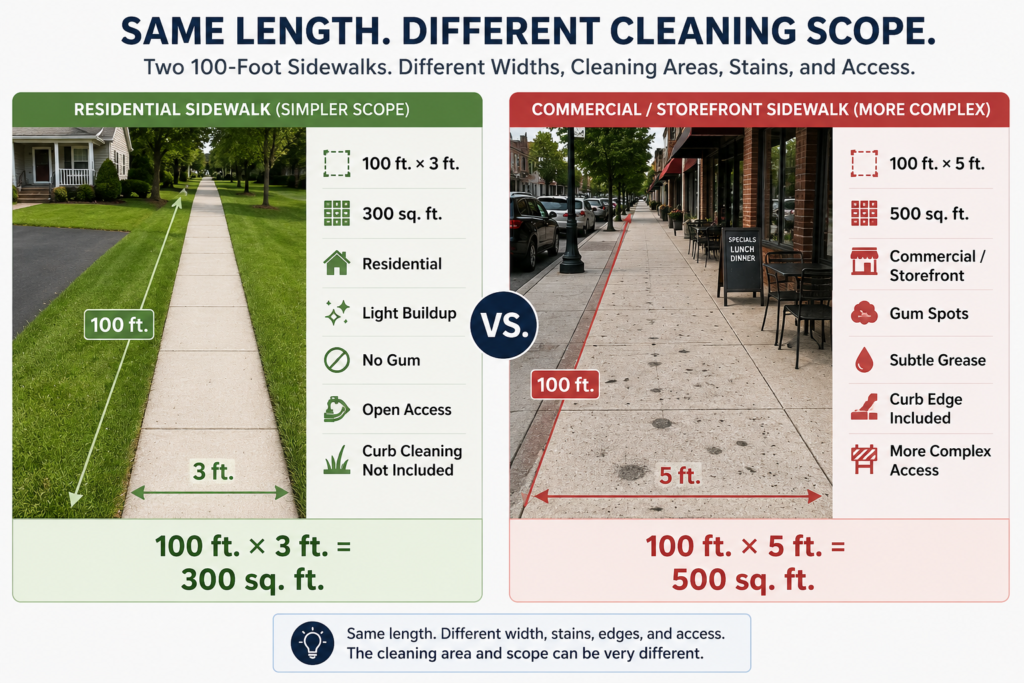
Same Sidewalk Length, Different Cleaning Scope
Consider two hypothetical sidewalks that are both 100 feet long.
Sidewalk A — Simpler Residential Walkway
- 100 ft. long
- 3 ft. wide
- 300 sq. ft.
- residential
- light dirt
- no gum
- no significant grease
- open access
- curb cleaning not included
Sidewalk B — More Complex Storefront Sidewalk
- 100 ft. long
- 5 ft. wide
- 500 sq. ft.
- commercial storefront
- multiple gum spots
- grease near the entrance
- curb face included
- pedestrian restrictions
- more detailed cleaning scope
Both are described as 100-foot sidewalks.
But Sidewalk B contains approximately 67% more flat surface area before gum, stains, curbs, or access requirements are considered.
Same length does not mean the same cleaning job.
DIY vs. Professional Sidewalk Pressure Washing
Concrete sidewalks are among the more practical exterior surfaces for DIY cleaning, but equipment and technique still matter.
Surface cleaners can be useful on larger flat concrete areas because they can produce a more consistent cleaning pattern than working exclusively with a narrow pressure-washer wand.
DIY may make sense when:
- the sidewalk is relatively small,
- buildup is light,
- water access is simple,
- there are few specialty stains,
- and suitable equipment is already available.
Professional cleaning may be more attractive when the project involves:
- large areas,
- extensive gum,
- oil or grease,
- rust,
- commercial foot traffic,
- difficult drainage,
- recurring maintenance,
- or several exterior surfaces during the same visit.
For another common flat-concrete project, see our driveway pressure washing cost guide.
How to Measure a Sidewalk
Use:
Length × average width = square footage
For example:
120 ft. × 4 ft. = 480 sq. ft.
If the sidewalk changes width, divide it into sections.
Example:
Section A
60 × 3 = 180 sq. ft.
Section B
40 × 5 = 200 sq. ft.
Section C
20 × 4 = 80 sq. ft.
Total:
180 + 200 + 80 = 460 sq. ft.
Measure adjoining concrete separately if it is also being cleaned.
Taskrabbit similarly describes walkway measurement using length × width.
Sidewalk Pressure Washing Cost Examples
The following are WashNumbers planning examples, not contractor quotes.
Small 50 Ft. Residential Sidewalk
Dimensions:
50 ft. × 4 ft.
Area:
200 sq. ft.
Baseline calculation:
200 × $0.47 = $94
Because that falls below the modeled minimum charge:
Modeled estimate: $100
100 Ft. × 4 Ft. Sidewalk
Area:
100 × 4 = 400 sq. ft.
Calculation:
400 × $0.47 = $188
Approximate ±20% planning range:
$150–$226
100 Ft. × 5 Ft. Sidewalk With Heavy Buildup
Area:
100 × 5 = 500 sq. ft.
Calculation:
500 × $0.47 × 1.15 = $270.25
Rounded modeled estimate:
about $270
Approximate planning range:
about $216–$324
200 Ft. × 4 Ft. Sidewalk With Difficult Access
Area:
200 × 4 = 800 sq. ft.
Calculation:
800 × $0.47 × 1.10 = $413.60
Rounded modeled estimate:
about $414
Approximate planning range:
about $331–$496
These examples show why sidewalk length alone is not enough to estimate a project accurately.
Estimate Your Sidewalk Pressure Washing Cost
Use the WashNumbers Pressure Washing Cost Calculator to build a broader pressure-washing estimate using project size, surface condition, access, and other variables.
You can also compare:
For contractors evaluating service pricing rather than homeowner project cost, see the Pressure Washing Pricing Calculator.
Frequently Asked Questions
How much does it cost to pressure wash a sidewalk?
Published pressure-washing references vary substantially.
Taskrabbit currently reports approximately $0.08–$0.50 per square foot for pressure washing generally, while Homewyse lists basic concrete pressure washing at approximately $0.42–$0.52 per square foot.
Small standalone sidewalks may also be affected heavily by minimum service charges.
How much does it cost to pressure wash a 100-foot sidewalk?
Length alone is not enough because you also need the sidewalk width.
A 100-foot sidewalk that is 4 feet wide contains:
100 × 4 = 400 sq. ft.
Under the WashNumbers $0.47/sq. ft. planning baseline:
400 × $0.47 = $188
That is a WashNumbers modeling example rather than a measured national average.
How do I calculate sidewalk square footage?
Multiply the sidewalk’s length by its average width.
For example:
100 ft. × 4 ft. = 400 sq. ft.
If width changes along the sidewalk, divide it into sections and add the individual areas together.
Does gum make sidewalk cleaning more expensive?
It can.
Gum often requires targeted treatment rather than only one continuous surface-cleaning pass.
A heavily trafficked storefront with dozens of gum spots can therefore require more labor than a similarly sized residential walkway with ordinary dirt.
Are commercial sidewalks cheaper per square foot?
They can be.
Larger commercial flatwork may achieve lower unit pricing because much more square footage is cleaned during one mobilization.
However, commercial jobs can also involve gum, grease, nighttime scheduling, pedestrian management, water recovery, or other requirements that increase complexity.
Is sidewalk pressure washing the same as driveway pressure washing?
Both frequently involve flat concrete, but the cleaning scope can differ.
Driveways often contain vehicle oil and larger continuous areas, while sidewalks may involve narrower geometry, curb faces, pedestrian traffic, gum, storefront stains, and detailed edge work.
See our driveway pressure washing cost guide for dedicated driveway pricing.
Should curb cleaning be included in sidewalk pressure washing?
Not automatically.
Ask whether the quote includes both the curb top and vertical curb face, especially for commercial properties.
Those surfaces may represent additional work beyond the flat sidewalk square footage.
Sources
- Taskrabbit — How Much Does Pressure Washing Cost?
- Homewyse — Cost to Pressure Wash Concrete
- Housecall Pro — How to Price Pressure Washing Jobs
- Angi — How Much Does It Cost to Pressure Wash a House?
- Angi — How Much Does It Cost to Pressure Wash a Driveway?
- SIMPSON — Pressure Washer FAQs
- SIMPSON — Choosing the Proper Nozzle for the Task at Hand
Work out your own number
Pressure Washing Cost Calculator
Put in your own square footage and surface instead of using an average.
Cost per Square Foot
What the rate should be before anyone quotes you a total.
Minimum Charge Explained
Why a small job costs the same as a slightly bigger one.
The Pricing Dataset
220 published prices with the source behind every figure.
 Written by Diego Hernández, founder of WashNumbers. Cost models are built from published contractor rates and public price observations. See how we build these numbers.
Last reviewed: August 2026