
Professional fence pressure washing commonly costs about $100 to $350 per project, although the final price depends heavily on fence length, height, material, condition, accessibility, and whether one side or both sides need to be cleaned. Angi currently reports a $100–$350 range, while HomeAdvisor lists roughly $150–$300 for many fence-washing projects.
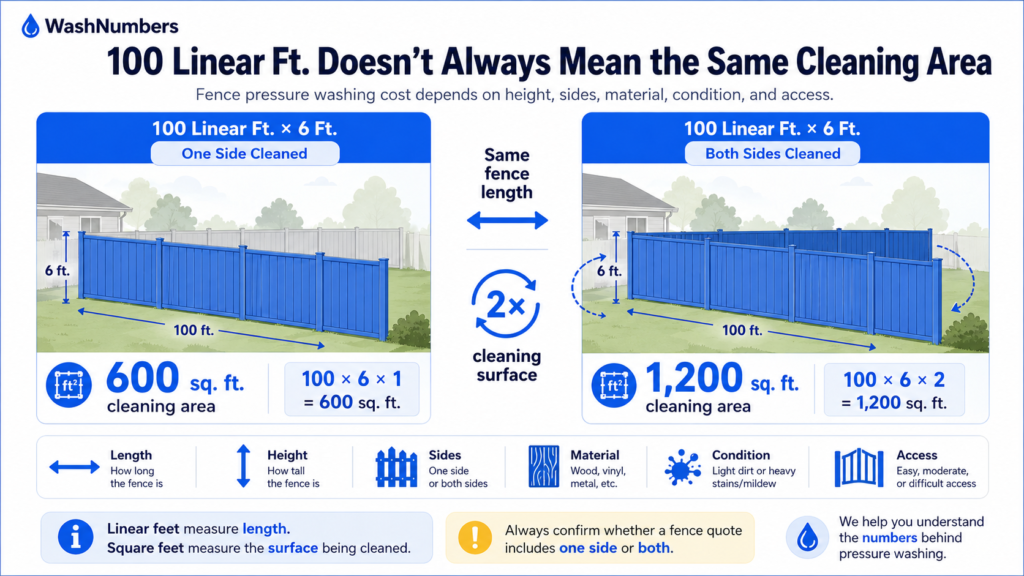
Unlike a driveway or patio, fence size cannot always be understood from linear footage alone. A 100-linear-foot fence that is 6 feet tall contains 600 square feet on one side—but 1,200 square feet if both sides are cleaned.
That distinction can have a major effect on the amount of surface a contractor actually needs to wash.
If you are comparing fence cleaning with other exterior surfaces, see our pressure washing cost per square foot guide.
This guide compares current U.S. pricing references, explains fence washing cost by size and material, converts linear feet into actual cleaning area, and shows why fence height and the number of sides matter when estimating a project.
2026 Fence Pressure Washing Cost at a Glance
Published pricing sources do not produce one universal fence-washing price.
Angi currently reports approximately $100–$350 per project, depending on factors including size, material, and grime buildup. HomeAdvisor gives a typical fence range of approximately $150–$300 and notes that wood fences may cost more because they can take longer to clean. Homewyse approaches the problem differently, currently estimating basic fence power washing at approximately $0.43–$0.53 per square foot under its standard project assumptions.
These figures should be compared rather than blindly averaged because they describe projects using different assumptions.
| Source | Published Fence Washing Cost | Important Context |
|---|---|---|
| Angi | $100–$350 per project | Project pricing varies with fence size, material, and the level of grime buildup. |
| HomeAdvisor | $150–$300 for many fences | Provides a general project range and notes that wood fences can require more time. |
| Homewyse | $0.43–$0.53 per sq. ft. | Basic fence power washing under standard, readily serviceable project assumptions. |
Published sources use different project sizes, scopes, labor assumptions, and pricing methods. These figures are benchmarks, not guaranteed quotes for the same fence.
One reason these figures can differ is measurement.
A contractor quoting by project total may never show the homeowner a square-foot rate. Another contractor may calculate actual fence surface area internally. A third may use linear feet while adjusting for height, material, and whether both sides are included.
That makes understanding the fence dimensions especially important.
Fence Pressure Washing Cost by Size
Fence length by itself does not tell you how much surface needs to be cleaned.
For a solid fence:
Length × height = one-side cleaning area
If both faces are being washed:
Length × height × 2 = both-side cleaning area
For example:
100 linear ft × 6 ft = 600 sq. ft.
Both sides:
100 × 6 × 2 = 1,200 sq. ft.
That is twice as much vertical surface even though the homeowner still owns a “100-foot fence.”
| Fence Length | Height | One Side | Both Sides |
|---|---|---|---|
| 50 linear ft. | 6 ft. | 300 sq. ft. | 600 sq. ft. |
| 100 linear ft. | 6 ft. | 600 sq. ft. | 1,200 sq. ft. |
| 150 linear ft. | 6 ft. | 900 sq. ft. | 1,800 sq. ft. |
| 200 linear ft. | 6 ft. | 1,200 sq. ft. | 2,400 sq. ft. |
This calculation works best for solid privacy-style fences.
Open ornamental fences are different because much of the measured rectangle is empty space. Posts, rails, pickets, lattice, gates, and irregular designs can also make a simple length × height calculation less representative of actual labor.
WashNumbers Fence Washing Cost Model
To make projects easier to compare, WashNumbers uses a transparent planning model.
For this page, the baseline assumptions are:
- Base rate: $0.48 per sq. ft. of cleaning area
- Modeled minimum charge: $100
- Average condition: 1.00×
- Normal access: 1.00×
- Planning range: ±20%
The $0.48 baseline is a WashNumbers modeling assumption selected within the current Homewyse published range of $0.43–$0.53 per square foot. It is not presented as a measured U.S. contractor average.
You can read more about how we separate published market references from WashNumbers assumptions on our methodology page.
WashNumbers formula
Estimated price = max($100, cleaning area × $0.48 × condition factor × access factor)
For a 6-foot fence with average buildup and normal access:
| Fence Size | One Side Area | One Side Model | Both Sides Area | Both Sides Model |
|---|---|---|---|---|
| 50 ft. × 6 ft. | 300 sq. ft. | $144 | 600 sq. ft. | $288 |
| 100 ft. × 6 ft. | 600 sq. ft. | $288 | 1,200 sq. ft. | $576 |
| 150 ft. × 6 ft. | 900 sq. ft. | $432 | 1,800 sq. ft. | $864 |
| 200 ft. × 6 ft. | 1,200 sq. ft. | $576 | 2,400 sq. ft. | $1,152 |
WashNumbers modeling examples assume a solid 6-foot fence, average surface condition, normal access, and the $0.48/sq. ft. baseline. These are planning outputs, not contractor quotes or published national averages.
Notice that the larger both-sides examples can exceed the broad project totals published by some consumer cost guides.
That is exactly why the assumptions matter: 1,200 or 2,400 square feet of actual cleaning area is not necessarily the same project those broad national ranges are describing.
The WashNumbers model is designed to expose that difference rather than hide it.
Fence Pressure Washing Cost per Linear Foot vs. Square Foot
Fence prices are sometimes discussed in linear feet, but linear footage measures only length.
Square footage incorporates height.
Consider two fences that are both 100 linear feet long:
- 100 ft. × 4 ft. = 400 sq. ft. per side
- 100 ft. × 8 ft. = 800 sq. ft. per side
They have identical linear footage, but one contains twice as much vertical surface.
This is why converting fence measurements to square footage can create a more useful comparison when the fence is solid.
Converting a Square-Foot Rate to an Effective Linear-Foot Rate
Under the WashNumbers $0.48/sq. ft. baseline:
A 6-foot fence cleaned on one side:
6 × $0.48 = $2.88 per linear ft.
Cleaning both sides:
6 × 2 × $0.48 = $5.76 per linear ft.
Those are mathematical conversions of the WashNumbers model, not published contractor market averages.
A contractor may use a different method and may not double the total price when cleaning two sides because travel, setup, and some other fixed costs do not double.
Does Fence Pressure Washing Include One Side or Both Sides?
Do not assume that a fence-washing quote includes both faces.
This is one of the most important questions to clarify before comparing estimates.
Homewyse’s fence-related work specifications explicitly describe pressure washing and rinsing one side of the fence surface in some costing scenarios, demonstrating why the number of faces is an important scope assumption.
For a 100-foot-long, 6-foot-high privacy fence:
One side:
100 × 6 = 600 sq. ft.
Both sides:
100 × 6 × 2 = 1,200 sq. ft.
The cleaning area doubles.
The contractor’s final quote does not have to double exactly because mobilization and setup are already covered, but comparing two quotes without knowing whether they cover one or both sides can be misleading.
This will also be the main concept behind the infographic for this page.
How Fence Height Changes Cleaning Area
Height can matter as much as length.
A homeowner may describe both of the following as a “100-foot fence,” yet they have very different amounts of surface.
| Fence Height | One Side Area | Both Sides Area | Relative Surface Area |
|---|---|---|---|
| 4 ft. | 400 sq. ft. | 800 sq. ft. | Baseline |
| 6 ft. | 600 sq. ft. | 1,200 sq. ft. | 50% more than 4 ft. |
| 8 ft. | 800 sq. ft. | 1,600 sq. ft. | 100% more than 4 ft. |
An 8-foot privacy fence has twice the rectangular surface area of a 4-foot fence of the same length.
Height may also affect working position, reach, and how easily the contractor can clean the upper portion of the fence.
Fence Pressure Washing Cost by Material
Fence material affects the appropriate cleaning technique and can influence the amount of time required.
Angi notes that softer woods require gentler pressure and may require more passes than some harder materials. HomeAdvisor also notes that wood fences may cost more because they can take longer.
WashNumbers does not assign an invented universal material multiplier because the condition of the specific fence is more important than the material name alone.
| Fence Material | Cleaning Consideration | Potential Scope Impact |
|---|---|---|
| Wood | Age, softness, grain condition, stain or sealer, and organic buildup can affect the safe cleaning method. | May require a gentler approach and additional time. |
| Vinyl | Often has a smooth surface but can develop algae, mildew, dirt, and discoloration. | Cleaning can be straightforward, but inappropriate pressure can still cause damage. |
| Composite | Manufacturer-specific cleaning requirements should be considered. | Technique may differ from traditional wood fencing. |
| Metal / Aluminum | Open ornamental designs contain less continuous surface than a solid privacy fence. | Square-foot rectangle calculations may overstate the actual surface being cleaned. |
Wood Fence Pressure Washing Cost
Wood requires more caution than simply applying the strongest available pressure.
Lowe’s recommends a wide-fan spray pattern when pressure washing wood decks and fences to help reduce the risk of damage. It also recommends removing obstacles, protecting nearby plants and electrical components, and checking equipment guidance before cleaning.
The condition of a wood fence can affect the scope significantly.
Potential factors include:
- soft or weathered wood,
- peeling stain,
- old sealer,
- algae or mildew,
- gray oxidation,
- loose fibers,
- damaged boards,
- and preparation for future staining.
A heavily weathered fence may therefore require a different approach from relatively new wood with only surface dirt.
Lowe’s also recommends protecting wood after cleaning with paint, stain, or sealer where appropriate.
For another wood exterior surface, see our deck pressure washing cost guide.
Vinyl Fence Pressure Washing Cost
Vinyl is low-maintenance compared with wood, but it still accumulates dirt and organic growth.
Lowe’s describes vinyl as a material that generally requires only periodic cleaning and recommends starting conservatively when using a pressure washer rather than immediately applying maximum pressure.
A relatively clean white vinyl privacy fence with open access can be straightforward.
A fence covered with algae behind thick landscaping may require substantially more preparation and treatment even though the material is the same.
Metal and Aluminum Fence Cleaning
An ornamental aluminum or metal fence creates a measurement challenge.
Imagine a 100-foot-long, 4-foot-tall fence.
The rectangular dimensions equal:
400 sq. ft.
But unlike a solid wood or vinyl privacy fence, much of that rectangle may consist of open air between pickets.
That means a simple length × height calculation can overstate the physical surface area.
At the same time, multiple narrow rails, posts, pickets, and decorative details can still require significant hands-on cleaning.
For open fence designs, labor complexity may be more informative than rectangular square footage alone.
How Fence Condition Changes Pressure Washing Cost
A fence with light dust is not the same cleaning job as one covered in years of organic buildup.
For planning purposes, WashNumbers currently uses:
- Light buildup: 0.90×
- Average buildup: 1.00×
- Heavy buildup: 1.15×
These are WashNumbers model assumptions, not published contractor averages.
For a 100 ft. × 6 ft. fence cleaned on one side:
Baseline area:
600 sq. ft.
Baseline estimate:
600 × $0.48 = $288
Light:
$288 × 0.90 = $259
Average:
$288 × 1.00 = $288
Heavy:
$288 × 1.15 = $331
Condition may reflect dirt, algae, mildew, moss, biological staining, and other buildup that requires more than a simple rinse.
How Access Affects Fence Washing Cost
Fence access can vary dramatically around the same property.
WashNumbers models:
- Easy access: 0.95×
- Normal access: 1.00×
- Difficult access: 1.10×
These are again planning assumptions.
Potential access complications include:
- dense bushes against the fence,
- narrow side yards,
- pools,
- sheds,
- steep slopes,
- retaining walls,
- limited gate access,
- long hose runs,
- neighboring property access,
- and landscaping that must be protected.
Both sides may technically be visible, but that does not mean both sides are equally accessible.
Other Factors That Affect Fence Pressure Washing Prices
Gates and Decorative Features
Gates, lattice tops, decorative posts, caps, and intricate sections can add detail work that simple square-foot measurements do not capture well.
Landscaping
Bushes and plants may need to be protected or worked around.
Lowe’s specifically recommends covering nearby plants and removing obstacles before pressure washing decks and fences.
Terrain
A fence along a flat driveway edge is very different from one running down a steep backyard slope.
Terrain can affect equipment placement and operator movement.
Existing Paint, Stain, or Sealer
The purpose of the wash matters.
A maintenance clean is not necessarily the same service as preparing weathered wood for refinishing.
Bundled Exterior Cleaning
Fence cleaning may sometimes be added while a contractor is already onsite for a driveway, house, patio, or deck.
Because some travel and setup are already covered, bundled pricing may not match the cost of booking the fence as a completely separate visit.
For whole-property planning, use the WashNumbers Pressure Washing Cost Calculator.
Fence Washing Before Staining or Sealing
Cleaning is often part of preparing a wood fence for a new finish.
Lowe’s recommends cleaning a wood fence before painting, staining, or sealing it, while Homewyse treats fence staining as a separate service from power washing.
That distinction matters when comparing quotes.
A quote may cover:
Cleaning only
or:
Cleaning + drying/preparation + staining/sealing
Those should not be treated as equivalent services.
Angi currently notes post-wash sealing as a meaningful additional expense in its fence-cost guidance rather than part of the base wash itself.
Ask exactly what is included before comparing totals.
DIY vs. Professional Fence Pressure Washing
DIY pressure washing can make sense for a fence in good condition when the homeowner understands the material and has suitable equipment.
However, more pressure is not automatically better.
Lowe’s recommends using an appropriate wide-fan spray on wood fencing and following the pressure washer manufacturer’s guidance to reduce the risk of damaging the surface.
DIY risk increases when the fence has:
- old or soft wood,
- damaged boards,
- peeling finish,
- delicate decorative components,
- difficult access,
- significant biological growth,
- or preparation requirements for staining.
Professional cleaning may make more sense when damage from an incorrect technique could cost more than the cleaning itself.
How to Measure a Fence for Pressure Washing
Start by measuring the linear length of each section.
Then measure height.
For a solid fence:
One side
Length × height = cleaning area
Both sides
Length × height × 2 = cleaning area
Example
Fence:
125 ft. long × 6 ft. high
One side:
125 × 6 = 750 sq. ft.
Both sides:
125 × 6 × 2 = 1,500 sq. ft.
If your fence contains several different heights, measure each section separately.
Example:
- 75 ft. × 6 ft. = 450 sq. ft.
- 25 ft. × 4 ft. = 100 sq. ft.
- Total one-side area = 550 sq. ft.
Then double the appropriate sections if both sides will be cleaned.
Do not assume a solid rectangular measurement accurately represents open ornamental fencing.
Fence Pressure Washing Cost Examples
The following are WashNumbers modeling examples, not contractor quotes.
Example 1 — 50 Ft. × 6 Ft. Fence, One Side
Cleaning area:
50 × 6 = 300 sq. ft.
Model:
300 × $0.48 = $144
Approximate ±20% planning range:
$115–$173
Example 2 — 100 Ft. × 6 Ft. Fence, One Side
Cleaning area:
100 × 6 = 600 sq. ft.
Model:
600 × $0.48 = $288
Approximate planning range:
$230–$346
Example 3 — Same 100 Ft. Fence, Both Sides
Cleaning area:
100 × 6 × 2 = 1,200 sq. ft.
Model:
1,200 × $0.48 = $576
Approximate planning range:
$461–$691
The fence is still 100 linear feet long, but the modeled cleaning area doubles.
Example 4 — 100 Ft. × 6 Ft., Both Sides, Heavy Buildup and Difficult Access
Base area:
1,200 sq. ft.
Formula:
1,200 × $0.48 × 1.15 × 1.10
Modeled estimate:
about $729
Approximate ±20% planning range:
about $583–$875
This example illustrates why a simple “price per linear foot” cannot capture every fence project.
Estimate Your Fence Pressure Washing Cost
Use the WashNumbers Pressure Washing Cost Calculator to build a broader exterior-cleaning estimate using project variables instead of relying on one national average.
Contractors evaluating their own pricing can also use the Pressure Washing Pricing Calculator.
For comparisons with other surfaces, see:
Driveway Pressure Washing Cost
Frequently Asked Questions
How much does it cost to pressure wash a fence?
Published estimates vary. Angi currently reports approximately $100–$350 depending on factors including fence size, material, and buildup, while HomeAdvisor gives approximately $150–$300 for many fence projects. Homewyse currently starts around $0.43–$0.53 per square foot for basic fence power washing.
The actual quote can vary significantly depending on dimensions, condition, accessibility, and whether one or both sides are included.
How much does it cost to pressure wash 100 feet of fence?
Linear footage alone is not enough to calculate the cleaning area.
A 100-foot-long fence that is 6 feet high contains 600 square feet on one side and 1,200 square feet on both sides.
Under the WashNumbers $0.48/sq. ft. planning model, that produces approximately $288 for one side or $576 for both sides before condition and access adjustments.
These are modeling examples, not national averages.
Is fence pressure washing priced per square foot or linear foot?
Either method may be used, depending on the contractor.
Square feet can be more descriptive for solid fences because it accounts for fence height. Linear feet only describe length.
Do you count both sides of a fence?
If both sides are being cleaned, both surfaces should be accounted for when estimating actual cleaning area.
A 100 ft. × 6 ft. fence contains 600 sq. ft. per side and 1,200 sq. ft. across both sides.
Always confirm whether a contractor quote includes one side or both.
Does fence height affect pressure washing cost?
It can.
A taller fence contains more surface area. A 100-foot-long, 8-foot-high solid fence has twice the rectangular surface area of a 100-foot-long, 4-foot-high fence.
Height may also change reach and working conditions.
Does a wood fence cost more to pressure wash?
It can, but material alone does not determine price.
HomeAdvisor notes that wood fencing may cost more because it can require additional time, while Angi notes that softer wood requires gentler treatment.
Condition, existing finish, accessibility, and whether the fence is being prepared for staining can all matter.
Is pressure washing safe for wood fences?
It can be when the material is suitable and the correct technique is used.
Lowe’s recommends an appropriate wide-fan spray for wood deck and fence cleaning to reduce the risk of surface damage.
Old, soft, deteriorated, or damaged wood deserves particular caution.
Should I pressure wash my fence before staining?
Cleaning is commonly part of preparation before refinishing a wood fence. Lowe’s recommends cleaning before applying paint, stain, or sealer.
Drying and surface preparation requirements should also be followed before applying the selected finish.
Sources
- Angi — How Much Does It Cost to Pressure Wash a Fence?
- Homewyse — Cost to Power Wash Fence
- HomeAdvisor — Pressure Washing Cost by Exterior Surface
- Lowe’s — Washing a Deck or Fence With a Pressure Washer
- Lowe’s — 5 Ways to Clean a Wood Fence
- Lowe’s — How to Clean a Vinyl Fence
Work out your own number
Pressure Washing Cost Calculator
Put in your own square footage and surface instead of using an average.
Cost per Square Foot
What the rate should be before anyone quotes you a total.
Minimum Charge Explained
Why a small job costs the same as a slightly bigger one.
The Pricing Dataset
220 published prices with the source behind every figure.
 Written by Diego Hernández, founder of WashNumbers. Cost models are built from published contractor rates and public price observations. See how we build these numbers.
Last reviewed: August 2026