
Parking lot pressure washing cost commonly falls around $0.08 to $0.25 per square foot in published 2026 pricing guidance. Some contractors instead quote approximately $8 to $20 per marked space. A full-lot bid can move outside those ranges when it includes oil or gum treatment, traffic phasing, drain protection, wastewater recovery, or other site-specific work.
Use the calculator below for an open-air asphalt, concrete, or mixed-surface parking lot. It applies visible WashNumbers assumptions to the cleanable area, surface condition, site access, wash-water plan, and frequency. The result is an independent planning estimate—not a contractor quote or a determination of local environmental requirements.
Parking Lot Pressure Washing Cost Calculator
Estimate an open-air parking lot cleaning budget from measured square footage, paving type, contamination, access, wash-water requirements, and service frequency. Optional space count is used only to compare the result with per-space bids.
2 Planning estimate
Typical modeled estimate
$1,640
per one-time visit
Why this estimate looks like this
- Starting paving rate$0.10 / sq. ft.
- Lot-volume factor0.82×
- Condition factor1.00×
- Access factor1.00×
- Wash-water factor1.00×
- Frequency factor1.00×
- Modeled minimum charge$250
This deterministic calculator uses WashNumbers assumptions and a ±25% planning band. It does not determine legal wastewater requirements or guarantee stain removal. Local labor, water access, drainage, contamination, traffic control, equipment, and bid scope can materially change a quote. Review the WashNumbers methodology before relying on the result.
How Much Does It Cost to Pressure Wash a Parking Lot?
A useful national planning range is approximately $0.08 to $0.25 per square foot for parking lot pressure washing, but there is no single rate that applies to every property. A large, vacant lot with light traffic film can be efficient to clean. The same square footage divided into occupied zones, covered in oil spots, or requiring full wash-water recovery can be a materially different job.
Published pricing also uses different units. Housecall Pro’s 2026 pressure-washing pricing guide lists parking lot cleaning at $0.08 to $0.25 per square foot. HomeGuide’s commercial pressure washing guide reports $8 to $20 per parking space and $0.10 to $0.25 per square foot for parking garages. These are published reference ranges, not guaranteed local prices.
This page is intentionally narrower than the commercial pressure washing cost calculator. The commercial tool compares many facility surfaces. This calculator focuses on open-air parking lots and includes paving type, vehicle phasing, marked-space comparison, and three levels of wash-water planning.
| Reference | Published Range | Pricing Unit | Interpretation |
|---|---|---|---|
| Housecall Pro, 2026 | $0.08–$0.25 | Per square foot | Parking lot cleaning; site variables still affect the bid |
| HomeGuide, 2026 | $8–$20 | Per marked space | Confirm whether aisles, curbs, stains, and other areas are included |
| HomeGuide, 2026 | $0.10–$0.25 | Per garage sq. ft. | Parking garages are a separate operating environment |
Do not combine these ranges mechanically. A per-space quote may cover only stalls or may use the number of stalls as a convenient unit for an entire lot. A square-foot quote may include every drive aisle and turning area. Compare the measured scope, not just the unit.
Parking Lot Pressure Washing Cost per Square Foot
Square-foot pricing is usually the clearest starting point for an open parking lot because the cleanable pavement can be measured. The calculator uses three documented starting rates: $0.10 for asphalt, $0.12 for concrete, and $0.13 for a mixed surface or a layout with many curbs and islands. These are WashNumbers modeling inputs selected within current commercial pricing references; they are not claimed contractor averages.
The starting rate is only the first step. The effective modeled rate can fall below it when a large, uniform area receives a volume factor, or rise above it when contamination, access, recovery, or scheduling add complexity. For a general explanation of unit pricing, see the guide to pressure washing cost per square foot.
After applying the factors, the calculator compares the result with a $250 modeled minimum and rounds upward to the next $10. The displayed low and high estimates form a planning band of approximately 25% below and above the typical result. A site-specific quote can still fall outside that band.
Transparent Calculator Assumptions
Every calculator choice has a visible factor. That makes the output reproducible: identical inputs produce identical results, and users can see why the estimate changes.
| Model Component | Selection | Factor or Rate | What It Represents |
|---|---|---|---|
| Paving type | Asphalt | $0.10/sq. ft. | Modeled open-lot starting rate |
| Paving type | Concrete | $0.12/sq. ft. | Modeled concrete starting rate |
| Paving type | Mixed surface or many curbs / islands | $0.13/sq. ft. | Additional modeled edging and transitions |
| Lot volume | Under 5,000 sq. ft. | 1.00× | No modeled volume reduction |
| Lot volume | 5,000–14,999 sq. ft. | 0.90× | Moderate large-area efficiency |
| Lot volume | 15,000–49,999 sq. ft. | 0.82× | Higher modeled production efficiency |
| Lot volume | 50,000+ sq. ft. | 0.75× | Highest modeled volume reduction |
| Condition | Routine maintenance / light soil | 0.85× | Limited buildup and predictable cleaning |
| Condition | Average dirt and traffic film | 1.00× | Baseline parking-lot condition |
| Condition | Heavy buildup or tire marks | 1.25× | More treatment, dwell time, or passes |
| Condition | Oil, grease, gum, or intensive spot treatment | 1.50× | Slower specialty treatment; removal is not guaranteed |
| Access | Vacant lot / closed work zone | 1.00× | Unrestricted baseline access |
| Access | After-hours, but clear access | 1.08× | Off-hours coordination without vehicle phasing |
| Access | Phased around vehicles or customer traffic | 1.15× | Barriers, pauses, and multiple work zones |
| Access | Obstructed, multi-zone, or security coordination | 1.25× | Highest modeled operating complexity |
| Wash-water plan | Existing compliant site plan | 1.00× | Baseline setup; not a legal determination |
| Wash-water plan | Drain protection plus collection setup | 1.15× | Added containment and collection complexity |
| Wash-water plan | Full recovery, holding, or off-site handling | 1.30× | Higher planning complexity; exact disposal fees are not itemized |
| Frequency | One-time service | 1.00× | No recurring-service reduction |
| Frequency | Twice per year | 0.97× | 3% modeled per-visit reduction |
| Frequency | Quarterly | 0.92× | 8% modeled per-visit reduction |
| Frequency | Monthly or more often | 0.85× | 15% modeled per-visit reduction |
The factors are modeling decisions, not industry rules. They are designed to show direction and relative impact without pretending to know a contractor’s crew speed, overhead, equipment, local labor market, or profit target. Contractors building an actual selling price should use the pressure washing pricing calculator with their own business inputs.
Estimated Cost by Parking Lot Size
The following examples hold every variable constant except square footage: asphalt, average dirt and traffic film, a vacant work zone, an existing compliant wash-water plan, and one-time service. This isolates the model’s volume effect.
| Cleanable Area | Volume Factor | Typical Estimate | Effective Modeled Rate |
|---|---|---|---|
| 1,000 sq. ft. | 1.00× | $250 minimum | $0.25/sq. ft. |
| 5,000 sq. ft. | 0.90× | $450 | $0.09/sq. ft. |
| 10,000 sq. ft. | 0.90× | $900 | $0.09/sq. ft. |
| 20,000 sq. ft. | 0.82× | $1,640 | $0.08/sq. ft. |
| 50,000 sq. ft. | 0.75× | $3,750 | $0.08/sq. ft. |
| 100,000 sq. ft. | 0.75× | $7,500 | $0.08/sq. ft. |
Boundary effect: The model changes factors at 5,000, 15,000, and 50,000 square feet. Real contractors do not necessarily use these thresholds, and a quote should not be expected to fall abruptly at the same points.
Parking Lot Cleaning Cost Examples
These examples use the calculator exactly as configured in August 2026. They demonstrate how scope changes the output; they are not accepted bids or surveyed contractor averages.
| Example Lot | Selected Scope | Typical Estimate | Planning Range |
|---|---|---|---|
| 5,000 sq. ft. asphalt lot | Light soil, vacant work zone, existing compliant site plan | $390 | $290–$490 |
| 20,000 sq. ft. asphalt lot | Average condition, vacant work zone, existing compliant site plan | $1,640 | $1,230–$2,050 |
| 40,000 sq. ft. concrete lot | Heavy buildup, phased traffic, drain protection and collection | $6,510 | $4,880–$8,140 |
Cost per Parking Space vs. Cost per Square Foot
A per-space price is convenient when a property manager knows the stall count but not the pavement area. It is not automatically comparable with a per-square-foot price. A typical marked stall occupies only part of the lot; drive aisles, turning areas, fire lanes, islands, curbs, loading zones, and unmarked pavement may also be cleaned.
The calculator therefore uses square footage to determine the estimate. If you enter the number of marked spaces, it divides the modeled total by that count and shows an equivalent per-space cost. The marked-space input never changes the total.
For example, the standard 20,000-square-foot asphalt scenario produces $1,640. If the lot has 80 marked spaces, the equivalent is $20.50 per space. That does not mean each stall costs $20.50 to wash independently; it allocates the price of the complete measured scope across 80 spaces.
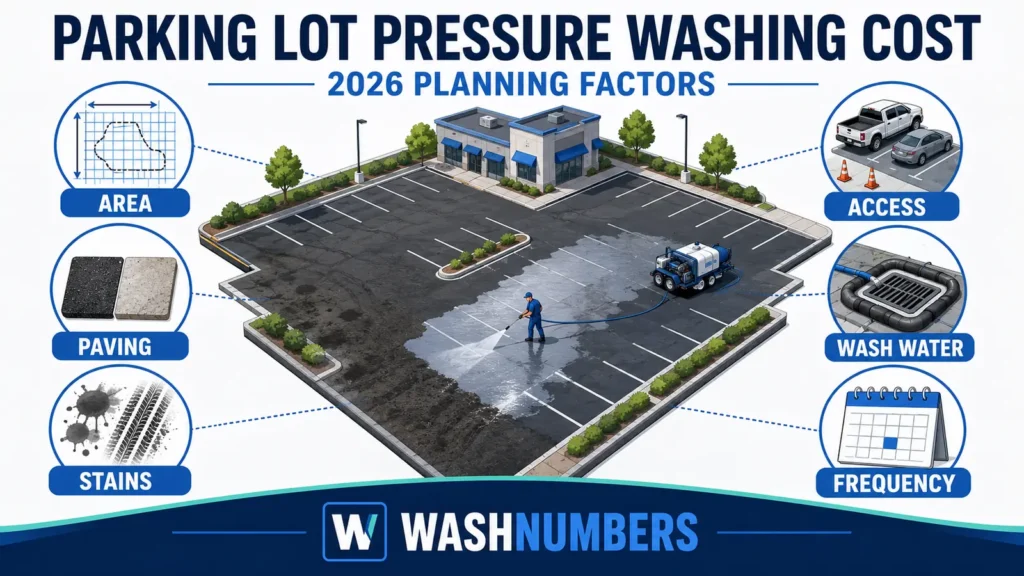
What Changes a Parking Lot Pressure Washing Price?
Measured Cleaning Area
Measure the pavement actually being washed, not the parcel size and not the building footprint. Satellite measurement can establish a preliminary area, but trees, canopies, islands, landscaping, excluded zones, and distorted imagery can affect the result. A contractor’s site walk should resolve the final boundaries.
Asphalt, Concrete, and Mixed Layouts
Paving material, age, coating, repairs, striping, surface condition, and edge complexity can change the cleaning method and production rate. Weathered asphalt or a recently sealed surface may require a more conservative approach. Concrete may reveal embedded oil and tire marks differently. Mixed lots with curbs and islands create more edges and transitions than a broad uninterrupted field.
The calculator’s material rates are simplified planning choices. They do not evaluate pavement strength, sealer condition, paint adhesion, drainage slope, or the suitability of a particular pressure, temperature, chemical, or surface cleaner.
Oil, Grease, Gum, Tire Marks, and Organic Growth
Loose dirt and traffic film are not equivalent to petroleum stains, restaurant grease, chewing gum, algae, rust, paint, or unknown residue. Treatment may require dry absorbents, degreaser, hot water, dwell time, agitation, spot work, repeated passes, or specialized disposal. A few isolated spots should be documented separately from full-lot contamination.
Ask the contractor to define the completion standard. “Pressure wash the lot” does not necessarily mean every historical stain will disappear. Deep oil can remain as a shadow after responsible cleaning, and aggressive treatment can be inappropriate for a weak or coated surface.
Vehicles, Customers, Deliveries, and Security
A fully vacant lot allows long, uninterrupted passes. An occupied retail, medical, apartment, school, or industrial property may require barriers, spotters, notices, temporary closures, drying time, multiple mobilizations, or section-by-section work. After-hours access can reduce customer conflict but still add scheduling and coordination.
Water Source and Wash-Water Management
Long hose runs, limited water supply, hydrant permissions, tank refills, low flow, drain locations, slopes, and collection points can affect production. The calculator separates an existing compliant site plan, drain protection plus collection, and full recovery or off-site handling. These choices represent planning complexity, not exact legal or disposal fees.
One-Time vs. Recurring Service
Recurring maintenance can create more predictable conditions and scheduling, so the model reduces the per-visit result by 3% for twice-yearly service, 8% for quarterly service, and 15% for monthly service. Annual cost still rises with the number of visits, which is why the calculator displays the annual total separately.
Parking Lot Sweeping vs. Pressure Washing
Sweeping
Removes loose litter, leaves, sand, sediment, and dry debris. It is usually the appropriate first step and may be enough for routine debris control.
Pressure washing
Uses water and, when appropriate, cleaning agents or heat to address adhered dirt, traffic film, organic buildup, and selected stains.
Sweeping and washing solve different problems. The City of Lawrence’s July 2026 mobile-cleaning BMP guide recommends considering dry methods first and sweeping or vacuuming trash, debris, and sediment before wet washing. Dry pre-cleaning can reduce the material that must be captured in wash water.
Confirm whether sweeping is included in a pressure-washing quote. Heavy debris removal, litter pickup, leaf loading, mechanical sweeping, catch-basin cleaning, and post-wash vacuuming may be separate services.
Will Pressure Washing Remove Parking Lot Oil Stains?
Pressure washing can improve many oil spots, especially when the scope includes appropriate pre-treatment, but complete removal is not guaranteed. Results depend on stain age, petroleum type, pavement porosity, sealer, previous treatment, temperature, chemistry, and the level of surface damage already present.
A good quote distinguishes among:
- Routine full-lot washing for dirt and traffic film
- A defined number or area of oil and grease spots
- Hot-water or detergent treatment
- Absorbent use and dry recovery before washing
- Expected improvement rather than a blanket removal guarantee
- Hazardous or unknown material requiring separate assessment
Scope warning: The calculator’s intensive condition factor models added effort. It does not certify that contamination is non-hazardous, select a chemical, determine disposal requirements, or promise a visual outcome.
Parking Lot Wash Water and Storm Drains
Parking-lot wash water can carry sediment, oil, grease, metals, cleaning compounds, and other pollutants. Requirements vary by city, wastewater authority, property, contaminants, and proposed disposal method. Never assume that water may enter a storm drain simply because the cleaning product is labeled biodegradable.
As one official example, the City of Sugar Land’s pressure-washing guidance states that pressure-washing wastewater discharge to storm drains is prohibited and that commercial operators should contact the city for disposal details. The City of Lawrence’s 2026 guide likewise instructs operators to locate storm drains, plan controls and collection, obtain permissions, and identify the disposal location before washing.
Common planning items can include dry pre-cleaning, drain covers, berms, vacuum pumps, holding tanks, oil-water separation, sanitary-sewer authorization, pretreatment, hauling, and disposal. Which measures are required is a site-specific regulatory question. Obtain instructions from the relevant local stormwater and wastewater authorities before finalizing the work.
Open Parking Lot vs. Parking Garage Cleaning
This calculator is for open-air parking lots. A garage or parking deck can add ventilation, level-by-level staging, ramps, low clearances, enclosed drainage, vertical surfaces, lighting, pedestrian routing, elevator areas, fire-safety coordination, and longer hose or recovery runs. Those differences make a garage a separate scope even when the floor area is similar.
For an enclosed or multi-level parking structure, use the parking garage cleaning cost calculator . It accounts for ramps, columns, low clearances, restricted access, ancillary surfaces, phased closures, and garage-specific wash-water and safety planning.
How to Compare Parking Lot Cleaning Quotes
Request written bids against the same specification. A low total may exclude stain treatment, sweeping, water recovery, after-hours phasing, curbs, or post-cleaning pickup. A higher total may include a materially broader scope.
- Measured cleanable square footage and site map
- Areas included and excluded from the price
- Asphalt, concrete, coatings, repairs, and test areas
- Dry sweeping and debris disposal
- Oil, grease, gum, tire-mark, or spot-treatment allowance
- Water source, hose distance, and refill plan
- Drain protection, collection, and disposal responsibility
- Vehicle removal, barriers, notices, and work phases
- Working hours, noise limits, security, and tenant access
- Completion standard and re-treatment policy
- Striping, sealing, repairs, and other excluded services
- Insurance and relevant commercial-lot experience
Ask each bidder for the total, effective price per measured square foot, and any allowances or unit prices for unpredictable spot treatment. That structure makes scope changes easier to understand.
What the Calculator Does Not Include
The calculator is an early-stage U.S. budget tool. Unless captured indirectly by a selected factor, the output does not itemize:
- ZIP-code-specific labor, fuel, insurance, taxes, permits, or market conditions
- Water purchase, hydrant meters, tank filling, or long-distance mobilization
- Wastewater testing, pretreatment, laboratory work, hauling, or disposal fees
- Traffic-control personnel, police details, security, towing, or tenant notices
- Mechanical sweeping, catch-basin cleaning, litter loading, or hazardous waste
- Graffiti, paint, rust, battery acid, fuel spills, or unknown contamination
- Repairs, sealing, crack filling, striping, wheel stops, curbs, or landscaping
- Parking garages, covered decks, loading docks, drive-thru lanes, or dumpster pads
- Emergency response, snow or ice removal, or work split across multiple properties
For a smaller residential comparison, see the driveway pressure washing cost guide. Pedestrian concrete should be estimated with the sidewalk pressure washing cost guide because gum, foot traffic, edges, and public access create a different scope.
Parking Lot Pressure Washing Cost FAQs
What is the average parking lot pressure washing cost per square foot?
Published 2026 guidance places parking lot cleaning around $0.08 to $0.25 per square foot. The applicable rate depends on total area, material, contamination, traffic, water access, recovery requirements, frequency, and location. Treat the range as market context rather than a local quote.
How much does it cost to pressure wash a 20,000-square-foot parking lot?
The WashNumbers model estimates $1,640 for 20,000 square feet of asphalt with average traffic film, a vacant work zone, an existing compliant wash-water plan, and one-time service. The displayed planning range is $1,230 to $2,050. Changing the material or scope changes the result.
How much does parking lot cleaning cost per space?
HomeGuide reports a published range of about $8 to $20 per marked space. Confirm what that unit includes because stalls are only part of a full parking lot. The calculator can show the equivalent cost per marked space after it calculates the measured square-foot scope.
Is parking lot sweeping included?
Not automatically. The calculator does not separately price mechanical sweeping, litter collection, leaf loading, sediment disposal, or catch-basin cleaning. Ask whether dry pre-cleaning and post-wash debris removal are included in the contractor’s written scope.
Does pressure washing remove all oil stains?
No result should be assumed. Pre-treatment and appropriate methods can improve many spots, but old or deep petroleum staining may remain visible. Ask the contractor to define the included number or area of spots, treatment method, exclusions, and expected completion standard.
Does the estimate include wastewater recovery?
The calculator includes selectable planning factors for drain protection plus collection and for full recovery or off-site handling. It does not determine what the law requires or itemize permits, testing, treatment, hauling, or disposal. Verify requirements with local authorities.
Does recurring parking lot washing cost less?
It can cost less per visit when buildup, scope, and scheduling become predictable. WashNumbers models a 3% per-visit reduction for twice-yearly service, 8% for quarterly service, and 15% for monthly service. Those are transparent assumptions, not guaranteed contract discounts.
Can a contractor use this calculator to set a quote?
It can provide market context, but it does not know the contractor’s labor burden, production rate, chemicals, equipment, overhead, payment fees, risk, or target margin. A profitable quote should be built from the contractor’s actual costs and scope.
Methodology and Final Use
The parking lot calculator is deterministic, not an AI-generated local estimate. Its starting rates sit within published commercial ranges, and every WashNumbers adjustment is disclosed above. The same input values always produce the same result.
Use the output to establish an initial budget, normalize bids to a common unit, and identify missing scope questions. Review the complete WashNumbers methodology, then obtain a written site-specific proposal before authorizing work.
Pricing references and calculator assumptions reviewed August 2026. WashNumbers provides independent educational planning tools and does not provide contractor quotes, pavement engineering, environmental compliance, legal, tax, or financial advice.
Parking lots are one piece of a bigger picture. Commercial pricing explained in full covers how the whole property gets quoted.
Work out your own number
Pressure Washing Cost Calculator
Put in your own square footage and surface instead of using an average.
Cost per Square Foot
What the rate should be before anyone quotes you a total.
Minimum Charge Explained
Why a small job costs the same as a slightly bigger one.
The Pricing Dataset
220 published prices with the source behind every figure.
 Written by Diego Hernández, founder of WashNumbers. Cost models are built from published contractor rates and public price observations. See how we build these numbers.
Last reviewed: August 2026