
A pressure washing minimum charge is the lowest amount a contractor will accept for a service visit, even when a simple square-foot calculation produces a smaller number. Published figures are not uniform: Housecall Pro’s March 2026 business-pricing guide says many pressure-washing businesses set minimums between $100 and $250 depending on local overhead, while HomeGuide’s June 2026 driveway guide describes a $75 to $150 minimum for small driveway jobs.
WashNumbers uses a $100 default floor in its current residential planning models. That figure is an editable modeling assumption—not a claimed national average and not a recommendation for what every contractor should charge. Use the calculator below to see whether an entered minimum changes an area-based estimate and how it affects the effective cost per square foot.
Pressure Washing Minimum Charge at a Glance
- Housecall Pro says many pressure-washing businesses set minimums of $100 to $250, depending on local overhead.
- HomeGuide’s 2026 driveway guide reports a $75 to $150 minimum service charge for small driveways.
- HomeGuide’s brick-patio guide states that many companies have a $100-or-more minimum in that specific context.
- WashNumbers uses a transparent $100 default in its residential planning calculators, but the field on this page is editable.
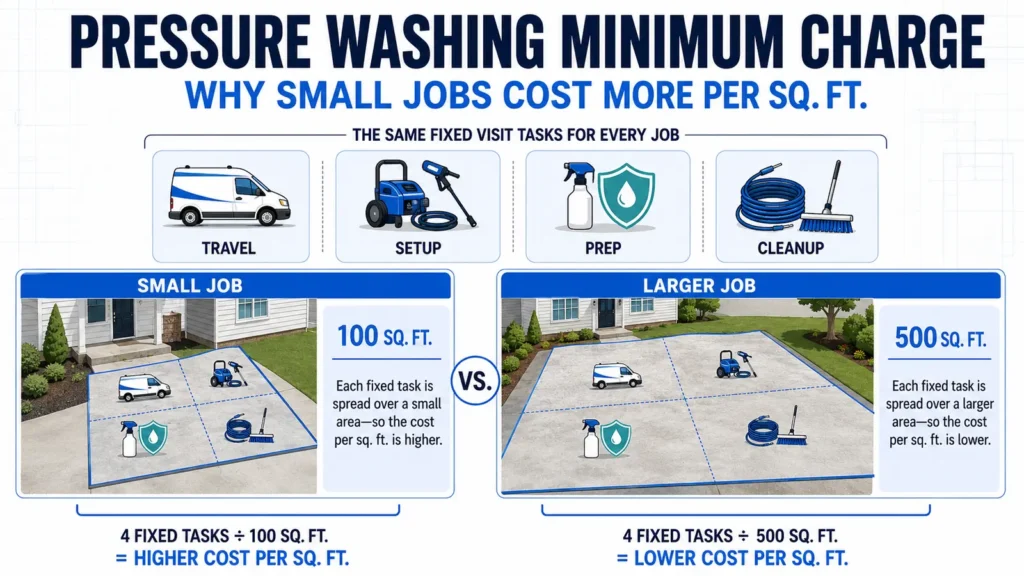
- A minimum normally matters most on a small project because travel, setup, preparation, and cleanup still occur even when the cleaning area is limited.
- The contractor’s written quote determines whether a minimum is a total price floor or whether a separate mobilization or service fee is added.
WashNumbers planning tool
Pressure Washing Minimum Charge Calculator
See when a service minimum replaces the area-based calculation and how that changes the effective cost per square foot on a small residential job.
Modeled job total
The $100 minimum applies. The adjusted area calculation is $90.
At about 223 square feet, this driveway model reaches the entered $100 minimum under the selected condition and access settings.
See the calculation
Planning illustration only—not a contractor quote or a recommendation for what a business must charge. Contractors should calculate their own profitable minimum from labor, travel, overhead, direct costs, and target margin using the Pressure Washing Pricing Calculator.
What Is a Typical Minimum Charge for Pressure Washing?
There is no single U.S. minimum that applies to every contractor, surface, or location. The available published references describe different audiences and project types.
Companies may describe the concept as a minimum charge for pressure washing, a pressure washing minimum price, a pressure washing minimum job price, or a pressure washing service-call minimum. Those labels are not guaranteed to mean the same billing structure, so the written quote should say whether the amount is a total price floor or a separate fee.
Housecall Pro’s 2026 guide is written for pressure-washing businesses. It explains that even a small job requires travel, setup, chemical preparation, and breakdown time, and says many businesses set minimums between $100 and $250 depending on local overhead.
HomeGuide’s June 2026 driveway guide is written for homeowners. It reports that many companies charge a $75 to $150 minimum for a small driveway to cover equipment mobilization, setup, and cleanup. HomeGuide’s broader pressure-washing page also explains that small jobs can cost more per square foot because of a minimum service charge. Its brick-patio guide states that many companies have a $100-or-more minimum in that surface-specific context.
These figures should not be combined into one artificial average. A range written for business owners, a small-driveway reference, and a brick-patio reference do not represent identical scopes or methods.
Published Minimum-Charge References
The figures below describe different scopes and should not be averaged into one claimed national rate.
| Source | Published figure | Context | How WashNumbers uses it |
|---|---|---|---|
| Housecall Pro March 9, 2026 |
$100–$250 | A common job-minimum range described for pressure-washing businesses, depending on overhead. | External business-pricing context; not inserted as the calculator default. |
| HomeGuide driveway guide June 2, 2026 |
$75–$150 | A minimum charge described for small driveway jobs to cover mobilization, setup, and cleanup. | External homeowner-price context for one specific surface. |
| HomeGuide brick-patio guide May 1, 2024 |
$100+ | A stated minimum used by many companies in the brick-patio cleaning context. | Additional surface-specific context, not a universal rule. |
| WashNumbers residential model | $100 default | An editable modeled floor used across current WashNumbers residential planning calculators. | Transparent planning assumption—not a claimed national contractor average. |
Figures and source dates were reviewed in August 2026. A contractor’s actual minimum may be lower or higher.
The contractor you contact may have no stated minimum, may use a higher minimum, or may price the requested surface as a flat-rate service. Local labor and fuel costs, crew size, travel distance, equipment, insurance, scheduling, surface risk, and the amount of non-cleaning time can all affect the number. Insurance alone runs $73 to $75 a month for general liability before anybody has turned a machine on, and that cost has to come out of every job including the small ones.
Why Do Pressure-Washing Companies Have a Minimum Charge?
The visible cleaning time is only one part of a service visit. A small section of sidewalk may take less time to wash than a large driveway, but it does not eliminate every cost or task surrounding the work.
Travel and Mobilization
A contractor still has to schedule the visit, drive a vehicle and equipment to the property, park, unload or stage hoses and tools, and reach the work area. Those steps can be similar whether the cleanable surface is 100 square feet or 500 square feet.
Setup and Property Preparation
The crew may need to connect to a water source, route hoses, inspect the material, protect nearby items, prepare cleaning products, and confirm where runoff will travel. Access problems, gates, stairs, long hose runs, furniture, vehicles, or landscaping can add time before cleaning begins.
Cleaning and Specialty Treatment
Square footage still matters, but surface condition can matter just as much on a small job. Oil, rust, oxidation, heavy organic growth, paint, mineral deposits, or other embedded stains may require separate products, testing, dwell time, agitation, or repeat passes. A basic minimum does not automatically include every specialty treatment.
Breakdown, Cleanup, and Administration
After washing, the contractor still has to rinse or clean the work area, collect hoses and equipment, load the vehicle, document completion, process payment, and travel to the next job. A minimum can help a business avoid accepting a visit whose total revenue does not cover the full service cycle.
How the Pressure Washing Minimum Charge Calculator Works
This tool begins with the same visible residential surface rates used in the current WashNumbers Pressure Washing Cost Calculator. It then applies the selected condition and access factors before comparing that result with the minimum you enter.
The calculation is:
Base area calculation = cleanable area × selected surface rate
Adjusted area calculation = base area calculation × condition factor × access factor
Modeled job total = the greater of the adjusted area calculation or the entered minimum
The calculator also shows:
- Minimum-charge impact: the difference between the entered minimum and the adjusted area calculation when the minimum applies.
- Effective modeled rate: the modeled job total divided by the cleanable area.
- Approximate crossover area: the area at which the adjusted square-foot calculation reaches the entered minimum under the selected settings.
The modeled job total is rounded to the nearest dollar. The crossover area is rounded up to a whole square foot so the area calculation has reached or exceeded the entered minimum.
The calculator’s default surface rates are documented WashNumbers planning assumptions. They are not hidden survey results, ZIP-code rates, or instructions for a contractor’s pricing. Review the WashNumbers pricing methodology for the role of model inputs and published references.
When Does a $100 Minimum Stop Affecting the Estimate?
Under average-buildup and normal-access settings, the crossover point is simply the $100 modeled minimum divided by the selected surface rate. For example, the driveway model uses $0.45 per square foot:
$100 ÷ $0.45 = 222.22 square feet
The calculator rounds that threshold up to approximately 223 square feet. At 200 square feet, the base driveway calculation is $90 and the $100 minimum controls the result. At 400 square feet, the base calculation is $180, so the same minimum no longer changes the modeled total.
Approximate Area Where a $100 Minimum Stops Applying
Average buildup and normal access in the current WashNumbers residential model.
| Surface | Base rate | Crossover area | Calculation |
|---|---|---|---|
| Patio | $0.40 / sq. ft. | 250 sq. ft. | $100 ÷ $0.40 |
| Driveway | $0.45 / sq. ft. | 223 sq. ft. | $100 ÷ $0.45, rounded up |
| Pool deck | $0.45 / sq. ft. | 223 sq. ft. | $100 ÷ $0.45, rounded up |
| Concrete / flatwork | $0.46 / sq. ft. | 218 sq. ft. | $100 ÷ $0.46, rounded up |
| Sidewalk | $0.47 / sq. ft. | 213 sq. ft. | $100 ÷ $0.47, rounded up |
| Fence cleaned area | $0.48 / sq. ft. | 209 sq. ft. | $100 ÷ $0.48, rounded up |
| Deck | $0.49 / sq. ft. | 205 sq. ft. | $100 ÷ $0.49, rounded up |
The crossover changes when the entered minimum, condition, or access setting changes. These are model thresholds, not contractor requirements.
These thresholds change if you edit the minimum or select a different condition or access factor. Heavy buildup or difficult access raises the adjusted area calculation, so it may reach the entered minimum at a smaller area. Light buildup or easy access has the opposite effect.
Small Pressure Washing Job Cost Examples
The examples below use the $100 WashNumbers model floor with average buildup and normal access. They illustrate why the effective per-square-foot figure can look high on a small project even when the underlying surface rate has not changed.
Small-Job Examples With a $100 Modeled Minimum
All examples use average buildup and normal access. The minimum impact is the difference between the adjusted area calculation and the $100 modeled total.
| Example | Area | Area calculation | Modeled total | Minimum impact | Effective rate |
|---|---|---|---|---|---|
| Small patio | 100 sq. ft. | $40.00 | $100 | +$60.00 | $1.00 / sq. ft. |
| Driveway section | 200 sq. ft. | $90.00 | $100 | +$10.00 | $0.50 / sq. ft. |
| Short sidewalk | 100 sq. ft. | $47.00 | $100 | +$53.00 | $1.00 / sq. ft. |
| Pool-deck section | 200 sq. ft. | $90.00 | $100 | +$10.00 | $0.50 / sq. ft. |
| Small deck | 150 sq. ft. | $73.50 | $100 | +$26.50 | $0.67 / sq. ft. |
An effective rate created by a small-job minimum is not the same as a contractor advertising that square-foot rate for every project.
For a 100-square-foot patio, the model begins at $40. The $100 floor changes the modeled total by $60, producing an effective rate of $1.00 per square foot for that particular small job.
That does not mean the model claims patios generally cost $1.00 per square foot. It means a fixed $100 total, spread across only 100 square feet, equals $1.00 per square foot. As the cleanable area grows, the fixed minimum is spread across more surface and eventually stops controlling the total.
For a broader view of how project size and pricing method affect unit rates, see the pressure washing cost per square foot guide.
Minimum Charge vs. Service Fee, Estimate Fee, and Deposit
These terms are sometimes used differently from one company to another. The written estimate or service agreement should explain how each amount is applied.
Minimum Job Charge
A minimum job charge is usually a price floor. If the contractor’s normal calculation produces an amount below the floor, the total becomes the minimum. In the WashNumbers calculator, the minimum replaces the lower area calculation; it is not added on top of it.
Mobilization or Service-Call Fee
A mobilization, trip, or service-call fee may be shown as a separate line item for bringing the crew and equipment to the property. Some businesses may include that cost inside their minimum, while others may add it to the work price. Ask how the company applies it before comparing totals.
Estimate or Inspection Fee
An estimate fee is a charge for evaluating the project or preparing a quote. It is separate from the final cleaning price unless the contractor says it will be credited toward approved work. Many estimates may be free, but that is a company decision rather than a universal rule.
Deposit
A deposit is an advance payment toward an agreed project. It is not automatically an extra fee or a minimum charge. Confirm the payment schedule, cancellation terms, and whether the deposit is refundable or transferable before paying.
Can Bundling Services Reduce the Effective Minimum?
Combining nearby surfaces into one visit can reduce duplicated travel and setup, but it does not guarantee a discount. The total may still increase because the contractor is cleaning more area and accepting a larger scope.
If you want a driveway, sidewalk, patio, pool deck, fence, or house exterior cleaned, ask the contractor to price the combined visit and provide line items where practical. That makes it easier to see whether the minimum applies once to the visit, separately to each service, or not at all after the combined work exceeds the company’s floor.
Useful surface-specific planning pages include:
- Driveway pressure washing cost
- Sidewalk pressure washing cost
- Patio pressure washing cost
- Pool deck pressure washing cost
When requesting a bundled quote, keep the scopes clear. Ask whether pretreatment, specialty stains, furniture moving, vertical faces, steps, rinsing, cleanup, sealing, repairs, or other optional work is included.
How Homeowners Should Compare Small-Job Quotes
Give each contractor the same information so the totals describe the same project:
- The surface or surfaces you want cleaned.
- The approximate cleanable area—not only a broad description such as “small patio.”
- Photos of the entire area and close-ups of stains or damage.
- The surface material and any known coating, paint, or sealer.
- Access details, including gates, stairs, parking, hose distance, and available water.
- Items you expect the contractor to move or protect.
- Any specialty stain treatment or post-cleaning service you want priced.
Then ask these questions:
- Is the quoted amount a minimum total or is a separate service fee added?
- Does the minimum apply once to the visit or separately to each service?
- Which preparation, cleaning, rinsing, and cleanup tasks are included?
- Are stain treatments, hot water, sealing, repairs, or restoration separate?
- Will an estimate fee or deposit be credited toward the job?
Compare the written scope and final total—not only the advertised square-foot rate. A low unit rate does not describe the full bill if the job is below the company’s minimum, and a higher total may include work that another proposal excludes.
How Contractors Should Set Their Own Minimum
Your minimum only makes sense once you know what your hourly rate needs to be, because the usual rule is two hours of it.
A contractor should not copy the $100 WashNumbers default or an online range without checking the business’s real costs. Housecall Pro recommends calculating the cost of sending a crew out, including setup and teardown, chemical preparation and travel, and then adding the intended profit margin.
A useful structure is:
Break-even visit cost = labor + allocated overhead + travel + chemicals + equipment allocation + other direct costs
Target minimum = break-even visit cost ÷ (1 − target margin)
The inputs must come from the contractor’s own operation. Crew wages and burden, billable hours, fuel, insurance, vehicle costs, equipment wear, marketing, office time, payment fees, local travel, taxes, and desired margin can differ materially from one business to another.
The WashNumbers Pressure Washing Pricing Calculator is the contractor-facing tool for building a price from costs and target margin. The calculator on this page serves a different purpose: it shows how an entered minimum interacts with a residential area model.
Review the minimum regularly. If small jobs consistently take longer, require more travel, consume more product, or produce less revenue per billable hour than expected, the underlying cost assumptions may need to be updated. If the company changes its service area, crew structure, equipment, or operating costs, an old minimum may no longer fit.
Related Pressure-Washing Pricing Tools
- Use the Pressure Washing Cost Calculator for an early homeowner budget across residential surfaces.
- Use the Pressure Washing Pricing Calculator to build a contractor price from labor, overhead, direct costs, and target margin.
- Compare published references and model assumptions in the pressure washing cost per square foot guide.
- Review all formulas and modeling choices in the WashNumbers methodology.
- Browse every pressure washing cost guide.
Setting your own minimum and want to know where it sits against your state? Add your numbers to the 2026 contractor rate survey. Seven questions, ninety seconds, no email required, and you get the state breakdown a week before it goes public.
Minimums exist because the clock does not care how small the job is. Setup and teardown cost the same on a two-car driveway as on a strip mall.
Pressure Washing Minimum Charge FAQs
What is the average pressure washing minimum charge?
There is no verified universal average. Housecall Pro’s March 2026 business guide says many pressure-washing businesses set minimums of $100 to $250 depending on local overhead. HomeGuide’s June 2026 driveway guide reports $75 to $150 for small driveway jobs. WashNumbers keeps those source-specific figures separate and uses an editable $100 default only as a residential planning assumption.
Why does a small pressure-washing job cost more per square foot?
Travel, mobilization, setup, preparation, breakdown, cleanup, and administration do not disappear when the cleanable area is small. When a minimum controls the total, dividing that fixed amount by fewer square feet produces a higher effective rate.
Is the minimum charge added to the pressure-washing price?
Not necessarily. In the WashNumbers calculator, it acts as a floor: the modeled total is the greater of the adjusted area calculation or the entered minimum. A real contractor may structure a minimum, trip fee, or service-call fee differently, so check the written quote.
At what size does a $100 minimum stop applying?
It depends on the surface rate and all adjustments. In the WashNumbers driveway model with average buildup and normal access, $100 divided by $0.45 per square foot equals 222.22 square feet, so the displayed crossover is approximately 223 square feet. Changing the surface, condition, access, or minimum changes the threshold.
Can I combine several small areas into one job?
You can ask for a bundled quote. Combining work may reduce duplicated travel and setup, but the contractor is also cleaning more surface, so a discount is not guaranteed. Ask for the total scope and line items needed for comparison.
Is a deposit the same as a minimum charge?
No. A minimum is a price floor for accepting or completing a service visit. A deposit is an advance payment toward an agreed project. The contractor’s terms should explain how the deposit is applied and what happens after cancellation or rescheduling.
Does this calculator tell contractors what they should charge?
No. It illustrates how an editable minimum affects the existing WashNumbers residential area model. Contractors should calculate a profitable minimum from their own labor, overhead, travel, direct costs, production, and target margin.
Sources and Methodology
Pricing references reviewed on August 24, 2026:
- Housecall Pro: How to Price Pressure Washing Jobs in 2026
- HomeGuide: Cost to Pressure Wash a Driveway
- HomeGuide: Pressure Washing Prices
- HomeGuide: Brick Patio Cost
- WashNumbers Pricing Methodology
Published sources use different audiences, project scopes, and methods. WashNumbers does not average them into a hidden formula. The page calculator uses visible WashNumbers surface rates, condition factors, access factors, and an editable $100 default floor. It is an early planning illustration, not a local quote or a required business price.
A floor only holds if the customer sees it before you arrive rather than on the invoice afterwards. That means it belongs on the estimate as its own line, next to the exclusions and the validity window, and we set out where each of those goes in our estimate template for this trade.
Tools for your business
Contractor Pricing Calculator
Build a quote that still leaves a margin after chemicals and drive time.
Production Rate Calculator
The hours a job takes, before you can price it.
Startup Cost Calculator
What a rig costs to build and how many jobs pay it back.
Add Your Rates to the Survey
Seven questions. You get the state-by-state results first.
 Written by Diego Hernández, founder of WashNumbers. Cost models are built from published contractor rates and public price observations. See how we build these numbers.
Last reviewed: August 2026