
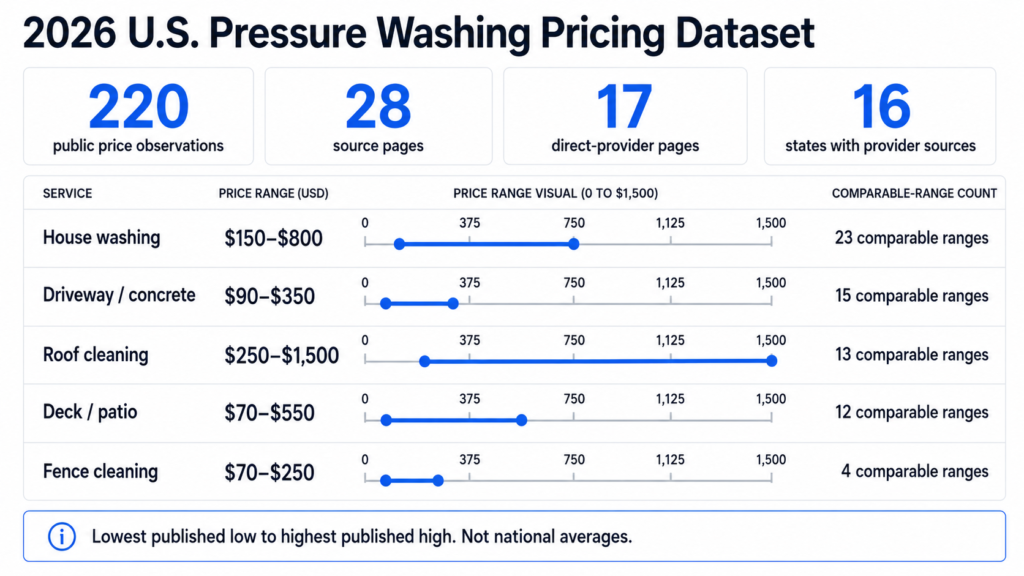
This page presents 2026 U.S. pressure washing pricing data from 220 public price observations collected across 28 source pages.
WashNumbers reviewed 220 publicly posted U.S. pressure washing price observations from 28 source pages. The dataset includes 134 observations from direct service providers, together with marketplace cost guides, industry pricing tools, and other editorial or calculator sources. The direct-provider pages cover 16 states.
This report shows what selected U.S. publishers publicly stated about pressure washing prices when the pages were reviewed. It is not a database of customer invoices, completed-job transactions, contractor revenue, or a statistically representative national sample. For a property-specific planning estimate, use the WashNumbers pressure washing cost calculator.
Last reviewed: August 25, 2026
Dataset version: 1.0
Research Snapshot
How to read these numbers: one source page can contribute several observations when it publishes prices for multiple services, sizes, or pricing units. The 220 observations do not represent 220 companies or 220 completed jobs.
Contractors: What Do You Actually Charge?
Everything below came off a public price page. That’s the honest ceiling of it, because nobody posts what they really close at.
I’m building the other half straight from the people holding the wand. Seven questions, about ninety seconds, no email required.
Embed This Pricing Graphic
Publishers may reuse this graphic. Attribution to WashNumbers is appreciated. Click inside the box and copy the complete embed code.
Pressure Washing Pricing Data at a Glance
House Washing Produced the Largest Comparable Group
The dataset contains 23 comparable, closed per-job house washing ranges published by direct providers. Within that group, the lowest published lower bound was $150, the highest published upper bound was $800, and the simple unweighted mean of the range midpoints was $439.
That $439 figure is not an average customer invoice or a recommended quote. It is only a descriptive midpoint calculated from the included published ranges. Home size, number of stories, siding, buildup, access, landscaping, and bundled services can all change the final price. See the separate house pressure washing cost guide for a homeowner-focused explanation.
Roof-Cleaning Ranges Showed the Widest Upper End
Among 13 comparable direct-provider roof-cleaning ranges, the lowest published lower bound was $250 and the highest closed upper bound was $1,500. The unweighted mean range midpoint was $574.
The wide spread should not be interpreted as evidence that roof cleaning normally costs $1,500. Roof size, pitch, material, treatment method, biological growth, safety requirements, and access can produce very different scopes.
Driveway and Concrete Pricing Remained Highly Scope-Dependent
The 15 comparable driveway and concrete observations had published lower bounds reaching $90, upper bounds reaching $350, and an unweighted mean range midpoint of $202.
Square footage, oil or rust treatment, drainage, surface condition, and whether sidewalks or curbs are included can materially affect the quote. The driveway pressure washing cost guide explains these variables in more detail.
Public Pricing Is Not Standardized
The reviewed pages used several different formats: closed price ranges, starting prices, minimum service charges, size bands, per-square-foot rates, hourly rates, and example project totals.
These formats are not interchangeable. WashNumbers preserves the original unit and price type instead of converting every figure into a false universal average.
| Service | Comparable ranges | Lowest published low | Unweighted mean midpoint | Highest published high |
|---|---|---|---|---|
| House washing | 23 | $150 | $439 | $800 |
| Driveway / concrete | 15 | $90 | $202 | $350 |
| Roof cleaning | 13 | $250 | $574 | $1,500 |
| Deck / patio | 12 | $70 | $240 | $550 |
| Fence cleaning | 4 | $70 | $149 | $250 |
Comparison rule: this table includes only direct-provider, per-job, closed ranges with a sufficiently clear service scope. Starting prices, minimum charges, point estimates, open-ended ranges, marketplace figures, and per-square-foot prices are excluded. The midpoint is the simple, unweighted mean of each published range midpoint—not a market average or expected invoice.
What the Dataset Contains
The complete workbook retains the provenance and format of each price claim. Every observation records the publisher, market, state when available, source class, service, stated scope, price type, lower and upper values, unit, reference size, access date, comparison eligibility, notes, and original URL.
By observation count, the dataset contains:
- 134 direct-provider observations (60.9%)
- 59 marketplace or cost-guide observations (26.8%)
- 19 industry-tool observations (8.6%)
- 8 other editorial or calculator observations (3.6%)
These percentages describe rows in the dataset, not market share or source authority. A detailed publisher that lists many service tiers contributes more rows than a page containing one broad estimate.
Direct-Provider Geographic Coverage
The 17 direct-provider source pages cover markets in California, Connecticut, Florida, Georgia, Massachusetts, Michigan, New Jersey, New York, North Carolina, Ohio, Oregon, South Carolina, Texas, Virginia, Washington, and Wisconsin.
The geographic coverage is useful for identifying variation in publicly posted prices, but it is not balanced by population, region, business count, or search demand. A state appearing in the dataset should not be treated as representative of the entire state.
Methodology
WashNumbers manually reviewed publicly accessible U.S. pages that displayed numeric pressure washing or adjacent exterior-cleaning prices. The main dataset prioritizes pages current to 2025 or 2026 and records the values as published in U.S. dollars.
The workflow was:
- Identify a publicly accessible page containing a numeric price, price range, minimum, starting price, hourly rate, or per-square-foot rate.
- Record one observation for each distinct service and scope rather than one row per page.
- Preserve the source’s original pricing unit and claim type.
- Classify the source as a direct provider, marketplace or cost guide, industry tool, or other editorial or calculator source.
- Separate closed ranges from starting prices, minimum charges, point estimates, and open-ended values.
- Mark a row as comparable only when it is a direct-provider, per-job, closed range with a sufficiently clear service scope.
- Retain the original source URL and access date so every row can be audited.
This research follows the broader WashNumbers methodology, including its emphasis on transparent assumptions and avoiding false precision.
Inclusion Criteria
A source could enter the main dataset when it:
- Was publicly accessible without joining a private group.
- Referred to pricing in the United States.
- Published at least one identifiable numeric price or range.
- Provided enough context to identify the service or pricing unit.
- Could be revisited through a stable source URL.
Exclusion and Deferral Rules
The main dataset excludes anonymous forum posts, private social-media discussions, sales pages with no numeric price, pages older than the freshness threshold, duplicated syndication, and pages whose figures changed or contradicted each other during verification.
Sources needing additional methodological verification are deferred rather than silently mixed into the analysis.
Important Limitations
This is a curated convenience sample of public price claims. It is designed for transparency and source comparison, not for estimating a statistically representative U.S. average.
The dataset does not measure:
- Prices paid on completed customer invoices.
- How frequently each price occurs in the market.
- Contractor revenue, costs, margins, or profitability.
- The number of contractors using a particular pricing model.
- A guaranteed minimum, maximum, or recommended quote.
- Taxes, discounts, travel fees, bundled services, or every scope detail unless the source stated them.
Public pages can be changed or removed after the recorded access date. Readers should open the original source before quoting a specific publisher’s figure.
What is inside the dataset
The workbook contains all 220 observations, the 28-page source register, comparison formulas, field definitions, excluded or deferred sources, and a publication guide.
The 2026 Pricing Dataset, in full
Review all 220 observations, the complete source register, methodology fields, comparison rules, and excluded or deferred sources. It opens in your browser. No download, no sign-in.
Open the dataset in Google SheetsWant it as a file? Inside the sheet, use File then Download.
How to Cite This Dataset
Suggested citation:
WashNumbers. “2026 U.S. Pressure Washing Pricing Dataset.” Version 1.0, August 25, 2026. https://washnumbers.com/pressure-washing-pricing-data/
Summary figures may be quoted for editorial or educational use. We appreciate attribution to WashNumbers and, where editorially appropriate, a link to this report.
The data must not be described as completed-job transactions, customer invoices, or a statistically representative national average.
Source Register
The workbook contains the URL attached to every observation. The 28 included source pages are listed below for transparency.
Direct Service-Provider Pages
- Squeegee Pros — Charlotte and Lake Norman, North Carolina
- C&M Services / The Soft Wash Pros — Northern Connecticut
- Sudsy Pressure Washing — Cincinnati, Ohio
- Platypus Power Washing — Richmond, Virginia
- The Total Wash Co. — Madison, Wisconsin
- LI Paver Savers — Nassau County, New York
- Twisted Nozzle Pressure Washing — Houston, Texas
- Perfect Pressure Cleaning — Jupiter and Palm Beach County, Florida
- Kleanway Cleaning Services — Miami and South Florida
- Velocity Cleaning Systems — Bellevue, Washington
- ViewCrew Services — Massachusetts
- Joe’s Window Cleaning — Georgia
- Pro Service SC — Columbia, South Carolina
- Foothill Pressure Washing — Southern California
- PSI Pressure Washing & Exterior Cleaning — New Jersey
- Window Genie — Milan, Michigan
- Westview Services — Lake Oswego and Portland, Oregon
Marketplace, Cost-Guide, Tool, and Editorial Pages
- QuoteIQ — Pressure Washing Cost Calculator
- Taskrabbit — Pressure Washing Cost Guide
- Homewyse — Cost to Pressure Wash per Square Foot
- Thumbtack — 2026 Pressure Washing Prices
- Angi — Driveway Pressure Washing Cost
- HomeAdvisor — Pressure Washing Cost Guide
- Bark — Pressure Washing Prices
- Giraffe Tools — Professional and DIY House-Washing Cost
- Southeast Softwash — Pricing Calculator
- Kickback Services — Pressure Washing Cost Guide
- LawnGuru — Pressure Washing Prices by Surface
The same sourcing rules apply to our industry statistics page, which lists the figures we could verify and the ones that fall apart when you look for the primary source.
Update Log
- August 25, 2026 — Version 1.0: Initial release with 220 observations from 28 source pages, including 17 direct-provider pages across 16 states.
WashNumbers plans to recheck high-value source pages quarterly and publish a new version when additions or corrections materially change the dataset.
Are You a U.S. Pressure-Washing Contractor?
Everything above came off a public price page. That’s the honest ceiling of this dataset, because nobody posts what they really close at.
Seven questions, about ninety seconds, no email required. You get the state-by-state report a week before it goes public, and your company listed and linked if you want it.
Frequently Asked Questions
Is This a National Average of Pressure Washing Prices?
No. It is a curated sample of publicly posted price claims. The sources were not selected through probability sampling, and detailed pages can contribute several observations. The results should not be described as a statistically representative national average.
Why Are Some Published Ranges So Different?
Pressure washing prices can vary with the service, surface, square footage, number of stories, material, buildup, stain treatment, access, local operating costs, minimum charges, and bundled work. Sources also use different pricing formats.
Are the Figures Actual Customer Invoices?
No. The dataset records what publishers stated publicly. Unless a source explicitly described a real project example, the figures should not be treated as completed-job transaction data.
Why Are Starting Prices Excluded From the Main Comparison Table?
A starting price normally represents the simplest eligible scope, while a closed range attempts to describe both a lower and upper boundary. Combining them would create a misleading summary.
Can I Use the Dataset to Estimate My Own Project?
It can provide context, but it cannot replace a property-specific quote. Use the pressure washing cost calculator as a planning tool and request local estimates before hiring a provider.
Where these numbers come from
2026 Pricing Dataset
220 observations, 28 sources, open in your browser.
Methodology
What we include, what we exclude, and why.
Industry Statistics
Market size, operator counts and what the trade actually looks like.
The Contractor Survey
The next edition is built from rates given directly by operators.
 Written by Diego Hernández, founder of WashNumbers. Cost models are built from published contractor rates and public price observations. See how we build these numbers.
Last reviewed: August 2026