
Use this free pressure washer water usage calculator to estimate total gallons, tank runtime, incoming-water shortfall, refill needs, and variable water cost. Enter the machine’s rated gallons per minute and the time the trigger will actually be held open.
The results are transparent planning calculations, not a guarantee of equipment performance. Actual flow, usable tank volume, supply pressure, plumbing, bypass configuration, and manufacturer requirements can change real-world operation.
Quick Answer
- A 2 GPM pressure washer uses 60 gallons during 30 minutes of continuous spraying.
- A 4 GPM pressure washer uses 240 gallons during 60 minutes of continuous spraying.
- An 8 GPM pressure washer uses 480 gallons during 60 minutes of continuous spraying.
- Water volume is calculated from GPM and trigger-on time, not PSI alone.
- A tank lasts longer when an incoming water source replaces some or all of the machine’s flow.
- Use the calculator below for a project-specific planning estimate.
Free planning tool
Pressure Washer Water Usage & Tank Calculator
Estimate total water use, tank runtime, supply shortfall, refill needs, and water cost from your machine’s GPM and actual trigger-on time.
Count spraying time, not travel, setup, moving equipment, or breaks.
Use 100% for a full tank or enter the estimated starting level.
Enter 0 for tank-only use. Use a measured flowing rate when connected to a refill source.
Use the variable rate from your utility bill. Fixed charges are not included.
Estimated result
View the formulas and assumptions
- Total water used = pressure washer GPM × trigger-on minutes.
- Starting tank water = tank capacity × starting level percentage.
- Net tank draw = pressure washer GPM − incoming supply GPM, with a minimum of zero.
- Runtime with supply = starting tank water ÷ net tank draw.
- Estimated cost = total gallons ÷ 1,000 × the rate entered.
Planning estimate: This model assumes steady rated flow while the trigger is on and steady incoming flow. Actual flow, usable tank volume, plumbing, pump requirements, and utility billing can differ. Confirm equipment and water-supply requirements in the manufacturer’s instructions.
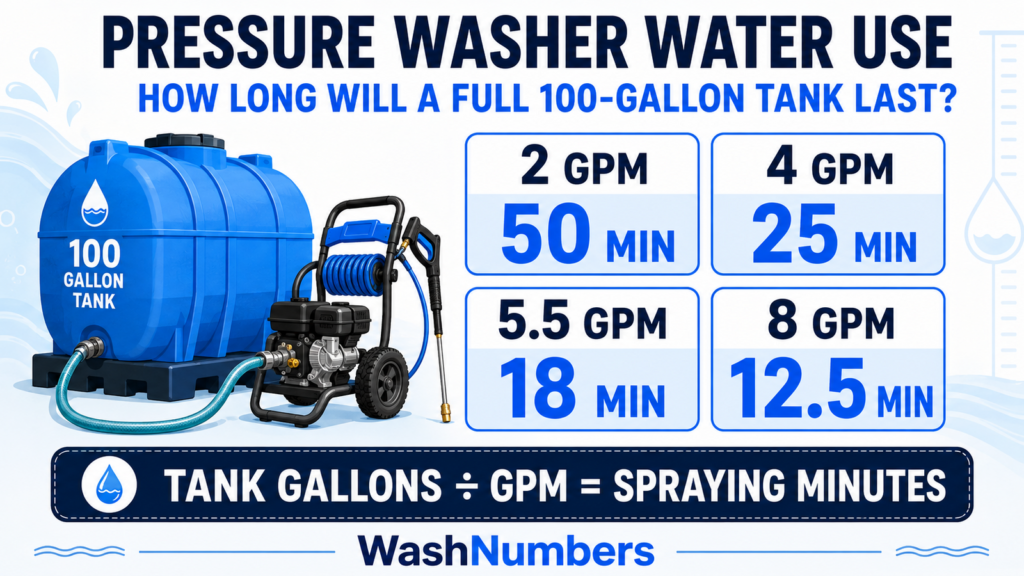
How Much Water Does a Pressure Washer Use?
A pressure washer's water use depends primarily on its flow rating and the number of minutes water is discharged. SIMPSON defines GPM as the amount of water flowing from the machine, while PSI describes cleaning pressure.
The basic formula is:
Total water used = GPM × trigger-on minutes
For example:
4 GPM × 45 minutes = 180 gallons
This calculation should use actual trigger-on time rather than the entire appointment. Travel, setup, moving hoses, applying treatment, dwell time, and breaks do not automatically represent full-flow spraying time.
| Pressure washer flow | 15 minutes | 30 minutes | 60 minutes | 120 minutes |
|---|---|---|---|---|
| 1.2 GPM | 18 gal | 36 gal | 72 gal | 144 gal |
| 2.0 GPM | 30 gal | 60 gal | 120 gal | 240 gal |
| 2.5 GPM | 37.5 gal | 75 gal | 150 gal | 300 gal |
| 3.0 GPM | 45 gal | 90 gal | 180 gal | 360 gal |
| 4.0 GPM | 60 gal | 120 gal | 240 gal | 480 gal |
| 5.5 GPM | 82.5 gal | 165 gal | 330 gal | 660 gal |
| 8.0 GPM | 120 gal | 240 gal | 480 gal | 960 gal |
Formula: GPM × actual trigger-on minutes. These are direct calculations, not average job totals.
The table is direct arithmetic. It does not claim that every house, driveway, or commercial job requires the same spraying time.
Pressure Washer Water Use per Hour
To convert a pressure washer's GPM rating into gallons per continuous spraying hour, multiply by 60:
- 1.2 GPM = 72 gallons per hour
- 2.0 GPM = 120 gallons per hour
- 2.5 GPM = 150 gallons per hour
- 3.0 GPM = 180 gallons per hour
- 4.0 GPM = 240 gallons per hour
- 5.5 GPM = 330 gallons per hour
- 8.0 GPM = 480 gallons per hour
These examples cover both smaller residential machines and higher-flow professional equipment. For context, Kärcher reports approximately 1.0 to 1.5 GPM for its U.S. Home & Garden electric pressure washers, while SIMPSON lists professional and industrial models with substantially higher flow ratings.
Always use the rating for the exact machine and configuration being evaluated.
Flow rate can also affect equipment price. If you are comparing residential and professional machines, see our pressure washer cost by type guide for current 2026 purchase-price ranges and an editable ownership-cost calculator.
How Long Will a Water Tank Last With a Pressure Washer?
Without an incoming refill source, tank runtime is calculated as:
Starting water in the tank ÷ pressure washer GPM = spraying minutes available
A full 100-gallon tank therefore provides:
- 50 minutes at 2 GPM
- 25 minutes at 4 GPM
- About 18 minutes 11 seconds at 5.5 GPM
- 12 minutes 30 seconds at 8 GPM
| Tank capacity | 2 GPM | 4 GPM | 5.5 GPM | 8 GPM |
|---|---|---|---|---|
| 50 gallons | 25 min | 12 min 30 sec | 9 min 5 sec | 6 min 15 sec |
| 100 gallons | 50 min | 25 min | 18 min 11 sec | 12 min 30 sec |
| 200 gallons | 1 hr 40 min | 50 min | 36 min 22 sec | 25 min |
| 275 gallons | 2 hr 17 min 30 sec | 1 hr 8 min 45 sec | 50 min | 34 min 23 sec |
| 525 gallons | 4 hr 22 min 30 sec | 2 hr 11 min 15 sec | 1 hr 35 min 27 sec | 1 hr 5 min 38 sec |
Important: Capacity ÷ GPM assumes a full tank, steady rated flow, and no refill source. Practical usable volume may be lower.
The calculation uses the selected starting level. A 275-gallon tank that is only 80% full begins with 220 gallons, not 275 gallons.
Nominal capacity may also differ from the water that can be used reliably in a particular setup. Tank shape, outlet position, vehicle angle, plumbing, reserve preferences, and equipment requirements can reduce practical availability.
Calculating Tank Runtime With an Incoming Water Supply
A tank can continue filling while the pressure washer operates. In that situation, the important number is the net rate at which water leaves the tank:
Net tank draw = pressure washer GPM − incoming supply GPM
Consider a 4 GPM pressure washer connected to a source supplying 3 GPM:
4 GPM − 3 GPM = 1 gallon per minute of net tank draw
A tank containing 100 gallons would last approximately 100 spraying minutes under those simplified steady-flow conditions.
If the measured incoming supply equals or exceeds the machine's flow, the calculator reports that the supply keeps up. This is a volume-balance result only. It does not prove that the source meets the pressure, plumbing, pump-feed, or connection requirements of a particular pressure washer.
For example, SIMPSON specifies minimum supply flow and pressure for its equipment in its pressure washer frequently asked questions. Requirements should be checked for the exact model rather than applied universally to every machine.
How to Measure Water-Supply GPM
The most useful input is a measured flowing rate from the water source that will be used on the job.
One practical method is a timed bucket test:
- Use a container with a known volume.
- Open the source fully under conditions similar to the intended setup.
- Record how many seconds it takes to fill the container.
- Calculate the flow rate with the formula below.
Supply GPM = container gallons × 60 ÷ fill time in seconds
If a 5-gallon container fills in 75 seconds:
5 × 60 ÷ 75 = 4 GPM
Washington State University's garden hose flow and time guidance explains why measured dynamic flow can be more reliable than estimating it only from hose diameter, length, and static pressure.
Measure at the relevant connection point and hose arrangement. Long hoses, fittings, elevation, restrictions, wells, and simultaneous water use elsewhere on the property can affect the available rate.
What Size Water Tank Do I Need?
The calculator estimates the water that must come from the tank after accounting for a continuous incoming source:
Required tank water = max(0, pressure washer GPM − supply GPM) × trigger-on minutes
Example 1: Tank-Only 4 GPM Setup
A 4 GPM machine spraying for 60 minutes requires:
4 × 60 = 240 gallons
A 275-gallon tank contains enough nominal volume for that calculation and would have approximately 35 gallons remaining.
Example 2: 5.5 GPM Machine With a 3 GPM Supply
The tank loses:
5.5 − 3 = 2.5 gallons per spraying minute
For 90 trigger-on minutes:
2.5 × 90 = 225 gallons required from the tank
A full 200-gallon tank would be 25 gallons short in this simplified model.
Example 3: 8 GPM Machine With a 275-Gallon Tank
With no refill source:
275 ÷ 8 = 34.375 minutes
That equals approximately 34 minutes 23 seconds of continuous rated flow. It does not mean the complete job must end after that time; the operator may refill, pause spraying, use a different source, or have less trigger-on time than total job time.
Select equipment only after considering vehicle payload, tank and water weight, securement, braking, plumbing, pump requirements, access to refill points, and the manufacturer's instructions. This calculator does not determine whether a tank or mobile setup is safe for a particular vehicle or machine.
How Much Does Pressure Washer Water Cost?
Water prices are not uniform. Utility bills can include variable water charges, sewer charges, fixed service fees, tiers, taxes, and different billing units.
The calculator therefore does not insert a supposed national rate. Enter the applicable combined variable rate per 1,000 gallons from the relevant utility bill.
The formula is:
Estimated variable cost = total gallons ÷ 1,000 × entered rate
For example, 240 gallons at an entered combined rate of $14 per 1,000 gallons produces:
240 ÷ 1,000 × $14 = $3.36
That example demonstrates the calculation only. It is not a claim that $14 is a national or local average, and fixed charges are excluded.
Water use is only one part of a service price. Labor, equipment, setup, travel, treatment, surface condition, access, protection, minimum charges, and business overhead can matter much more. Use the pressure washing cost calculator for a broader project-price estimate or review the pressure washing cost per square foot guide for surface-based pricing context.
Does PSI Change Water Consumption?
PSI and GPM describe different parts of pressure-washer performance. PSI describes pressure, while GPM describes water flow.
This calculator does not estimate gallons from PSI because pressure alone is insufficient to determine volume. Two machines can have similar PSI ratings but different GPM ratings.
Use the manufacturer's published GPM for the exact model, nozzle, operating condition, and configuration. A specification is still a planning input rather than a field measurement; actual delivered flow can differ because of equipment condition, regulation, restrictions, supply, and setup.
Water Use Examples by Project
The examples below keep the arithmetic separate from claims about typical job duration.
House Exterior Example
A 2.5 GPM machine with 50 minutes of actual trigger-on time uses:
2.5 × 50 = 125 gallons
That does not mean every house wash uses 125 gallons. House size, stories, cleaning method, treatment, dwell time, rinsing, and included surfaces change the scope. See the house pressure washing cost guide for pricing variables that are separate from water consumption.
Driveway Example
A 4 GPM machine with 75 minutes of trigger-on time uses:
4 × 75 = 300 gallons
The number describes machine discharge during those spraying minutes. It does not predict the time required for every driveway. Surface area, equipment, pretreatment, staining, edges, rinsing, and operator process can all change the job. See the driveway pressure washing cost guide for a defined pricing comparison.
Commercial Example
An 8 GPM machine spraying for 120 minutes uses:
8 × 120 = 960 gallons
If a continuous source supplies 5 GPM, the tank must cover the 3 GPM difference. Over 120 spraying minutes, that equals 360 gallons from the tank. A starting volume of 275 gallons would be 85 gallons short without a refill or other change.
For broader commercial cost planning, use the commercial pressure washing cost calculator.
Water Supply, Runoff, and Practical Limits
Calculating volume does not determine whether a cleaning setup or discharge method is appropriate.
Before operating:
- Confirm the exact pressure washer's required inlet flow and pressure.
- Confirm whether the equipment is designed for direct, gravity-fed, or pump-assisted tank supply.
- Inspect hoses, connections, filters, valves, and tank plumbing.
- Do not exceed vehicle payload or equipment ratings.
- Plan for interruptions, reserve water, and refill access.
- Follow local requirements for wash-water collection, treatment, and disposal.
Wash water can collect dirt, oil, chemicals, paint particles, and other contaminants from a surface. The U.S. EPA stormwater program explains that some stormwater discharges are regulated to prevent pollutants from reaching surface waters. Requirements vary by activity and jurisdiction, so local authorities are the appropriate source for site-specific compliance instructions.
How to Use the Calculator More Accurately
- Use the exact machine's rated GPM rather than guessing from PSI.
- Estimate trigger-on minutes separately from total job duration.
- Enter the tank's actual starting level.
- Measure incoming flow under realistic operating conditions.
- Use the correct variable utility rate and billing unit.
- Add a practical reserve outside the result if your operation requires one.
- Compare the estimate with measured water use after completed jobs and refine future inputs.
The calculator is most valuable as a transparent planning model. It should help users see which assumption changes the result rather than hide those assumptions behind one unexplained answer.
Frequently Asked Questions
How many gallons of water does a pressure washer use per hour?
Multiply the machine's GPM by 60. A 2 GPM machine uses 120 gallons during one hour of continuous rated flow, a 4 GPM machine uses 240 gallons, and an 8 GPM machine uses 480 gallons. Actual trigger-on time may be shorter than the total job duration.
How long will a 100-gallon tank last with a 4 GPM pressure washer?
A full 100-gallon tank provides 25 minutes of continuous 4 GPM flow without incoming water: 100 ÷ 4 = 25. Practical usable volume and equipment requirements can differ.
How long will a 275-gallon tank last at 4 GPM?
A full 275-gallon tank provides approximately 68 minutes 45 seconds at 4 GPM with no incoming refill source. The calculation is 275 ÷ 4 = 68.75 minutes.
What size tank is needed for one hour at 4 GPM?
The direct water-volume calculation is 240 gallons because 4 × 60 = 240. Tank selection should also consider usable capacity, reserve, vehicle payload, plumbing, refill access, and manufacturer requirements.
Will a garden hose keep a pressure washer tank full?
It depends on measured incoming flow and the machine's draw. In the calculator's simplified volume model, a supply equal to or greater than the pressure washer's GPM keeps up. The source must still satisfy the exact equipment's pressure, flow, and connection requirements.
Does a pressure washer use water when the trigger is released?
The calculator models rated discharge only while the trigger is open. Pressure-washer and bypass systems differ. If a particular setup diverts, discharges, or otherwise removes water from the tank while the trigger is released, that additional draw must be measured and added separately.
How can I calculate pressure-washing water cost?
Multiply total gallons by the applicable variable water and sewer rate per gallon. When the bill gives a rate per 1,000 gallons, divide total gallons by 1,000 and multiply by that rate. Fixed fees and unrelated billing charges are not included.
Is the calculator suitable for commercial pressure washing?
It can provide a transparent volume estimate for residential or commercial equipment when the inputs are appropriate. It does not design plumbing, determine vehicle payload, certify equipment compatibility, or replace manufacturer and professional guidance.
Methodology and Limitations
WashNumbers calculates total water use directly from user-entered GPM and trigger-on minutes. Tank results use the selected capacity, starting percentage, and incoming flow. Refill results round up to whole additional tank fills when the calculated shortfall is greater than zero.
U.S. gallons are converted to liters using the National Institute of Standards and Technology conversion of 1 U.S. gallon = 3.785412 liters.
The calculator does not infer GPM from PSI, assign a universal water price, estimate unmeasured trigger time, or claim one tank size is appropriate for every vehicle and pressure washer.
Review the WashNumbers methodology for the site's source-selection, calculation, and limitation principles. More free resources are available in the pressure washing tools directory.
Technical references reviewed by WashNumbers: August 2026.
Sources
- SIMPSON: PSI vs. GPM — What Matters Most?
- SIMPSON: Pressure Washer Frequently Asked Questions
- Kärcher: Electric Pressure Washers
- Washington State University: Garden Hose Flow and Time Calculator
- National Institute of Standards and Technology: Conversion Factors
- U.S. EPA: NPDES Stormwater Program
Tools for your business
Contractor Pricing Calculator
Build a quote that still leaves a margin after chemicals and drive time.
Production Rate Calculator
The hours a job takes, before you can price it.
Startup Cost Calculator
What a rig costs to build and how many jobs pay it back.
Add Your Rates to the Survey
Seven questions. You get the state-by-state results first.
 Written by Diego Hernández, founder of WashNumbers. Cost models are built from published contractor rates and public price observations. See how we build these numbers.
Last reviewed: August 2026