
Buying a pressure washer can mean spending about $100 on a basic electric unit or more than $10,000 on a commercial hot-water trailer system.
The appropriate budget depends on what you plan to clean, how frequently the machine will be used, whether electricity is available, and whether you need residential convenience or professional duty capability.
This guide compares current published prices, explains the additional costs that are easy to overlook, and includes an editable calculator for estimating upfront and long-term ownership cost.
The machine is rarely more than a third of what you spend. Hoses, a surface cleaner, a buffer tank, insurance and licensing add up faster than the pump does, and we costed the whole build in our guide to pressure washing startup costs.
Buy the machine first and the attachment second, because the attachment has to match the flow you ended up with rather than the other way round. Which deck goes with which pump is far less settled than it looks, and we compared the four published rules in our guide to matching a surface cleaner to your GPM.
Quick Answer
- Light-duty electric pressure washers commonly start around $100–$200.
- Higher-output electric models often fall around $200–$400.
- Battery and hybrid machines can cost approximately $200–$500 or more, especially when batteries and chargers are not included.
- Residential gas pressure washers commonly cost around $300–$700.
- Professional cold-water machines may cost approximately $700–$2,000 or more.
- Commercial hot-water and trailer systems can cost around $3,500–$18,000 or more.
- The machine price is not the full ownership cost. Taxes, hoses, surface cleaners, nozzles, batteries, detergents, maintenance, fuel, water, and storage can all affect the real budget.
These are planning bands based on current published listings reviewed by WashNumbers. They are not universal national averages, and individual products can fall outside them.
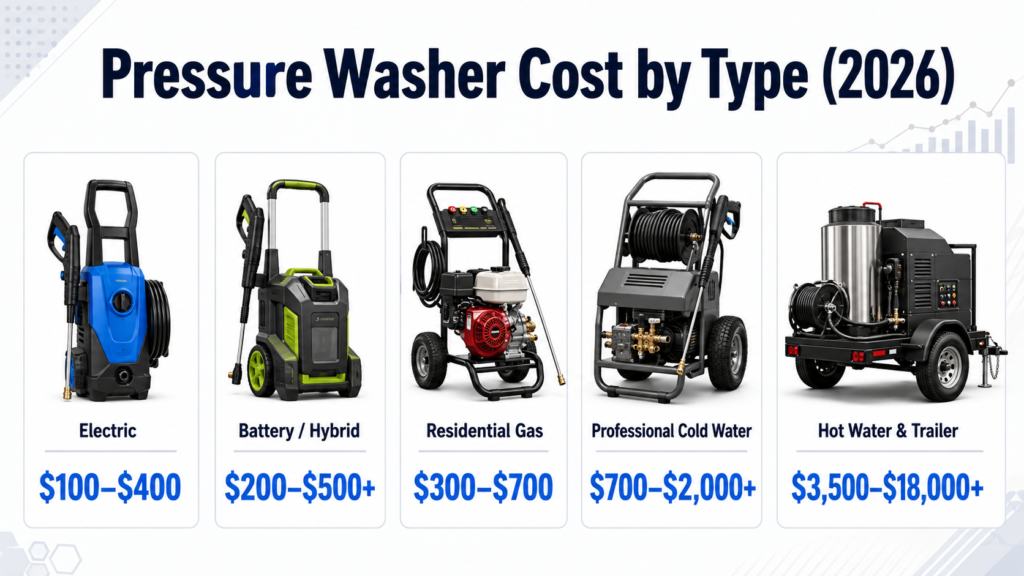
| Pressure Washer Type | 2026 Planning Price | Typical Use | Important Cost Detail |
|---|---|---|---|
| Light-duty electric | $100–$200 | Vehicles, furniture, and small household jobs | Usually lower purchase and maintenance cost |
| Higher-output electric | $200–$400 | Patios, walkways, fences, and recurring maintenance | Compare GPM, hose length, motor, and accessories |
| Battery or hybrid | $200–$500+ | Portable or remote light-to-medium work | Displayed price may exclude batteries or charger |
| Residential gas | $300–$700 | Driveways, concrete, and larger residential projects | Add fuel, engine maintenance, and storage |
| Professional cold-water | $700–$2,000+ | Frequent or paid exterior-cleaning work | Pump, engine, GPM, duty cycle, and warranty matter |
| Commercial hot-water or trailer | $3,500–$18,000+ | Grease, commercial equipment, and intensive cleaning | Heating, trailer, tank, transport, fuel, and service add cost |
These are WashNumbers planning bands based on current published examples reviewed August 28, 2026. They are not universal averages, and individual products can fall outside the ranges.
How Much Does a Pressure Washer Cost in 2026?
A broad residential pressure washer may cost anywhere from approximately $100 to $1,000. However, that range does not describe every machine available.
Angi’s current pressure-washer comparison publishes an overall purchase range of approximately $100–$1,000 for common electric and gas equipment.
Current retailer listings show why the type of machine matters:
- Home Depot listed a 1,900 PSI RYOBI electric pressure washer at approximately $169.
- A higher-output 2,500 PSI RYOBI electric model was listed at approximately $299.
- Greenworks listed some higher-output electric models around $400.
- Residential 3,200 PSI gas models were listed around $329–$490.
- Professional cold-water models at the same advertised PSI could exceed $800 or $1,000 because of their engines, pumps, frames, and intended duty.
- Northern Tool’s commercial hot-water listings extended from approximately $3,900 to well above $10,000.
The correct comparison is therefore not simply “How much is a pressure washer?” It is “How much is a pressure washer built for the work, frequency, and ownership responsibilities I actually have?”
Pressure Washer Purchase Cost Calculator
Use the calculator below to combine the machine price with sales tax, accessories, operating expenses, maintenance, ownership period, and expected usage.
The preset machine prices are editable planning defaults. Replace them with an actual retailer price or contractor-equipment quote whenever possible.
Pressure Washer Purchase Cost Calculator
Estimate upfront cost, first-year cost, multi-year ownership cost, and cost per use. Every value can be edited.
The calculator uses your inputs, not a claim about a universal average. It excludes financing charges, storage space, unexpected major repairs, and the value of your time.
Pressure Washer Prices by Type
Light-Duty Electric Pressure Washer Cost
A compact or light-duty corded electric pressure washer may cost approximately $100–$200.
These machines are generally aimed at occasional household work such as:
- Washing outdoor furniture
- Cleaning a vehicle carefully
- Removing light buildup from a small patio
- Cleaning bins, tools, or other small surfaces
Electric machines are typically quieter, lighter, and easier to maintain than gas machines. However, their lower flow rate and lighter construction may make large or heavily soiled projects slower.
A low purchase price does not automatically mean poor value. It may be the most economical option when the machine will only be used occasionally for small jobs.
Higher-Output Electric Pressure Washer Cost
More capable corded electric models commonly fall around $200–$400.
For example, current listings reviewed by WashNumbers included electric models around $269–$400, depending on advertised PSI, GPM, motor design, accessories, and promotions.
These machines may be better suited to:
- Patios and walkways
- Small or medium driveways
- Fences
- Decks when the material and cleaning method permit it
- Recurring household maintenance
Electric pressure washers still require access to a suitable electrical outlet and water supply. Hose length, cord management, GPM, and the included nozzles can matter as much as the headline PSI.
Battery and Hybrid Pressure Washer Cost
Battery-powered and hybrid pressure washers can cost approximately $200–$500 or more.
Always check whether the displayed price includes:
- Battery
- Charger
- Additional battery packs
- Hose
- Spray gun
- Nozzles
- Detergent equipment
A tool-only price can look inexpensive but produce a much higher complete-system cost if the buyer does not already own compatible batteries.
Battery machines offer portability, but battery runtime and available cleaning power should be considered before choosing them for large surfaces.
Residential Gas Pressure Washer Cost
Residential gas pressure washers commonly cost approximately $300–$700.
Current examples reviewed by WashNumbers included 3,200 PSI gas machines listed at approximately $329 and $490.
Gas equipment commonly provides more water flow and sustained cleaning capability than a basic electric machine. It can be useful for larger driveways, concrete, extensive flatwork, and locations where an electrical cord would be inconvenient.
The higher purchase price may also bring additional ownership responsibilities:
- Fuel
- Engine oil
- Spark-plug and air-filter maintenance
- Pump care
- Winterization
- Noise
- Exhaust emissions
- More storage space
A gas machine should normally be operated outdoors and according to all manufacturer safety instructions.
Professional Cold-Water Pressure Washer Cost
Professional cold-water pressure washers may cost approximately $700–$2,000 or more.
Two machines can advertise similar PSI while having very different prices. The more expensive machine may include:
- A higher-quality engine
- Greater GPM
- A triplex pump
- Serviceable pump components
- A stronger frame
- Commercial hoses and fittings
- A longer expected duty cycle
- Better access to replacement parts
- A commercial warranty
Contractors should evaluate equipment cost as part of the complete economics of the business. The WashNumbers pressure washing pricing calculator can help separate equipment wear, labor, overhead, direct costs, fees, and target profit when building a customer quote.
Commercial Hot-Water Pressure Washer Cost
Commercial hot-water machines can cost approximately $3,500–$10,000 or more. Large trailer-mounted systems may exceed $10,000–$18,000.
Current Northern Tool listings reviewed by WashNumbers included:
- A hot-water commercial machine around $3,900
- Larger systems around $8,000
- A trailer-mounted system around $11,000
- Higher-specification commercial configurations approaching or exceeding $18,000
Hot water can be useful for grease, oil, food-service residue, equipment cleaning, and other commercial contamination. The system is more complex because it may include a burner, heating coil, fuel system, additional controls, tank, and trailer.
That complexity increases purchase cost, fuel use, maintenance requirements, transportation needs, and potential repair expenses.
What Determines the Price of a Pressure Washer?
Power Source
Corded electric machines generally have the lowest entry price. Battery, gas, diesel, and hot-water systems introduce additional components and higher costs.
PSI and GPM
PSI describes water pressure, while GPM describes water flow.
Neither figure means much if the tip on the end is the wrong size. A machine rated 4,000 PSI running one orifice size too large puts out around 3,160, and the plate on the pump will still say 4,000. The nozzle chart has the sizing table and the formula behind it.
A machine with more GPM can often rinse and clean larger surfaces more efficiently. PSI alone should not be used to judge value or suitability.
Multiplying PSI by GPM produces a simplified “cleaning units” comparison, but it does not measure pump quality, duty cycle, nozzle selection, cleaning method, or surface safety.
Pump Design
Entry-level residential machines often use less expensive pump designs. Professional machines may use serviceable triplex pumps designed for more frequent use.
Pump replacement or repair can be one of the most important long-term ownership considerations.
Engine or Motor Quality
The engine or motor affects purchase price, durability, servicing, noise, portability, and operating requirements.
Professional engines and brushless electric motors may cost more than basic consumer alternatives.
Cold Water Versus Hot Water
Heating water requires substantially more equipment. Commercial hot-water systems can include a burner, heating coil, fuel tank, temperature controls, and additional safety components.
Duty Cycle and Construction
A homeowner using a pressure washer several times per year has different requirements from a contractor operating equipment for hours every week.
Frames, wheels, hoses, pumps, engines, fittings, and thermal protection may all change with the intended duty.
Included Accessories
A higher machine price may include equipment that would otherwise need to be purchased separately.
Compare the complete package rather than the machine alone:
- Surface cleaner
- Turbo nozzle
- Additional spray tips
- Longer hose
- Hose reel
- Detergent tank
- Batteries and charger
- Wand extensions
- Quick-connect fittings
Warranty and Replacement Parts
A lower purchase price may be less attractive if replacement parts are difficult to obtain or the warranty excludes the intended use.
Contractors should verify whether a residential warranty remains valid when the machine is used commercially.
Additional Pressure Washer Costs
Sales Tax and Delivery
Displayed prices may not include sales tax, delivery, lift-gate service, assembly, or freight.
These costs can be particularly important for commercial skid units and trailer-mounted systems.
Surface Cleaner
A surface cleaner can make large areas of concrete or pavement faster and more consistent to clean.
Compatibility depends on the machine’s PSI, GPM, fittings, and manufacturer guidance. Buying a surface cleaner that is too large for the machine’s flow can produce poor results.
Extra Hose and Fittings
A longer pressure hose can improve reach but adds cost and may affect pressure or handling.
Hose quality, temperature rating, maximum PSI, fittings, and compatibility should be checked before purchase.
Nozzles and Spray Accessories
Turbo nozzles, foam equipment, extension wands, gutter attachments, and specialty tips can increase the setup cost.
The most aggressive attachment is not automatically the safest or most appropriate one for a surface.
Detergents and Chemicals
Cleaning products should be compatible with the machine, application system, surface, local rules, and manufacturer instructions.
Chemical cost can become significant for contractors or frequent users.
Protective Equipment
The initial budget may also need to cover:
- Eye protection
- Suitable footwear
- Gloves
- Hearing protection for louder equipment
- Protective clothing
- Traffic or work-area controls
Fuel, Electricity, and Water
Gas and hot-water systems require fuel, while electric machines use household or commercial electricity.
Every pressure washer also requires water. Use the WashNumbers pressure washer water usage calculator to estimate gallons used, supply shortfall, tank runtime, refill requirements, and variable water cost.
Maintenance and Repairs
Possible ownership expenses include:
- Engine oil
- Pump oil when applicable
- Spark plugs
- Air filters
- Fuel treatment
- Pump protector
- Hose replacement
- O-rings and fittings
- Nozzle replacement
- Battery replacement
- Burner service
- Unexpected pump or engine repairs
Storage and Transportation
A compact electric machine may fit on a shelf. A professional gas machine, skid, buffer tank, hose reel, or trailer system may require substantial storage and transport capacity.
Those requirements are real ownership costs even when they do not appear on the product’s price tag.
Water is the cost nobody budgets for. Our figures for how much water a pressure washer uses put a number on it by machine type and job length.
Example: Three-Year Pressure Washer Ownership Cost
Assume a homeowner buys a $299 electric pressure washer and adds $100 of accessories.
With 7% sales tax, $60 per year in operating expenses, $40 per year in maintenance allowance, three years of ownership, and 12 uses per year:
| Machine price | $299.00 |
|---|---|
| Accessories and setup | $100.00 |
| Upfront cost with 7% sales tax | $426.93 |
| Three years of operating and maintenance costs | $300.00 |
| Modeled three-year ownership cost | $726.93 |
| Modeled cost per use across 36 uses | $20.19 |
The modeled three-year cost is approximately $726.93, or $20.19 per use across 36 uses.
This example is only arithmetic. It does not claim that every owner will experience the same costs or equipment life.
How Much Should You Spend on a Pressure Washer?
Occasional Small Household Jobs
A budget of approximately $100–$200 may be reasonable for a basic electric machine when the work is light and infrequent.
Regular Residential Maintenance
A budget around $200–$400 may provide a broader selection of higher-output electric machines and included accessories.
Larger Driveways and Frequent Flatwork
A budget of approximately $300–$700 opens more residential gas and higher-output electric options.
Surface compatibility and safe technique still matter. More pressure is not always appropriate.
Starting a Pressure Washing Business
A contractor may need to budget approximately $700–$2,000 or more for a professional cold-water machine, before considering hoses, reels, tanks, chemicals, surface cleaners, insurance, transport, and other business expenses.
The cheapest machine capable of producing water pressure is not necessarily capable of supporting repeated paid work.
Commercial Grease and Hot-Water Applications
Budgets may begin around $3,500–$5,000 and rise beyond $10,000 for larger commercial and trailer-mounted systems.
The complete project may also require water storage, wastewater planning, transport, burner fuel, commercial accessories, and additional maintenance.
Buying the machine is the easy part. Pricing your jobs properly is what decides whether it pays for itself.
Should You Buy, Rent, or Hire a Professional?
Buying May Make Sense When
- You expect to use the machine repeatedly.
- You have suitable storage.
- You are comfortable maintaining it.
- The machine fits several recurring tasks.
- Long-term ownership cost is lower than repeated rentals.
Renting May Make Sense When
- You only have one or two projects.
- You need a specialized machine temporarily.
- You do not have storage space.
- You want to test a machine category before buying.
- The rental includes equipment that would be expensive to purchase.
Our pressure washer rental cost guide compares rental time, taxes, accessories, transport, fuel, cleaning products, and professional alternatives.
Hiring a Professional May Make Sense When
- The surface is delicate or easily damaged.
- The property has difficult access.
- The project involves significant height.
- Oil, grease, rust, biological growth, or other contamination requires specialist treatment.
- Wastewater handling or local restrictions complicate the work.
- The owner does not have the time, equipment, or experience to perform the work safely.
Use the WashNumbers pressure washing cost calculator to create a planning estimate for professional residential cleaning.
Is a Used Pressure Washer Worth Buying?
A used pressure washer can reduce the initial purchase price, but the discount should be weighed against condition and remaining service life.
Before purchasing used equipment, consider checking:
- Cold-start behavior
- Engine smoke or unusual noise
- Pump pressure and water flow
- Oil condition
- Water, fuel, or oil leaks
- Hose damage
- Trigger-gun operation
- Unloader behavior
- Burner operation on hot-water equipment
- Maintenance records
- Engine hours when available
- Replacement-part availability
- Whether the warranty is transferable
A low used price can become expensive if the machine immediately needs a pump, hose, engine, burner, battery, or other major component.
There is no reliable universal percentage that every used machine should cost relative to new. Age, condition, service history, brand, local availability, and included accessories all matter.
Pressure Washer Cost FAQs
What Is the Average Cost of a Pressure Washer?
Angi currently publishes a broad purchase range of approximately $100–$1,000 for common pressure washers.
However, basic electric machines may cost near the lower end, while professional cold-water and hot-water commercial systems can cost substantially more than $1,000.
How Much Does an Electric Pressure Washer Cost?
Basic and higher-output electric pressure washers commonly cost approximately $100–$400 based on current listings reviewed by WashNumbers.
Battery-powered models may cost more when batteries and chargers are included separately.
How Much Does a Gas Pressure Washer Cost?
Many residential gas pressure washers cost approximately $300–$700.
Professional gas machines with serviceable pumps, stronger engines, greater GPM, and commercial components may cost approximately $700–$2,000 or more.
How Much Does a Commercial Pressure Washer Cost?
Professional cold-water machines may cost approximately $700–$2,000 or more.
Commercial hot-water and trailer systems can range from approximately $3,500 to more than $18,000, depending on flow, pressure, heating system, engine, pump, tank, trailer, and configuration.
How Much Do Pressure Washer Accessories Cost?
A basic setup may require only a small nozzle or detergent purchase, while a more complete system could add hundreds or thousands of dollars.
Surface cleaners, hoses, reels, tanks, batteries, chargers, fittings, chemical systems, and professional accessories should be priced separately.
Is It Cheaper to Buy or Rent a Pressure Washer?
Buying can become less expensive when the machine is used repeatedly over several years.
Renting may cost less for a single project or when a specialized machine is only needed temporarily. Compare the complete costs, including taxes, transport, accessories, fuel, cleaning products, maintenance, storage, and your time.
How Do You Calculate Pressure Washer Cost per Use?
A simple planning formula is:
Cost per use = (upfront cost + ownership expenses − resale value) ÷ total expected uses
The calculator on this page performs that calculation using editable assumptions.
Is a More Expensive Pressure Washer Always Better?
No.
The best-value machine is the one that safely matches the intended surfaces, cleaning frequency, water supply, storage, maintenance capability, and required duty.
Paying for power or commercial capability that will never be used may not improve value.
Methodology and Current Price References
WashNumbers reviewed current published retailer, manufacturer, and consumer-pricing references on August 28, 2026.
Examples used to develop the planning bands include:
- Angi’s pressure washer buy, rent, or hire comparison
- Current RYOBI pressure washer listings at Home Depot
- Current 3,200 PSI gas pressure washer listings at Home Depot
- Current Greenworks electric pressure washer listings
- Current Northern Tool hot-water pressure washer listings
Retail prices, availability, promotions, shipping, taxes, and included accessories can change. A listed product is an example, not an endorsement or a verified national average.
Read the complete WashNumbers methodology for information about published references, modeling assumptions, limitations, and updates.
Work out your own number
Pressure Washing Cost Calculator
Put in your own square footage and surface instead of using an average.
Cost per Square Foot
What the rate should be before anyone quotes you a total.
Minimum Charge Explained
Why a small job costs the same as a slightly bigger one.
The Pricing Dataset
220 published prices with the source behind every figure.
 Written by Diego Hernández, founder of WashNumbers. Cost models are built from published contractor rates and public price observations. See how we build these numbers.
Last reviewed: August 2026