
Use this pressure washing pricing calculator to estimate what you should charge for a job based on your labor, direct costs, overhead, payment fees, and target profit margin. Instead of relying on generic price-per-square-foot averages, WashNumbers helps you build a quote around the actual numbers behind your pressure washing business.
Run the numbers before you quote.
Calculate a pressure washing quote using your actual labor, job costs, overhead and target margin — not generic national averages.
Job details
Start with the basic information about the job.
Labor
Include the real labor cost of everyone working the job.
Direct job costs
Add expenses caused directly by completing this job.
Overhead
Allocate part of your ongoing business expenses to this job.
Pricing target
Choose the margin and pricing constraints for this quote.
How to Use the Pressure Washing Pricing Calculator
WashNumbers is a free pressure washing pricing calculator built for contractors who want to price jobs using their own costs, labor and profit targets. Instead of starting with a generic price per square foot, the calculator works backward from the economics of your business to estimate what you need to charge.
To build a quote, enter the estimated job time, crew size, labor rates, direct job expenses and overhead. Then choose your target profit margin, payment processing fees, minimum charge and rounding preference. The pressure washing quote calculator will calculate your modeled cost, target price, recommended quote, estimated profit and actual margin.
Already know what you plan to charge? Select Check My Quote and enter your proposed price. WashNumbers will show whether that pressure washing price covers the costs you entered and how much modeled profit and margin remain.
Looking for other ways to analyze your pricing and profitability? Explore our free pressure washing business tools for calculators designed around the financial side of running an exterior cleaning business.
How to Price a Pressure Washing Job
Pricing a pressure washing job involves more than multiplying square footage by a standard rate. A profitable quote needs to account for the time and money required to complete the work, the ongoing cost of operating the business and the profit the business needs to generate.
A practical pricing process starts by estimating the full cost of completing the job. That means accounting for labor, chemicals, fuel, equipment wear and other direct expenses before allocating an appropriate amount of business overhead.
Once those costs are understood, you can calculate the revenue required to achieve a desired profit margin. WashNumbers automates this process while keeping the individual cost assumptions visible, so you can see why a particular pressure washing price is being recommended.
What Should a Pressure Washing Quote Include?
The inputs in a pressure washing cost calculator are only useful when they reflect the real expenses of the business. Leaving out a significant cost can make a job appear more profitable than it actually is.
Labor Costs
Labor should include the value of your own working time as well as wages or labor costs for employees and helpers.
Owner labor and business profit are different. If you spend hours completing a job but assign no cost to your own time, the remaining money can look like profit even though part of it is effectively compensation for your labor.
WashNumbers can also include round-trip travel time in labor calculations. For multi-person crews, the calculator accounts for the additional labor hours created by each worker.
Chemicals and Cleaning Supplies
Include chemicals and consumable cleaning supplies that are expected to be used on the job. The amount can vary significantly depending on the service, surface condition, treatment method and property.
Fuel and Travel
Driving to and from a job consumes both fuel and time. WashNumbers separates the direct monetary cost of travel from travel time, allowing you to model each independently.
Equipment Wear
Pressure washers, surface cleaners, pumps, hoses and other equipment eventually require maintenance or replacement. Allocating an equipment wear cost to jobs can help prevent these expenses from being ignored when setting prices.
If you are planning an equipment purchase, review current pressure washer purchase costs before deciding how much machine depreciation, maintenance, and replacement cost to allocate across future jobs.
Lead Acquisition and Other Job Costs
If acquiring a particular customer has a measurable cost — such as paid advertising or a lead fee — you can include it in the job. The calculator also provides an additional field for other expenses that do not fit the standard categories.
Business Overhead
Overhead includes ongoing expenses required to operate the business that cannot always be assigned directly to a single pressure washing job. Depending on the business, these may include insurance, software, phone service, storage, accounting, licenses, marketing and fixed vehicle expenses.
WashNumbers lets you enter an overhead amount directly or estimate an hourly overhead rate from monthly overhead and expected billable business hours.
Pressure Washing Profit Margin vs. Markup
Profit margin and markup are often confused, but they measure different things.
Suppose your modeled cost for a pressure washing job is $200. Applying a 50% markup gives:
$200 × 1.50 = $300 selling price
The resulting profit is $100. However, $100 of profit on $300 of revenue represents a margin of only:
$100 ÷ $300 = 33.3% profit margin
If the goal were instead a true 50% margin, $100 of every $200 in revenue would need to remain after the modeled costs. Ignoring percentage-based transaction fees for this simplified example, a $200 cost would therefore require a $400 selling price.
The WashNumbers pressure washing pricing calculator uses target margin rather than simply adding a markup percentage to your costs.
How Payment Processing Fees Affect Your Quote
Payment processing is easy to underestimate because a percentage-based fee increases as the selling price increases.
For example, simply adding a 3% fee to your operating costs and then calculating your target margin does not model the transaction correctly. The processing percentage applies to the final amount collected from the customer.
WashNumbers therefore allows you to enter both a percentage processing fee and an optional fixed transaction fee. The pricing calculation accounts for those fees when determining the revenue required to reach your selected margin.
Pressure Washing Pricing Example
Consider a solo pressure washing operator estimating a job that will require three hours on site plus 30 minutes of round-trip travel.
The operator enters:
- Owner labor rate: $30 per hour
- On-site time: 3 hours
- Round-trip travel: 30 minutes
- Direct job costs: $60
- Allocated overhead: $40
- Target profit margin: 40%
- Processing fee: 3%
- Minimum job charge: $200
- Quote rounding: next $10
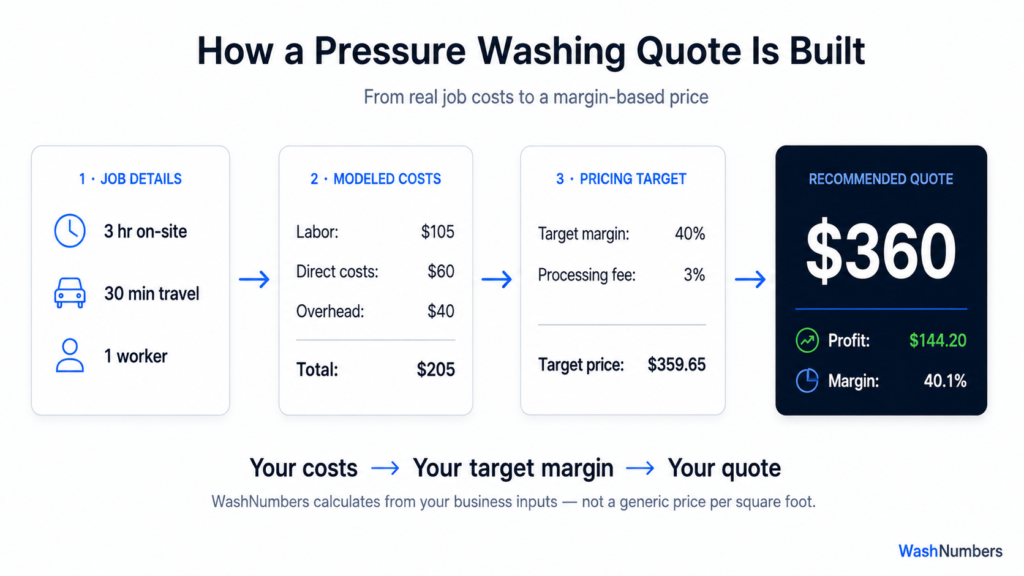
Because travel time is included in labor, the operator has 3.5 modeled labor hours. At $30 per hour, labor costs $105. Adding $60 in direct job costs and $40 in allocated overhead produces a modeled operating cost of $205.
With a 40% target margin and 3% processing fee, the calculated target price is approximately $359.65. Rounding upward to the next $10 produces a $360 recommended quote.
At $360, the 3% processing fee is $10.80. After the $205 modeled operating cost and processing fee, estimated modeled profit is $144.20, producing an actual modeled margin of approximately 40.1%.
Why We Don't Price Pressure Washing by Square Footage Alone
A price-per-square-foot rate can be useful for estimating or comparing pressure washing jobs, but square footage alone does not determine profitability.
Two 2,500-square-foot jobs can have different travel requirements, surface conditions, chemical consumption, labor time, access difficulties and equipment demands. Applying exactly the same rate to both jobs can therefore produce very different financial outcomes.
For this reason, WashNumbers does not use a generic pressure washing price per square foot to generate the recommended quote. The calculator first determines a price from the business inputs you provide.
If you enter square footage, WashNumbers then calculates the effective price per square foot implied by your quote. This gives you a useful comparison metric without allowing a generic market average to override your actual costs.
Understanding Your Pressure Washing Pricing Results
Modeled Cost
The total labor, direct job costs and allocated overhead included in the calculation.
Cost Floor
The approximate revenue required to cover the modeled operating costs and entered payment processing fees before targeting additional business profit.
Target Price
The calculated revenue required to achieve the profit margin selected in the pressure washing pricing calculator.
Recommended Quote
The target price after considering your minimum job charge and rounding the result upward according to your selected increment.
Estimated Profit
The quoted revenue remaining after subtracting the modeled operating costs and payment processing fees.
Profit Margin
Estimated modeled profit divided by quoted revenue. Because the recommended quote can be rounded upward or affected by your minimum charge, the resulting margin may be slightly higher than the target margin.
Profit per Total Job Hour
Estimated profit divided by on-site time plus round-trip travel time. This can provide a different perspective from looking only at the total profit from the job.
Revenue per Labor Hour
Total quoted revenue divided by the modeled labor hours across the crew.
Effective Price per Square Foot
When job size is entered, WashNumbers divides the quote by the number of square feet. This is a comparison metric and does not determine the recommended price.
Common Pressure Washing Pricing Mistakes
Pricing Only From a Competitor's Rate
Another contractor may have different labor costs, equipment, overhead, efficiency and profit requirements. A price that works for one pressure washing business may not work for another.
Treating Owner Labor as Profit
Money remaining after chemicals and fuel is not necessarily business profit if the owner's working time has not been accounted for.
Forgetting Overhead
Insurance, software, marketing and other recurring expenses still need to be funded even though they may not appear on an individual job receipt.
Confusing Markup With Margin
Adding 40% to your costs does not create a 40% profit margin. Margin is measured against revenue, while markup is measured against cost.
Ignoring Travel Time
A three-hour cleaning job may occupy substantially more than three hours of the working day once travel is included.
Letting Rounding Reduce the Target Margin
WashNumbers rounds recommended quotes upward so that rounding does not accidentally move the quote below the mathematically calculated target price.
Use Your Own Pressure Washing Business Numbers
There is no single pressure washing price that is appropriate for every contractor, service and market.
WashNumbers is designed to help you understand what a job looks like using your labor costs, your expenses, your overhead and your target margin. Local demand, competition, taxes, job difficulty, risk, experience and other factors may still influence the final price you decide to present to a customer.
For that reason, treat the recommended quote as a business planning output rather than a universal market rate.
Pressure Washing Pricing Calculator FAQ
How do I calculate a price for a pressure washing job?
Start by estimating the labor required to complete the job and add direct costs such as chemicals, fuel and equipment wear. Allocate an appropriate share of business overhead, then calculate the revenue required to achieve your desired profit margin. WashNumbers performs these calculations automatically from the values you enter.
Should I charge for pressure washing by the hour or square foot?
Both can be useful quoting methods, but neither automatically guarantees profitability. WashNumbers calculates a target price from costs and margin first and can then show the effective price per square foot for comparison.
Should I include my own labor when pricing jobs?
If you personally perform the work, assigning a labor cost to your time helps separate compensation for working in the business from the profit generated by the business.
What is the difference between pressure washing markup and margin?
Markup measures profit relative to cost, while margin measures profit relative to revenue. A 50% markup on a $200 cost produces a $300 price and a 33.3% margin, not a 50% margin.
Does the calculator tell me the average pressure washing price in my area?
No. WashNumbers does not estimate local market prices. It calculates results from the business costs, time estimates and pricing targets you enter.
Can I check a quote I've already calculated?
Yes. Select Check My Quote, enter the price you are considering and WashNumbers will estimate the profit and margin produced by that price using your entered costs.
Methodology and Limitations
WashNumbers uses deterministic formulas rather than AI-generated pricing recommendations. Given the same inputs, the calculator will produce the same modeled result.
Results depend entirely on the accuracy and completeness of the information entered. Actual costs, taxes, payment fees, job duration and profitability may differ.
WashNumbers provides business planning estimates and educational information. It does not provide accounting, tax, legal or financial advice.
For the formulas, definitions and assumptions used by our calculators, see the WashNumbers Methodology.
If you want the reasoning rather than just the number, the guide on working out your rate from your own costs walks through the whole calculation.
Tools for your business
Contractor Pricing Calculator
Build a quote that still leaves a margin after chemicals and drive time.
Production Rate Calculator
The hours a job takes, before you can price it.
Startup Cost Calculator
What a rig costs to build and how many jobs pay it back.
Add Your Rates to the Survey
Seven questions. You get the state-by-state results first.
 Written by Diego Hernández, founder of WashNumbers. Cost models are built from published contractor rates and public price observations. See how we build these numbers.
Last reviewed: August 2026