
A guy in Phoenix bought a 36 inch surface cleaner for a 4 GPM machine because bigger has to be faster. It was not. He dropped to a 20 inch deck and got about thirty percent of his cleaning speed back, which is the kind of number that makes you wonder how much money the first deck cost him before he worked it out.
That is the whole problem with surface cleaner size in one story. The deck does not clean anything. The water does. Buy more deck than your pump can feed and the spray bar turns slowly, the passes stripe, and you walk a driveway twice.
What makes it worse is that the spec you need to get this right is the one manufacturers do not publish.
The number that decides surface cleaner size is GPM, not PSI
The same GPM figure decides your wand tip as well. Get the surface cleaner right and fit the wrong orifice on the wand and you have still lost a third of your pressure, so it is worth checking both against the nozzle sizing table.
PSI is stripping force. GPM is what spins the bar and flushes what you just stripped off the slab. J. Racenstein puts flow at the 80 percent factor in your hourly output and reckons an 8 GPM machine finishes a 1,000 square foot driveway roughly 50 percent faster than a 4 GPM one at the same pressure.
So surface cleaner size is a flow question. Every rule of thumb in this trade is some version of inches per gallon.
The trouble is that the rules disagree with each other by a factor of two.
Four published rules for surface cleaner size, four different answers
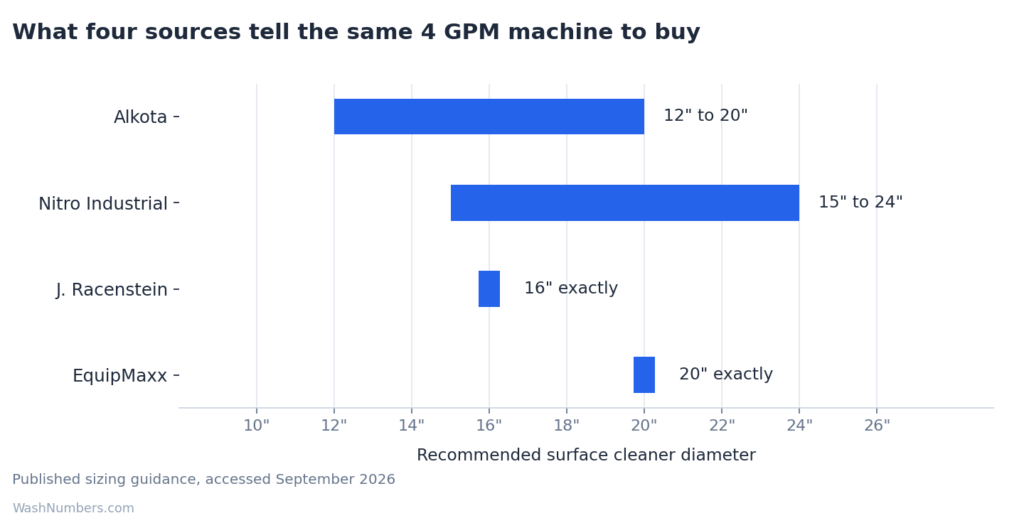
Here is what the sources actually say, side by side, for the same 4 GPM machine.
| Source | The rule as published | 4 GPM machine | 8 GPM machine |
|---|---|---|---|
| J. Racenstein | Four inches of cleaner diameter per GPM | 16″ | 28″ to 30″, where they cap it |
| Alkota | 2 to 3 GPM is below the threshold for a cleaner at all; 4 GPM takes 12″ to 20″; 5 to 8 GPM takes 24″ to 30″ | 12″ to 20″ | 24″ to 30″ |
| Nitro Industrial | 10″ to 12″ for 1.5 to 2.5 GPM; 15″ to 16″ for 2.5 to 4 GPM; 20″ to 24″ for 4 GPM and up | 15″ to 24″ | 20″ to 24″ |
| EquipMaxx | A 20″ needs 3 GPM minimum with 4 GPM the sweet spot; 24″ and up needs 5 GPM or more | 20″ | 24″ and up |
At 4 GPM you are being told to buy anywhere from a 12 inch deck to a 20 inch deck depending on who you ask. That is not a rounding difference. That is one source telling you a machine is barely big enough for a surface cleaner at all and another putting you on a deck nearly three times the area.
My read, and it is a read rather than a measurement: the four-inches-per-gallon rule is the one that matches what manufacturers actually build. A 4 GPM machine on a 16 to 19 inch deck is the configuration the whole industry sells, and the conservative rule is written by a retailer who would rather sell you a second cleaner later than field a complaint now.
The surface cleaner size spec nobody publishes
Here is the gap. To choose a surface cleaner size properly you need the minimum GPM a deck needs to work. What gets printed on the product page is almost always the maximum it can take.
Look at what that produces.
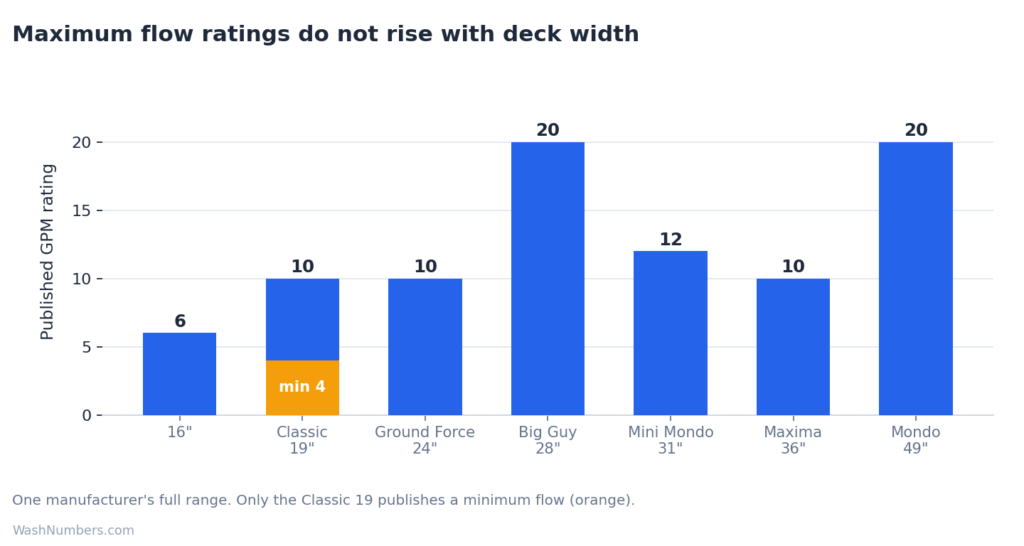
| Model | Diameter | Published GPM | PSI | What that tells you |
|---|---|---|---|---|
| Whisper Wash 16 | 16″ | 6 max | 5,000 | Ceiling only |
| Whisper Wash Classic | 19″ | 4 min, 10 max | 2,000 to 4,000 | The only floor in the range |
| Ground Force | 24″ | 10 max | 5,000 | Ceiling only |
| Big Guy | 28″ | 20 max | 5,000 | 38 lb operating weight |
| Mini Mondo | 31″ | 12 max | 5,000 | Dual swivel |
| Maxima | 36″ | 10 max | 5,000 | Rated for half the flow of the 28″ |
| Mondo | 49″ | 20 max | 5,000 | Dual swivel |
Read that column carefully. A 28 inch deck is rated to 20 GPM and a 36 inch deck to 10. The bigger cleaner takes twice the flow of the one that is eight inches wider. Those are ceilings, set by hose and swivel and nozzle capacity, and they tell you nothing whatsoever about how much water the thing needs to turn properly.
Whisper Wash is one of the very few that publishes a floor: the Classic 19 lists a minimum of 4 GPM and a maximum of 10. That single number is more useful for picking a surface cleaner size than every max rating in the table put together, and almost nobody else prints it.
So the trade runs on rules of thumb because the specification that would settle the argument is not on the box.
What actually goes wrong when the deck is too big
Getting surface cleaner size wrong in this direction fails in three ways, in order of how much they cost you.
The bar slows down. A rotating spray bar is driven by reaction from the nozzles. Split the same flow across a longer arm at a bigger radius and it turns slower, which means the same square foot gets hit fewer times per second as you walk.
You get striping. Alkota describes it as shadowing or striping that leaves swirl marks on the surface, and once a customer sees zebra stripes across their driveway in raking afternoon light you are going back to redo it.
You walk it twice. Which is the Phoenix case. An oversized deck on a starved machine is genuinely slower than a correctly matched smaller one, and that is the counterintuitive bit that costs people money.
Undersized is a much milder failure. A 12 inch deck on an 8 GPM machine cleans well, just in more passes with more turns, and turns are where flatwork time really goes. If you have to be wrong, be wrong small.
Nozzle maths, because this is where people actually get stuck
Your machine has a total flow. The cleaner splits it across two tips, or four.
The arithmetic is additive. Alkota gives the example plainly: a single #6 becomes a pair of #3s on a two-nozzle bar. Four tips on the same machine means four smaller orifices, not four of the same.
Two practical consequences. Running a two-tip bar where the cleaner shipped with four, without changing tip sizes, starves it. And buying a used deck off Facebook that comes with somebody else’s tips in it means you are running their machine’s flow, not yours. Check the tips before you blame the surface cleaner size.
The constraints nobody mentions until you own the thing
Surface cleaner size is not only a hydraulic decision.
Gate width. A standard residential side gate is 36 inches and a lot of older ones are 32. A 31 inch Mini Mondo does not go through a 32 inch gate with your hands on the handle. Measure a gate before you buy a big deck for residential work.
Weight, wet. A 28 inch aluminium deck runs about 38 pounds operating. That is fine on flat concrete and unpleasant lifting in and out of a truck bed forty times a week.
The swivel. This is the part that fails and the part worth paying for. Sealed bearing swivels last, bushing swivels wear and start weeping, and a leaking swivel drips down the inside of the deck and marks the surface you are cleaning. If you are choosing between two cleaners at the same surface cleaner size, buy the one with the better swivel and ignore everything else on the spec sheet.
Deck material. Aluminium is the working standard. Poly is lighter and cheaper and cracks if you drop it off a tailgate. Stainless is heavy and mostly bought for looks.
So what do I buy
Explicit, because everything above is caveats. This is the surface cleaner size I would put on each setup.
One 4 GPM machine, mostly residential driveways and patios. A 16 to 19 inch deck with a bearing swivel. Do not let anyone talk you up to 24.
5 to 6 GPM. 20 to 24 inches. This is the sweet spot of the trade and where most working contractors end up.
8 GPM and above, commercial flatwork. 24 to 30 inches, and at that point you are also thinking about a second deck for gates and small patios rather than one cleaner for everything.
Two machines you can run together. Size to the combined flow only if you are actually going to run both into one cleaner, which needs a Y and matched hose. Otherwise size to the bigger machine.
And if you are already at the top end and wondering whether a bigger deck will move your day rate, the honest answer is that the deck is not usually the constraint. Our collected production rates for flatwork put a single operator between 1,500 and 3,500 square feet an hour, and the difference between the bottom and the top of that range is flow and site conditions more than diameter.
What this changes about your pricing
If you have been quoting flatwork off somebody else’s square-foot rate without knowing whether their setup matches yours, the surface cleaner size is one of the reasons your numbers do not land. A 4 GPM operator on a 16 inch deck and an 8 GPM operator on a 24 will not make the same money at the same price per square foot.
The published ranges are in our cost per square foot breakdown, and the reason a small job has to carry a floor regardless of area is in why minimum charges exist.
Frequently asked questions
What surface cleaner size do I need for a 4 GPM pressure washer?
16 to 19 inches. Whisper Wash lists 4 GPM as the minimum for its 19 inch Classic, so a 4 GPM machine is right at the floor of that deck rather than comfortably above it. If your machine is a genuine 4.0 and not an optimistic rating, stay at 16.
Can I use a surface cleaner with a 3 GPM machine?
Marginally. Alkota puts 2 to 3 GPM machines below the threshold for a surface cleaner attachment altogether, and 15 to 16 inch decks are commonly rated from 2.5 GPM. It will turn. It will not clean quickly, and you will be walking slowly enough that a wand is competitive.
Does a bigger surface cleaner always clean faster?
No, and this is the most common expensive mistake in choosing a surface cleaner size. An oversized deck on an undersized machine starves the spray bar and cleans more slowly than a smaller deck running properly. One documented case gained about thirty percent going from 36 inches down to 20 on a 4 GPM machine.
How do I know if my surface cleaner is starved?
Listen to the bar and look at the finish. A properly fed cleaner spins fast enough that you hear a steady whirr rather than individual passes, and it leaves an even matt finish. Visible arcs or stripes at normal walking pace means either too little flow or too much speed.
What PSI do I need for a surface cleaner?
Most decks are rated to 4,000 or 5,000 PSI, which is well above what you should be putting on residential concrete anyway. Pressure is not what limits your choice here. Flow is, which is why every sizing rule in this trade is written in gallons.
How many nozzles should my surface cleaner have?
Two on smaller decks, four on larger ones. What matters is that the tips add up to your machine’s flow: a #6 total becomes two #3s or four smaller tips, and running the wrong set is the most common reason a correctly sized cleaner underperforms.
Should I match surface cleaner size to two machines run together?
Only if you are genuinely going to feed one deck from both, which needs a Y fitting and matched hose runs. Otherwise size to the larger machine on its own, because the day one pump goes down you still have to finish the job.
Aluminium, poly or stainless?
Aluminium for working use. Poly is fine for light duty and cracks when dropped. Stainless adds weight and cost without adding cleaning performance, and the swivel matters far more than the shroud material either way.
Help fix the thinnest data in this trade
Every sizing rule on this page is somebody’s rule of thumb, including the ones I agree with. Nobody publishes minimum GPM by diameter, nobody publishes production by deck size, and I have not found a single manufacturer table that would let you choose a surface cleaner size from measured data rather than from custom.
We are collecting the real numbers directly from working US contractors, including equipment and what it produces. Seven questions, answered in ranges, no business named. Contributors get the full breakdown before it goes public.
Add your numbers to the 2026 pricing survey
Tools for your business
Contractor Pricing Calculator
Build a quote that still leaves a margin after chemicals and drive time.
Production Rate Calculator
The hours a job takes, before you can price it.
Startup Cost Calculator
What a rig costs to build and how many jobs pay it back.
Add Your Rates to the Survey
Seven questions. You get the state-by-state results first.
 Written by Diego Hernández, founder of WashNumbers. Cost models are built from published contractor rates and public price observations. See how we build these numbers.
Last reviewed: September 2026