
Every pressure washer nozzle chart online answers the easy question. Red is zero degrees, white is forty, black is soap. Fine. Then you walk into a supply house, look at a wall of tips stamped 25040 and 2504, and realize the color was never the part you needed.
The part you needed is the number. That number is what decides whether your machine puts out the pressure it says on the pump, and almost nobody publishes it in a form you can read on a phone.
So this one covers both. The colors, quickly, because they take thirty seconds. Then the sizing, properly, including the arithmetic so you can size a tip for any machine rather than hoping yours matches a poster built for a 4,000 PSI unit.
What the color actually tells you
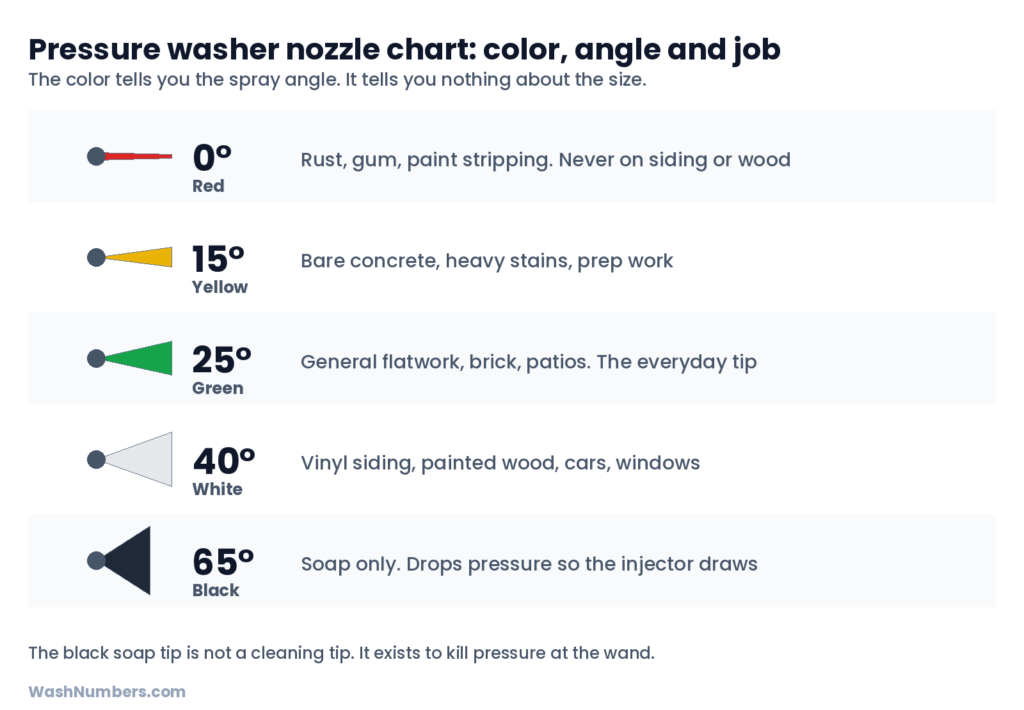
The color is the spray angle. That is the whole of it.
A red tip throws a pencil of water at zero degrees. A white one spreads it across forty. The wider the fan, the more the force is spread out, so the same machine hits softer per square inch and covers more ground per pass.
That trade is the only thing the color describes. It says nothing about how much water goes through the tip, and nothing about what pressure your pump will see.
Two red nozzles sitting next to each other in the same bin can belong to completely different machines. Same color, same angle, different orifice, and fitting the wrong one will cost you a third of your pressure or blow past what your pump is rated for.
The practical rule. Pick the color by the surface. Pick the number by the machine. They are two separate decisions, and any pressure washer nozzle chart that only shows you colors has answered half the question.
The number stamped on the nozzle
Look at the flat of the tip. You will see four or five digits.
The first two are the angle. The rest are the orifice size.
| Stamped on the tip | Spray angle | Orifice size |
|---|---|---|
| 2504 | 25° | 4.0 |
| 25040 | 25° | 4.0 |
| 1503 | 15° | 3.0 |
| 4005 | 40° | 5.0 |
| 0002 | 0° | 2.0 |
Four digit and five digit stampings mean the same thing. The five digit version just carries a decimal place, so 25040 is a 4.0 and 25045 is a 4.5. Different manufacturers print it differently and it trips people up constantly.
The orifice number is not a diameter in inches. It is the flow the tip passes, in gallons per minute, at 4,000 PSI. That definition is what makes the sizing arithmetic work.
Pressure washer nozzle chart by GPM and PSI
This is the half of the pressure washer nozzle chart that actually decides your pressure. Find your machine’s flow down the side and its pressure across the top. Where they meet is the orifice you want.
| Machine GPM | 1,500 PSI | 2,000 PSI | 2,500 PSI | 3,000 PSI | 3,500 PSI | 4,000 PSI |
|---|---|---|---|---|---|---|
| 2.0 | 3.5 | 3.0 | 2.5 | 2.5 | 2.0 | 2.0 |
| 2.5 | 4.0 | 3.5 | 3.0 | 3.0 | 2.5 | 2.5 |
| 3.0 | 5.0 | 4.0 | 4.0 | 3.5 | 3.0 | 3.0 |
| 3.5 | 5.5 | 5.0 | 4.5 | 4.0 | 3.5 | 3.5 |
| 4.0 | 6.5 | 5.5 | 5.0 | 4.5 | 4.5 | 4.0 |
| 5.0 | 8.0 | 7.0 | 6.5 | 6.0 | 5.5 | 5.0 |
| 5.5 | 9.0 | 8.0 | 7.0 | 6.5 | 6.0 | 5.5 |
| 8.0 | 12.0 | 11.0 | 10.0 | 9.0 | 8.5 | 8.0 |
Two things about this table that the posters on supply house walls do not tell you.
Your machine’s numbers are on the pump, not the box. Retail boxes quote peak figures. The plate on the pump is what you size against.
Round to the nearest available size, and if you are between two, go up. A tip slightly too large costs you some pressure. A tip slightly too small sends it somewhere it should not go, which is the next section.
The formula, so you can size any machine
The table covers the common combinations. Real machines land between them all the time, and a 3,500 PSI unit has no business reading a pressure washer nozzle chart built for 4,000.
The arithmetic is one line:
Nozzle size = GPM × √(4,000 ÷ PSI)
That is the industry formula, published by Dultmeier Sales, who have been selling this equipment since 1935.
Worked example
A 4.0 GPM machine rated at 3,000 PSI.
4,000 ÷ 3,000 = 1.333 √1.333 = 1.155 4.0 × 1.155 = 4.62
Nozzles come in half sizes, so you buy a 4.5. If the job wants a bit more bite you could run a 4.5 and accept slightly higher pressure. You would not drop to a 4.0.
Run it once for your machine, write the number on the side of the trailer, and never think about it again. Every tip you buy from then on is that number with whatever angle the job needs.
What happens when the size is wrong
This is the part that costs people money, and I have never seen it published with actual figures. So here they are.
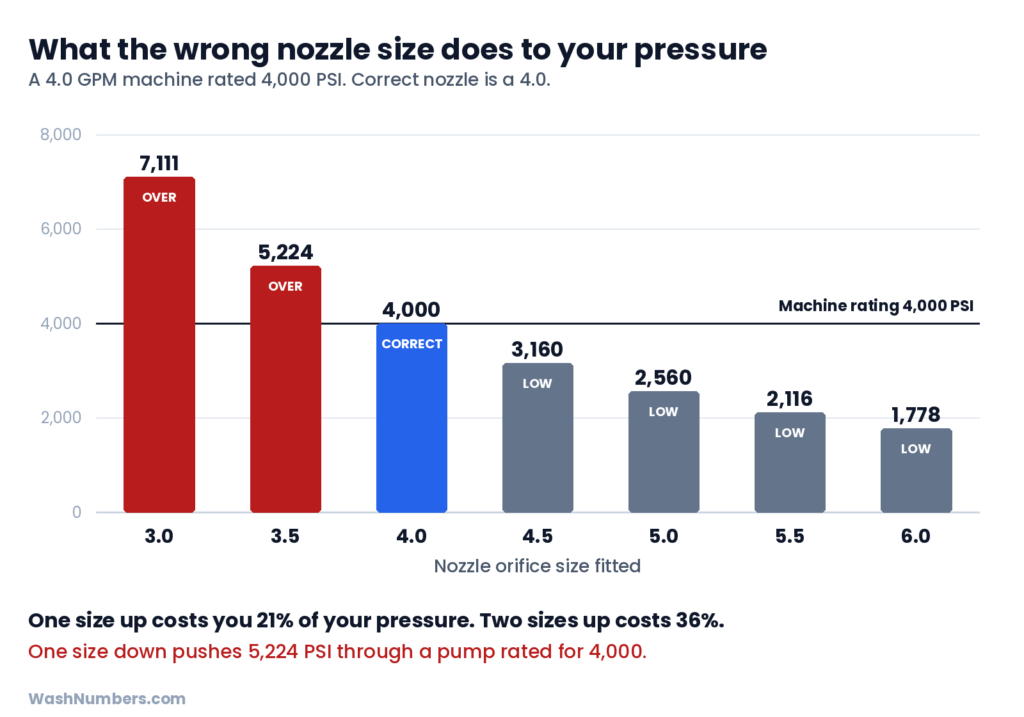
Take a 4.0 GPM machine rated 4,000 PSI. Correct tip is a 4.0.
| Nozzle fitted | Pressure at the tip | Against the 4,000 PSI rating |
|---|---|---|
| 3.0 | 7,111 PSI | 78% over |
| 3.5 | 5,224 PSI | 31% over |
| 4.0 | 4,000 PSI | Correct |
| 4.5 | 3,160 PSI | 21% under |
| 5.0 | 2,560 PSI | 36% under |
| 5.5 | 2,116 PSI | 47% under |
| 6.0 | 1,778 PSI | 56% under |
Go one size up to a 4.5 and you lose 21% of your pressure. The machine is not broken. The gauge is not lying. You fitted a bigger hole and the water leaves without building up behind it.
Go two sizes up and you have a 4,000 PSI machine putting out 2,560. That is the situation behind most of the “my pressure dropped, is my pump going?” threads on every contractor forum, and the fix is a two dollar tip.
The other direction is worse. A 3.5 on that machine puts 5,224 PSI through a pump rated for 4,000. What happens next depends on your unloader. If it is set right it dumps and you lose flow. If it is not, something gives: a seal, a hose, or the pump itself.
That asymmetry is why the rule is round up, never down.
How to tell a nozzle is worn out
No pressure washer nozzle chart tells you this part, because a chart assumes the tip is new. Nozzles are a wear item. Water carrying grit through a carbide orifice erodes it, the hole grows, and because pressure falls with the square of the size, a hole you cannot see has grown does real damage to your numbers.
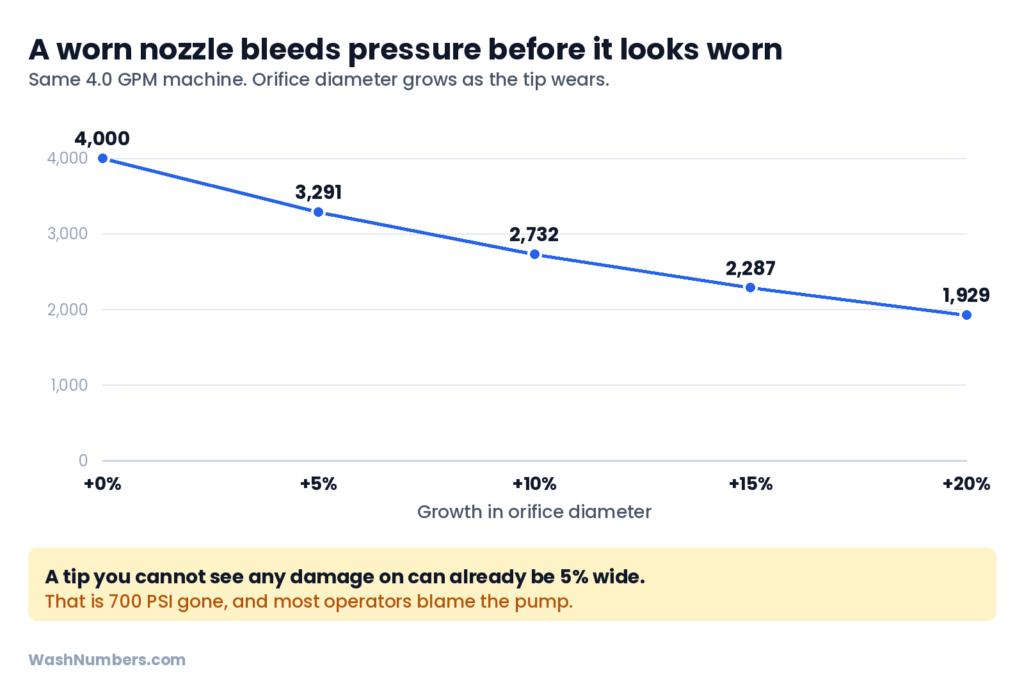
A 5% growth in diameter is invisible to the eye. It costs you around 700 PSI.
The field test. Same machine, same water, same tip angle, and watch your gauge with the trigger pulled. If pressure has fallen 15% or more from what that machine did new, and the unloader and inlet screen are clean, the tip is the first thing to change. It is also the cheapest thing to change, which is why it should be the first thing you try rather than the last.
Operators running daily go through tips faster than they expect. Keeping a spare set of the right size on the truck costs less than an hour of the time you lose diagnosing a pump that was fine all along.
The black soap nozzle is not a cleaning tip
The black tip has a much wider angle and a far bigger orifice than anything else on your belt. It is not there to clean.
It exists to collapse pressure at the wand, because a downstream injector will not draw chemical unless the pressure drops low enough. Fit anything narrower and the injector sits there pulling nothing while you wonder why the mix looks like water.
Two things follow from that.
The soap tip is sized for the machine too. Too small and it will not drop pressure far enough to trigger the draw. Too big and you lose the reach you need to get product onto a second story.
What comes out of the tip is weaker than what is in the bucket. The injector dilutes on the way through, and how much depends on the ratio. If you have not worked that out for your setup, the downstream injector ratio guide does the arithmetic, and the SH mix calculator handles what to put in the bucket in the first place.
Mistakes I keep seeing
Buying nozzles as a colored set without checking the size. Those five packs at the big box store are sized for a homeowner machine around 2.5 GPM. Fit them to a 5.5 GPM commercial unit and you have crippled it. No pressure washer nozzle chart on the packaging will warn you, because the packaging only talks about colors.
Treating the red tip as the powerful one. It is not more powerful, it is more concentrated. All five tips pass the same water at the same pressure. Red just puts it through a smaller footprint, which is why it cuts lines into concrete and strips paint off wood.
Matching the tip to the machine instead of to the surface. Once the size is right, the angle is a surface decision every single time. Siding gets 40. Bare concrete gets 25 or 15. Nothing gets 0 unless you have already accepted you might mark it.
Ignoring the tip when chasing a pressure problem. Unloader, inlet screen, then nozzle. Those three cover most of it, and the nozzle is the one that costs two dollars to rule out.
When it is the tip and when it is the machine
| What you see | Most likely cause | Check this first |
|---|---|---|
| Pressure low, flow normal | Worn or oversized tip | Swap in a new tip of the right size |
| Pressure low, flow low | Inlet restriction or supply | Inlet screen, garden hose, water source |
| Pressure surging | Unloader | Unloader adjustment, then valves |
| Pressure fine, no chemical draw | Wrong tip for the injector | Fit the black soap tip |
| Pressure way above rating | Undersized tip | Stop and check the stamping |
Work down that list before you open the pump. In most cases the answer is in the first row and costs less than lunch.
FAQ
What size nozzle do I need for my pressure washer?
Take the flow and pressure off the pump plate and run them through the formula: nozzle size = GPM × √(4,000 ÷ PSI). A 4.0 GPM machine at 3,000 PSI needs a 4.5. Round to the nearest half size and go up rather than down if you are between two.
What do the numbers on a pressure washer nozzle chart mean?
First two digits are the spray angle in degrees. The rest are the orifice size, which is the flow the tip passes in gallons per minute at 4,000 PSI. A 25040 is a 25 degree tip with a 4.0 orifice. A 2504 is the same thing written shorter.
Can I use the same pressure washer nozzle chart for any machine?
The color part, yes. Angles are universal across manufacturers. The size part depends entirely on your flow and pressure, which is why a chart printed for 4,000 PSI machines will hand a 3,500 PSI operator the wrong number.
Why did my pressure drop after changing nozzles?
Almost certainly a larger orifice. Pressure falls with the square of the size, so one half size up on a 4.0 GPM machine takes you from 4,000 PSI to about 3,160. Check the stamping on the tip you took off against the one you put on.
Is a 0 degree nozzle more powerful?
No. It concentrates the same force into a much smaller area. That is why it cuts and etches. For almost all residential work it does more damage than good, and plenty of operators never carry one.
How often should pressure washer nozzles be replaced?
There is no fixed interval because it depends on water quality and hours. Use pressure as the signal: when a clean machine is down 15% or more from what it made new, change the tips before you look anywhere else.
What is the black nozzle for?
Chemical only. Its wide angle and large orifice drop pressure far enough for a downstream injector to draw. It cleans nothing on its own.
Do turbo nozzles need the same sizing?
Yes. A turbo is a 0 degree tip spun in a cone, and it carries the same orifice sizing as any other nozzle. Size it to the machine exactly as you would a fixed tip.
Get your own number
Sizing a tip takes one line of arithmetic and thirty seconds. Getting it wrong costs you a third of your pressure, or a pump.
Take the flow and pressure off your pump plate, run the formula, and write the answer somewhere you will see it. From then on the pressure washer nozzle chart above is a two second lookup: your number, and whichever angle the surface needs.
If you are still working out what the machine should be doing in the first place, the production rates page covers how much ground a given flow actually clears in an hour, and the surface cleaner sizing guide covers matching a surface cleaner to the same GPM figure you just used here.
Tools for your business
Contractor Pricing Calculator
Build a quote that still leaves a margin after chemicals and drive time.
Production Rate Calculator
The hours a job takes, before you can price it.
Startup Cost Calculator
What a rig costs to build and how many jobs pay it back.
Add Your Rates to the Survey
Seven questions. You get the state-by-state results first.
 Written by Diego Hernández, founder of WashNumbers. Cost models are built from published contractor rates and public price observations. See how we build these numbers.
Last reviewed: September 2026