
Here is a number that catches most people out. Pull straight 12.5% through a downstream injector on a typical setup and what reaches the siding is about 1.1%. Not 12.5%, not the 3% you had in your head. Just over one.
Which is fine, because 1.1% is roughly what a house wash wants. The problem is the operators who then dilute the drum first, thinking they are being careful, and end up spraying water with a smell.
Your downstream injector ratio decides all of it, and most contractors have never measured theirs.
What the downstream injector ratio actually means
An injector sits after the pump and uses the pressure drop to pull chemical out of the drum. A ratio of 10:1 means that for every gallon of chemical drawn, ten gallons of water go past it. So the finished spray is one part chemical in eleven parts total.
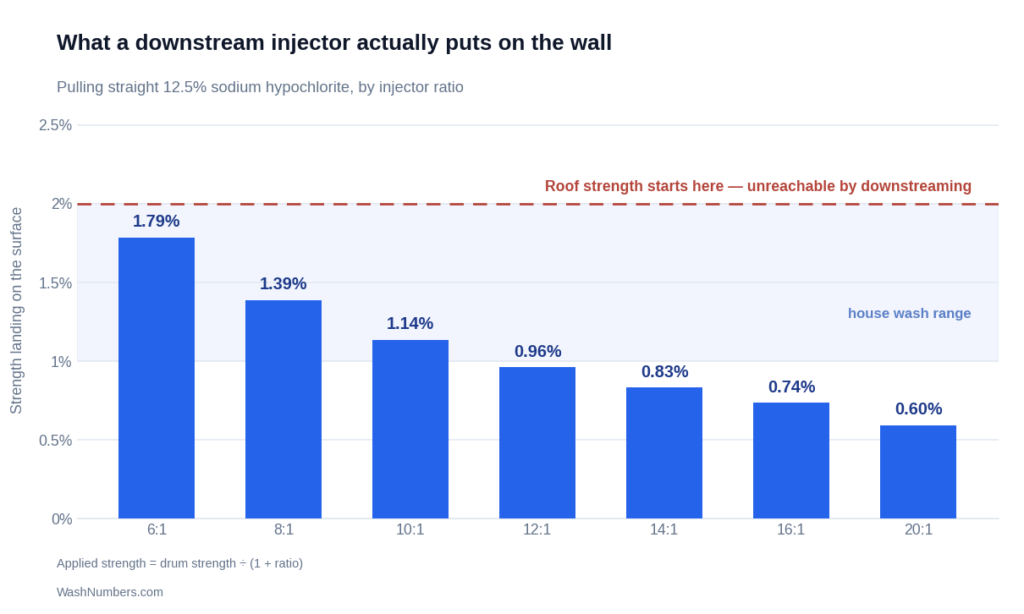
Applied strength = drum strength ÷ (1 + ratio).
Straight 12.5% through a 10:1 injector gives 12.5 ÷ 11, which is 1.14%. Through a 14:1 it is 0.83%. The same drum, the same machine, two different jobs.
| Injector ratio | Applied strength | What that suits |
|---|---|---|
| 6:1 | 1.79% | Strong house wash, heavy siding growth |
| 8:1 | 1.39% | Standard house wash |
| 10:1 | 1.14% | Standard house wash, most common setup |
| 12:1 | 0.96% | Light siding, painted surfaces |
| 14:1 | 0.83% | Light work, delicate substrates |
| 16:1 | 0.74% | Below house wash strength for most growth |
| 20:1 | 0.60% | Too weak for anything but a rinse |
Look down that column and one thing becomes obvious. There is no downstream injector ratio in normal use that lets you apply 2% or 3% to a surface, because you would need a drum stronger than anything sold. If a roof needs 2.5%, you are batch mixing it. There is no way around that with an injector.
Measure yours, do not trust the box
Injectors are sold with a nominal rating and almost none of them hit it once fitted to a real machine. Ten minutes with a bucket tells you your actual downstream injector ratio, and it is the most useful ten minutes you will spend on your setup this year.
This is not a pressure washing quirk. The same device doses fertiliser and chlorine into irrigation lines, and University of Georgia Extension gives growers the same warning: injection rate varies with the pressure differential across the venturi, so the system has to be calibrated rather than assumed.
- Put exactly one gallon of water into a container and drop the injector line into it.
- Spray into a clean 5 gallon bucket, at working pressure, with the nozzle you actually use.
- Stop the moment the gallon is drawn dry.
- Measure what is in the bucket. Subtract the gallon that came from your container.
If the bucket holds 11 gallons, ten of them are water and your downstream injector ratio is 10:1. Do it with the hose length you normally run, because that is the variable that moves it most.
What changes your downstream injector ratio
| Factor | What it does to the draw |
|---|---|
| Hose length after the injector | The big one. More hose means more back pressure and a weaker draw. A hundred extra feet can take you from 9:1 to 13:1 |
| Nozzle size | A smaller orifice raises pressure and cuts the draw. Too small and the injector stops pulling altogether |
| Machine GPM | More flow past the injector means more water per part of chemical, so a weaker mix |
| Injector wear | The ball and seat wear open with use. An old injector usually draws less, not more |
| Chemical temperature | Cold hypochlorite is thicker and draws slightly slower |
| Lift from drum to injector | The further the chemical has to be pulled upward, the weaker the draw |
Hose length is the one that surprises people. Adding a hundred feet of hose after the injector raises back pressure and weakens the draw, so the same machine that pulled 9:1 in the driveway pulls 13:1 by the time you are round the back of the house. Your mix got a third weaker and nothing on the truck told you.
This is also why two contractors with identical equipment report completely different chemical consumption. They are not disagreeing about the chemistry, they are running different hose.
When to stop downstreaming
Downstreaming is faster, involves no mixing on site and wastes less chemical when a job gets cut short. For house washes it is the right call most of the time, whatever your downstream injector ratio turns out to be.
Switch to batch mixing when:
- The surface needs more than about 1.5%. Roofs, heavy concrete and north-facing growth are all above what any downstream injector ratio can deliver from a 12.5% drum.
- You need the same result twice. Batch mixing is repeatable. Downstreaming drifts with hose length, nozzle wear and injector age.
- The job is delicate. If being 40% out on concentration would damage something, mix it where you can measure it.
Our SH mix calculator handles the batch side, and it assumes you are spraying the tank straight rather than sending it through an injector.
What it costs you per job
The consumption figure is the one that shows up in your accounts. At a 10:1 downstream injector ratio you draw a gallon of chemical for every ten gallons of water sprayed, so a house wash that puts out 60 gallons of finished solution pulls about 5.5 gallons from the drum.
Change the downstream injector ratio to 14:1 and the same job draws 4 gallons. Cheaper per job, weaker on the wall, slower to clean. Whether that trade is worth it depends on what you are washing, and there is no universally correct answer.
Chemical is a bigger share of a job than most operators account for. The guide to working out your hourly rate puts it alongside the rest of your overhead.
Questions
What is a normal downstream injector ratio?
Most setups measure between 8:1 and 14:1 in real use. Ratings on the packaging tend to be optimistic, and the figure you get depends more on your hose and nozzle than on the injector itself.
Why is my injector not drawing at all?
Almost always back pressure. Too much hose after the injector, too small a nozzle, or a nozzle that is not the low pressure black tip an injector needs to open. Injectors only draw when pressure drops, so a high pressure tip stops the draw completely.
Can I get 3% on a roof by downstreaming?
No. At even 8:1 you would need 27% in the drum. Roof work at that strength is batch mixed and applied with a low pressure pump, not sent through an injector.
Does hose length really change the downstream injector ratio that much?
Yes, and it is the most common reason a mix that worked on the front of a house does nothing on the back. Every extra length of hose after the injector reduces the draw.
Should I dilute the drum when downstreaming?
Usually not. Most operators pull straight 12.5% and let the injector do the diluting, because at typical ratios that already lands close to house wash strength. Diluting first only makes sense if you have measured your ratio and the result is coming out too hot.
How do I make the mix stronger without changing the injector?
Shorten the hose run after the injector, or move to a larger nozzle. Both reduce back pressure and increase the draw. Neither will get you anywhere near roof strength.
Does chemical temperature affect the draw?
Slightly. Cold hypochlorite is more viscous and draws a little slower, which is one more reason the same setup behaves differently in March and July.
Before your next house wash
Do the bucket test once, write the number on the machine with a marker, and stop guessing. Knowing your real downstream injector ratio turns every other calculation on this site from an estimate into an answer.
If you batch mix as well as downstream, the mix calculator covers that side, and the soft washing cost guide shows what the work sells for. The rest of the WashNumbers calculators are built the same way, with the assumptions on the page rather than hidden, and every one of them is explained in our methodology.
Tools for your business
Contractor Pricing Calculator
Build a quote that still leaves a margin after chemicals and drive time.
Production Rate Calculator
The hours a job takes, before you can price it.
Startup Cost Calculator
What a rig costs to build and how many jobs pay it back.
Add Your Rates to the Survey
Seven questions. You get the state-by-state results first.
 Written by Diego Hernández, founder of WashNumbers. Cost models are built from published contractor rates and public price observations. See how we build these numbers.
Last reviewed: August 2026