
The number on the jug is a starting point, not a fact. Sodium hypochlorite leaves a good supplier at 12.5%, and after three weeks in the back of a van in August it can be closer to nine. Mix off the label and a house wash that worked all spring quietly stops working, usually on the job where the customer is watching.
That gap is what this SH mix calculator closes. Put in the strength you actually have rather than the strength printed on the drum, the percentage you want landing on the surface, and the size of the batch. It gives you gallons of bleach, gallons of water, the dilution ratio and your surfactant total. Every SH mix calculator worth using starts from that measured number rather than from the label.
How the SH mix calculator works
There is no mystery in the arithmetic, and you should know it well enough to sanity-check any tool, this SH mix calculator included.
Gallons of SH = batch size × target percentage ÷ your actual strength. Water is whatever is left over.
Worth being clear about what is what on this page. The dilution arithmetic is exact: give it a measured strength and a target and the gallons are the gallons, with nothing to disagree about. Everything below it — mix strengths by surface, dwell times, surfactant — is field practice drawn from published contractor guidance and manufacturer literature, not laboratory work. Treat it as a starting point and let the label on the product in your hand and its safety data sheet override anything here.
What mix strength for which surface
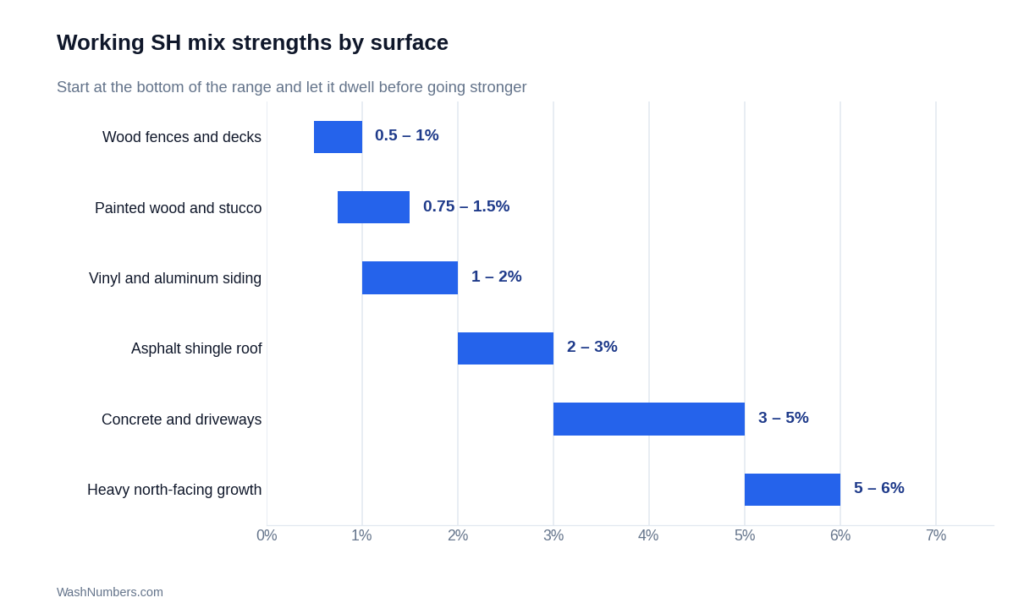
These are working ranges, not laws. Start at the bottom of the range, feed that figure into the SH mix calculator, let it dwell, and step up only if the surface tells you to.
| Surface | Mix strength | Dwell | Watch out for |
|---|---|---|---|
| Vinyl and aluminum siding | 1 – 2% | 8 – 12 min | Rinse before it dries or you get streaking |
| Painted wood and stucco | 0.75 – 1.5% | 5 – 10 min | Test a hidden section first, paint varies |
| Asphalt shingle roof | 2 – 3% | Follow the shingle manufacturer’s instructions | Never high pressure. Check the warranty first |
| Concrete and driveways | 3 – 5% | 10 – 15 min | Works on organic growth, not on oil |
| Heavy north-facing growth | 5 – 6% | 15 min | Two light passes beat one strong one |
| Wood fences and decks | 0.5 – 1% | 5 min | Higher strength greys the timber |
Two things people get backwards. Stronger is not faster: a 6% mix on siding does not clean quicker than 1.5%, it just strips more and damages more. And dwell time does more work than concentration, right up until the point where the mix dries on the wall, which is when you get streaking that no amount of rinsing fixes.
Pick the surface, read the range, and let the SH mix calculator turn it into gallons. These ranges are the working figures the trade uses, not manufacturer specifications: on anything painted, coated or under warranty, the substrate manufacturer’s own cleaning instructions win.
Your 12.5% is probably not 12.5%
This is the part almost nobody prices in, and it is why the SH mix calculator asks for your real strength rather than assuming the label.
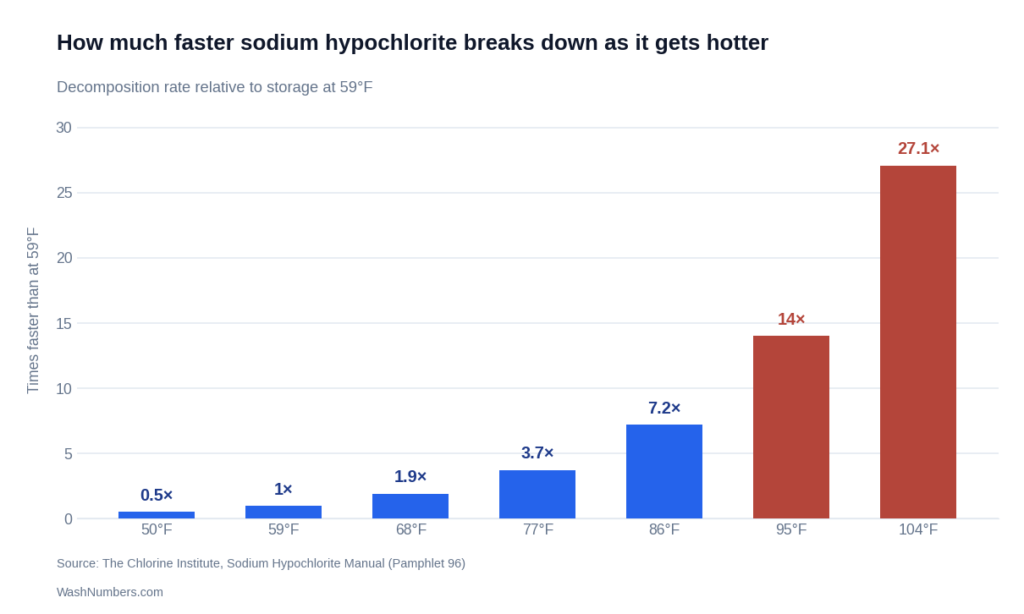
Sodium hypochlorite decomposes on its own, and heat is the main driver. The Chlorine Institute’s sodium hypochlorite manual puts it plainly: decomposition roughly doubles for every 18°F rise in temperature, and a solution held at 59°F breaks down around fourteen times slower than the same solution at 95°F.
Fourteen times. That is the difference between a shaded shed and the bed of a truck in a Texas July.
| Factor | What it does | What to do about it |
|---|---|---|
| Heat | Decomposition roughly doubles for every 18°F rise. At 95°F it breaks down about 14 times faster than at 59°F | Never leave it in the van overnight in summer |
| Sunlight | UV drives decomposition toward oxygen and chlorate | Opaque containers, stored in shade |
| Metal traces | Nickel, copper and cobalt accelerate breakdown | No metal funnels, drums or transfer fittings |
| Falling pH | Most stable between pH 11.9 and 13, degrades quickly below 10.8 | Never mix with anything acidic |
| Concentration | Stronger solutions decompose faster than dilute ones | Buy quantities you will use within a few weeks; a drum that sits is a drum losing strength |
The fix costs almost nothing. A pack of chlorine test strips or a cheap titration kit tells you what you are actually holding, and thirty seconds testing before you mix beats an afternoon wondering why the algae is still there. Buy smaller quantities more often instead of a drum that sits for two months, and keep it out of the sun in an opaque container.
Batch mixing or downstreaming
This matters, so read it before you trust the number.
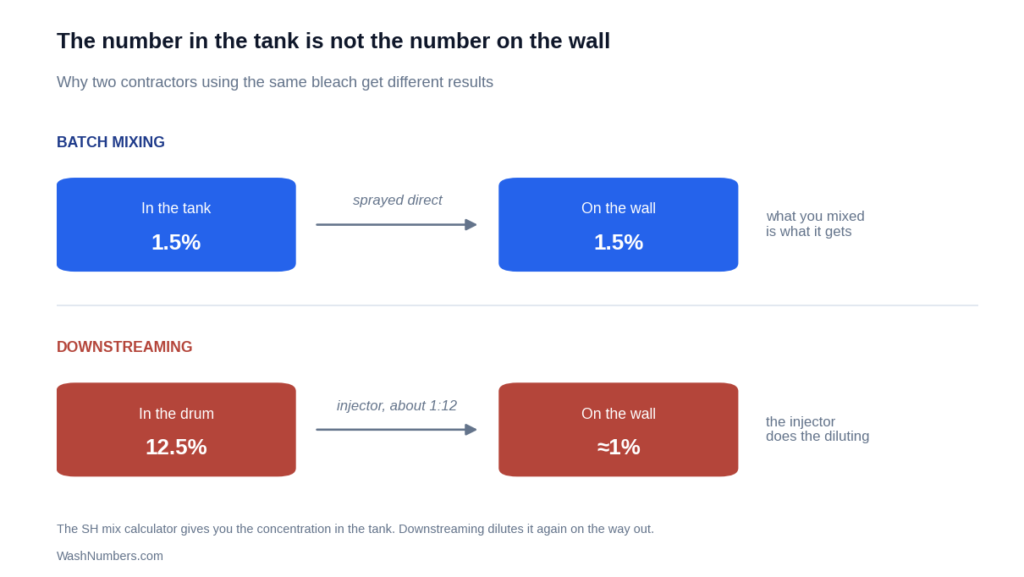
The SH mix calculator gives you the mix in the tank. If you are batch mixing and spraying that tank straight onto the wall, the number it gives you is the number that lands on the surface, and you are done.
If you downstream, you are not. A downstream injector pulls roughly one part chemical to every eight to fourteen parts water on a measured setup, depending on hose length, GPM and how tired the injector is, so the mix hitting the siding is a fraction of what is in the drum. Contractors who downstream usually pull straight 12.5% and let the injector do the diluting, which is why their consumption looks so different from a batch mixer’s.
Neither approach is wrong. Batch mixing is more accurate and easier to repeat, downstreaming is faster and means less mixing on site. Just know which one you are doing before you read a number off the SH mix calculator or anything else.
If you downstream, our downstream injector calculator works out what is actually reaching the surface.
Surfactant and dwell
A compatible surfactant is what most operators add on a house wash, and it is not there to make the mix stronger. Check that the product label allows it on the surface you are treating before you reach for it. It makes the solution cling long enough to work instead of running down the wall in twenty seconds, and it cuts the surface tension so the mix gets into the texture rather than sitting on top of it.
Dose it off the label, not off a rule of thumb. Soft wash surfactants are sold at wildly different concentrations: some are dosed in ounces per hundred gallons of finished mix, others in ounces per five, so a figure that is right for one product is nonsense for the next. Find the rate on the container, convert it to ounces per gallon of finished mix, and put that number in the surfactant field. If the label gives a range, start at the bottom of it. Too little and the mix sheets off the wall; too much and you are buying foam and rinsing longer for nothing.
Whatever you settle on, put it in the surfactant field of the SH mix calculator so the ounces come out alongside the rest of the batch.
Five ways to ruin a good mix
- Mixing off the label. The whole point of the section above. Test your strength, then run it through the SH mix calculator.
- Letting it dry on the surface. Keep the wall wet, work in shade where you can, and rinse before the sun does it for you.
- Metal anything. Traces of copper, nickel and cobalt accelerate decomposition. No metal funnels, no metal containers.
- Mixing with anything acidic. Sodium hypochlorite is most stable at a high pH and falls apart below about 10.8, and acid plus bleach releases chlorine gas. This is the one that puts people in hospital.
- Going stronger instead of going slower. Two light passes with dwell time beat one hot mix, cost less product, and do not kill the shrubs.
Questions
How much SH do I need for a house wash?
For an average single-storey house you are mixing somewhere between 30 and 60 gallons of solution at 1 to 2%. At 1.5% from fresh 12.5% bleach that is about 4 to 7 gallons of SH for the job.
Can I use this SH mix calculator if I downstream?
Not directly. It gives you the concentration in the tank, and a downstream injector dilutes that again by roughly 8:1 to 14:1 on the way out, which is what most setups actually measure. Use it for batch mixing, or use it to work out what you would need in the tank if you were spraying it neat.
What percentage should I use on an asphalt shingle roof?
Two to three percent is the range the trade works in, but the instruction that matters is the shingle manufacturer’s own cleaning guidance, and the roof’s warranty usually depends on following it. ARMA describes a low-pressure application, a limited contact time and a thorough rinse, with the detail varying by product. What is not negotiable: never high pressure. The granules on an asphalt shingle are the roof’s protection and a wand takes them off in one pass.
How do I find out my real bleach strength?
Chlorine test strips rated to at least 15% will get you close for a few dollars. A titration kit is more accurate and still cheap. If you buy from a supply house that dates its stock, ask for the fill date, because a jug filled last week and a jug filled in June are different products at the same price.
How long does mixed solution last in the tank?
Mix what you need for the day. Dilution on its own is not the reason: at the same temperature a weaker solution is more stable than concentrate, which is exactly what the table above says. What flattens a batch sitting in a tank is everything that comes with the tank — heat, sunlight through a translucent wall, any metal in the plumbing, and any drop in pH from whatever else went in. A tank left in the sun through a July afternoon can be noticeably weaker by the time you finish the job, and surfactant does not improve with age either. Run the SH mix calculator for the batch you actually need that morning rather than mixing a drum to keep.
Why did my mix work in April and stop working in August?
Two things at once. Your bleach is degrading much faster in summer heat, and the growth you are cleaning is at its most established. Same recipe, weaker product, harder job. Test your strength and adjust rather than blaming the chemical.
Does the SH mix calculator work in litres?
The inputs are in gallons and ounces because that is what the US trade buys and mixes in. The dilution arithmetic itself is unit-free, so if you enter litres in the batch field, the bleach and water figures come back in litres. The surfactant field does not follow: it is fixed in ounces per gallon, so leave it at 0 when you are working in litres and dose the surfactant separately off its label.
Is a stronger mix ever the right answer?
On heavy north-facing organic growth and on concrete, yes. On siding, wood and painted surfaces, almost never. The damage from an over-strength mix shows up later, on someone else’s warranty claim, and it is the fastest way to turn a good job into a bad review.
Before you mix the next batch
Test what you actually have, put it into the SH mix calculator, and mix to a number rather than to habit. It takes a minute and it is the difference between a repeatable result and a coin flip. The SH mix calculator is free and there is nothing to sign up for.
If you price this work for a living, the guide to working out your hourly rate from your own costs covers the other half of the job, and chemical is a bigger line in that calculation than most people allow for. Our figures on how much water a pressure washer actually uses pair with this one for working out what a batch really costs you.
The rest of the WashNumbers calculators are built the same way, with the assumptions shown rather than hidden, and every one of them is explained in our published methodology.
Contractors are welcome to put our calculators on their own site free of charge. No tracking, no lead capture, no signup for your customers.
Tools for your business
Contractor Pricing Calculator
Build a quote that still leaves a margin after chemicals and drive time.
Production Rate Calculator
The hours a job takes, before you can price it.
Startup Cost Calculator
What a rig costs to build and how many jobs pay it back.
Add Your Rates to the Survey
Seven questions. You get the state-by-state results first.
 Written by Diego Hernández, founder of WashNumbers. Cost models are built from published contractor rates and public price observations. See how we build these numbers.
Last reviewed: September 2026