
Three quotes for the same 40,000 square foot retail parking lot came back at $3,400, $6,800 and $11,900. None of them were wrong. They were pricing three different jobs, and only one of the three said so in writing.
That spread is what makes commercial pressure washing cost so hard to pin down. Residential work is fairly predictable. Commercial work depends on grease, on access hours, on whether the wash water has to be recovered, and on how much square footage you are buying at once.
Quick answer: what commercial pressure washing costs
Commercial pressure washing costs $0.10 to $0.35 per square foot for routine flatwork like sidewalks and parking areas, and $0.40 to $1.00 per square foot once grease, gum or heavy staining is involved. Contractors working by the hour charge $50 to $150. Most hold a minimum charge between $250 and $400, which is what you pay on anything under roughly 2,000 square feet.
A single storefront usually lands between $200 and $600. A large facility with structured parking and food service can run $2,000 to $10,000 or more per visit.
Average commercial pressure washing cost in 2026
| Scope | Typical range | What it usually buys |
|---|---|---|
| Minimum service charge | $250 – $400 | Anything under about 2,000 sq ft |
| Routine flatwork, per sq ft | $0.10 – $0.35 | Sidewalks, walkways, clean parking areas |
| Intensive cleaning, per sq ft | $0.40 – $1.00 | Grease, gum, oil staining, restoration work |
| Hourly rate | $50 – $150 | Small or hard to measure scopes |
| Single storefront | $200 – $600 | Entry, walkway, awning, front glass surround |
| Large facility, per visit | $2,000 – $10,000+ | Multi-building sites, structured parking |
| Recurring contract | $100 – $600 per month | Scheduled maintenance, usually monthly or quarterly |
Those are national ranges. Labor rates in Boston and Seattle sit well above rural Alabama, and a contractor who has to truck in his own water prices differently from one who taps a spigot on site.
Commercial pressure washing cost per square foot by surface
Surface matters more than most price guides admit, because it decides the equipment and the pace. A 20 inch surface cleaner covers flat concrete at a walking pace. A dumpster pad with baked-on grease needs hot water, degreaser dwell time and a second pass, and it might take an hour to do 400 square feet.
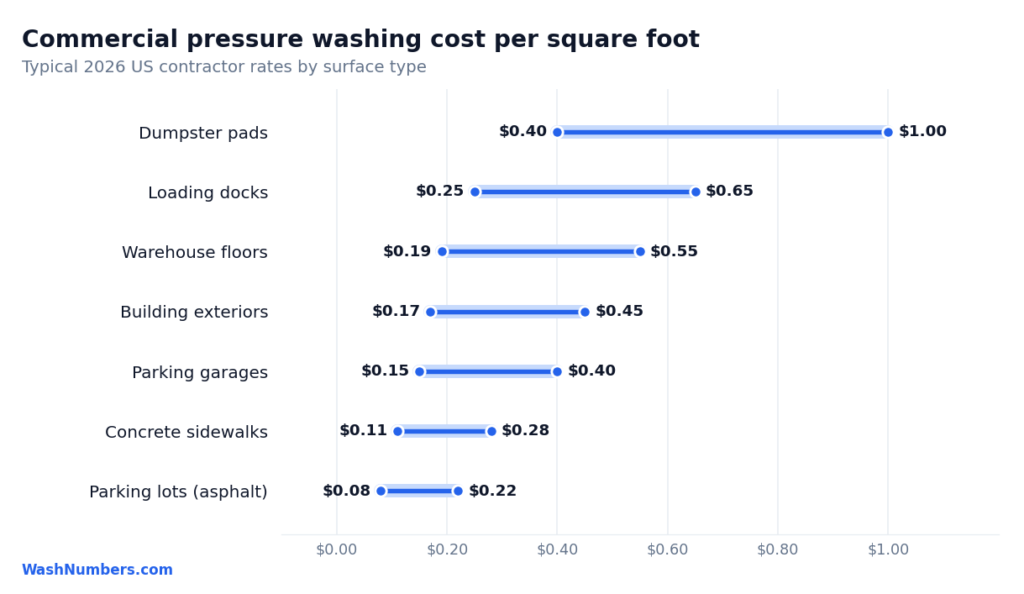
| Surface | Cost per sq ft | Why it prices this way |
|---|---|---|
| Concrete sidewalks and walkways | $0.11 – $0.28 | Fast with a surface cleaner, minimal chemical |
| Parking lots (asphalt) | $0.08 – $0.22 | Large areas, low rate, but oil spots add passes |
| Building exteriors | $0.17 – $0.45 | Soft wash, ladder or lift time, surface protection |
| Parking garages | $0.15 – $0.40 | Low clearance, poor drainage, wash water containment |
| Warehouse and shop floors | $0.19 – $0.55 | Oil, tire marks, often requires reclaim |
| Loading docks | $0.25 – $0.65 | Heavy soil, hot water, tight scheduling |
| Dumpster pads | $0.40 – $1.00 | Grease, odor treatment, almost always needs reclaim |
Parking lots are sometimes quoted per space instead, at $8 to $20 a stall. If your lot is oddly shaped or has a lot of islands and curbing, per space usually works out cheaper for you than per square foot, because the contractor is not charging you for pavement he never touches.
Cost by property type
Two buildings with identical square footage can be quoted 60% apart because of what happens on the ground. This is the breakdown almost no cost guide publishes, and it is the one property managers actually need.
| Property type | Typical visit cost | The cost driver |
|---|---|---|
| Office building | $400 – $1,800 | Mostly glass surrounds and entry concrete. Clean soil, easy access, low rates |
| Retail strip center | $600 – $2,500 | Gum removal on the walkway is the line item that moves the price |
| Restaurant / food service | $450 – $1,600 | Grease. Requires hot water and reclaim on the dumpster pad and drive-thru |
| Gas station / c-store | $700 – $2,800 | Fuel and oil residue is hazardous runoff. Containment is mandatory, not optional |
| Apartment or HOA community | $800 – $4,000 | Mixed surfaces, resident scheduling, breezeways and stairwells |
| Industrial / warehouse | $1,200 – $6,000+ | Scale, plus shutdown windows that push work to nights and weekends |
| Structured parking deck | $0.15 – $0.40 per sq ft | Drain mapping and wash water recovery dominate the quote |
If you run a restaurant or a fuel site and a quote comes in noticeably below these ranges, that is worth a question rather than a celebration. It usually means the contractor is planning to send the runoff down the storm drain.
Wash water containment: the line item nobody quotes
Here is where most commercial pressure washing cost comparisons fall apart.
Under the Clean Water Act, storm drains discharge straight to rivers and lakes with no treatment. Wash water carrying detergent, grease, oil or heavy metals is a pollutant, and directing it into a storm drain is a violation that lands on the property owner as often as on the contractor. The EPA’s Clean Water Act compliance program covers the enforcement side, and most municipalities layer their own stormwater ordinance on top.
Doing it properly means blocking the drains, capturing the water with a vacuum boom or berm setup, filtering it, and disposing of it into the sanitary sewer with permission or hauling it off site. That equipment and that labor cost money.
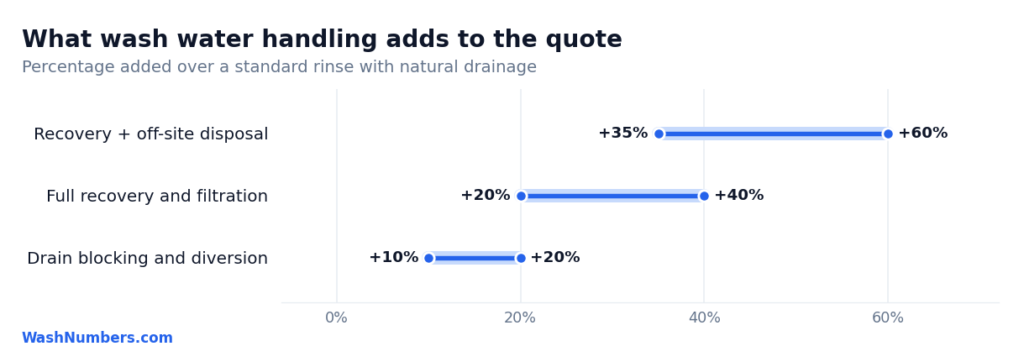
| Approach | Effect on price | When it applies |
|---|---|---|
| Standard rinse, natural drainage | Baseline | Clean water, no detergent, no oily surface |
| Drain blocking and diversion | +10% to 20% | Light detergent use near a storm inlet |
| Full recovery and filtration | +20% to 40% | Grease, oil, fuel residue, most food service and fuel sites |
| Recovery plus off-site disposal | +35% to 60% | Heavy industrial residue, some municipal contracts |
So when one bid is $3,400 and another is $11,900, the containment approach is usually most of the gap. Ask every bidder the same question: what happens to the water? The answers will sort your quotes faster than anything else you can ask.
Containment is the clearest example of a cost that never shows up in published averages, which is one of the reasons our industry statistics treat those averages with some caution.
Why the rate drops as the job gets bigger
A contractor’s day has a fixed cost before a trigger gets pulled: drive time, setup, water sourcing, breakdown. On a 1,500 square foot sidewalk that overhead is most of the invoice, which is why the effective rate can land near $0.30 per square foot even on easy concrete.
Spread the same overhead across 60,000 square feet and the rate falls toward $0.09.
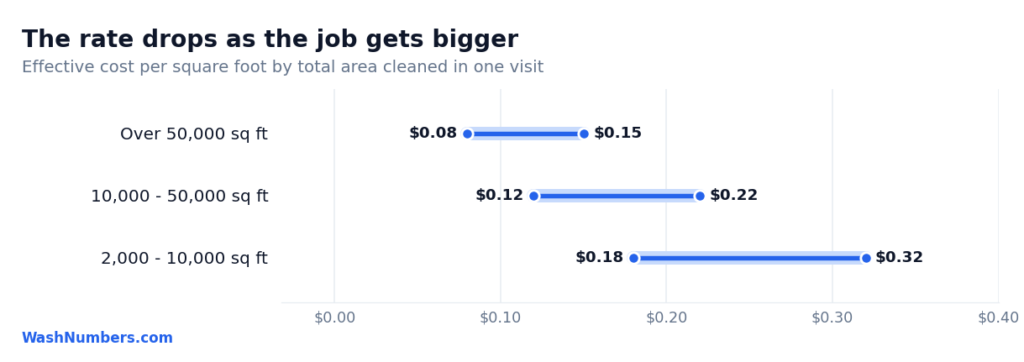
| Area cleaned | Typical effective rate | Ballpark total |
|---|---|---|
| Under 2,000 sq ft | Minimum charge applies | $250 – $400 |
| 2,000 – 10,000 sq ft | $0.18 – $0.32 | $400 – $3,200 |
| 10,000 – 50,000 sq ft | $0.12 – $0.22 | $1,300 – $11,000 |
| Over 50,000 sq ft | $0.08 – $0.15 | $4,000+ |
This is the single best lever you have. If you manage three properties in the same city, bidding them as one package instead of three separate jobs will usually save you 15% to 25% without any negotiation at all.
Per square foot, hourly or flat rate?
All three are legitimate. They just shift the risk to different people, and one of them is usually bad for you.
Per square foot
Best for measurable flatwork. You know the number before work starts, and if the job takes longer than expected that is the contractor’s problem. Ask what the measured area is and check it, because the difference between gross lot area and actual cleanable surface can be 20%.
Hourly
Fine for small or genuinely unpredictable scopes. Bad for large jobs, because every inefficiency lands on your invoice and you have no ceiling. If a contractor wants to price a 40,000 square foot lot by the hour, ask for a not-to-exceed number in the contract.
Flat rate
Usually the cleanest arrangement for recurring commercial work. The scope is defined once, the price is fixed, and nobody argues monthly. Just make sure the scope document is specific: “clean the parking lot” and “clean the parking lot including curbing, islands, cart corrals and the trash enclosure pad” are two very different purchases.
Recurring contracts versus one-time cleaning
A property that gets washed quarterly never builds up the soil load that makes a job expensive. Contractors know this, and price recurring work accordingly.
| Frequency | Discount off one-time rate | Why |
|---|---|---|
| One-time | Baseline | Unknown condition, single trip, full setup cost |
| Annual | 0% to 5% | A year of buildup means it is effectively a one-time job |
| Quarterly | 10% to 20% | Predictable soil load, scheduled route |
| Monthly or more | 20% to 35% | Fast visits, minimal chemical, route efficiency |
Run the math before assuming a contract is cheaper. Four quarterly visits at 15% off will still cost more across the year than one annual clean. What you are buying is a property that looks maintained all twelve months, not a lower annual spend.
Three real-world examples
Strip center walkway, 6,400 sq ft
Concrete walkway with gum, no grease, daytime access with the lot half full. Quoted at $0.24 per square foot, working out to $1,536. No containment required beyond drain socks near two inlets. The gum is what moved this from $0.15 to $0.24: it is removed one piece at a time.
Restaurant dumpster pad and drive-thru, 1,900 sq ft
Heavy grease, hot water, degreaser with dwell time, full wash water recovery. Below the minimum square footage, so the contractor priced it as a package at $685. Per square foot that is $0.36, which looks expensive until you account for the reclaim setup taking longer than the actual washing.
Retail parking lot, 38,000 sq ft
Asphalt, moderate oil spotting, work performed between 11pm and 5am so the lot stays open during business hours. Quoted at $0.13 per square foot plus a $400 night differential, for $5,340. Volume brought the base rate down. The night window put some of it back.
What a legitimate commercial quote includes
Any contractor can print a number on a page. A real commercial quote has these things on it, and if yours does not, ask before you sign:
- A certificate of insurance naming general liability limits, and ideally naming you as additional insured. What that certificate costs the contractor, and what an additional insured endorsement adds on top, is in our guide to pressure washing insurance cost. On commercial property this is not optional. A pressure washer at 4,000 PSI can strip mortar, force water behind cladding and injure people.
- The measured area the price is based on, not an estimate from a satellite image.
- The wash water plan in writing. What gets captured, where it goes.
- Water source. Whether the contractor is using your spigot or bringing his own, and who pays for it.
- Access window. Day, night, weekend, and any differential attached to it.
- Surfaces explicitly excluded. Curbing, islands, stairwells and awnings are the four that get quietly left out.
- Chemical approach. Whether it is a straight pressure wash or a soft wash with sodium hypochlorite, which matters for landscaping near the building.
Red flags worth walking away from
Some of these look like good news at first glance, which is exactly why they work.
- A quote far below the ranges above with no explanation. Somebody is skipping containment, insurance, or both.
- No certificate of insurance offered. If damage happens on your property with an uninsured contractor, the claim comes to you.
- Pricing from an aerial image without a site visit on anything over about 10,000 square feet.
- Vague scope language. “Full exterior clean” means whatever the contractor decides it means on the day.
- Pressure specs used as a selling point. On painted surfaces, EIFS or older masonry, high pressure is damage, not cleaning power. A contractor who leads with PSI numbers on a building exterior is telling you something.
- A large deposit up front on a job that is one day of work.
How to bring the price down without cutting corners
- Bundle properties. The biggest available saving, and it costs you nothing but a phone call.
- Give a flexible access window. If the contractor can fit you into an existing route rather than a dedicated night, that flexibility is worth 10% to 15%.
- Measure the actual cleanable area yourself and quote from it, so you are not paying for landscaping and curbs you did not ask to be cleaned.
- Go quarterly instead of reactive. Restoration cleaning of a neglected surface costs two to four times a maintenance visit.
- Separate the truly dirty zones from the rest. Paying the intensive rate on the whole property when only the dumpster pad needs it is the most common overspend in commercial work.
Commercial pressure washing cost FAQ
How much does commercial pressure washing cost per square foot?
Between $0.10 and $0.35 per square foot for routine flatwork, and $0.40 to $1.00 where grease, gum or oil staining is present. Under about 2,000 square feet the minimum charge of $250 to $400 applies instead.
Why is commercial pressure washing more expensive than residential?
Three reasons: insurance requirements are higher, wash water usually has to be contained rather than allowed to run off, and access windows are often restricted to nights or weekends. The washing itself is not fundamentally different. The conditions around it are.
What is a typical minimum charge?
Most commercial contractors hold a minimum between $250 and $400. Below that, the drive time and setup cost more than the cleaning, so nobody prices a small job by the square foot.
Does a commercial pressure washing price list exist?
Not in any meaningful national sense, and be skeptical of any that claims to be one. Rates move with local labor cost, water access, disposal rules and how much square footage is being bought at once. The tables on this page are ranges, and a real number comes from a site visit.
How much does it cost to pressure wash a commercial parking lot?
Usually $0.08 to $0.22 per square foot, or $8 to $20 per parking space. A 40,000 square foot lot typically lands between $3,200 and $8,800 depending on oil spotting, access hours and containment requirements.
Do I need to worry about where the wash water goes?
Yes, and the liability can reach the property owner, not only the contractor. Ask every bidder how they handle it and get the answer in writing. It is also the fastest way to understand why two quotes are thousands of dollars apart.
How often should commercial property be pressure washed?
Quarterly for food service, fuel sites and high-traffic retail. Twice a year for office and light retail. Annually is enough for low-traffic properties, though at that interval you are paying restoration rates rather than maintenance rates.
Is soft washing cheaper than pressure washing for a building exterior?
Roughly comparable per square foot, and often the only correct method. On painted surfaces, EIFS and older masonry, high pressure causes damage. Soft washing pricing works out in a similar band because the chemical cost replaces the labor you save on pressure.
Getting a number for your property
The ranges on this page will tell you whether a quote is reasonable. For a figure specific to your square footage, surface and access conditions, run it through the commercial pressure washing cost calculator, which shows every adjustment factor it applies rather than returning a number from nowhere.
For individual surfaces, the parking lot cleaning cost guide, the sidewalk cleaning rates and the parking garage cleaning cost breakdown go deeper than the summary tables here. If you want the reasoning behind these figures, the WashNumbers methodology lays out where every rate comes from and what we are modeling rather than measuring.
And if you price this work for a living, the contractor pricing calculator works the same numbers from the other direction, starting from your costs and target margin.
Work out your own number
Pressure Washing Cost Calculator
Put in your own square footage and surface instead of using an average.
Cost per Square Foot
What the rate should be before anyone quotes you a total.
Minimum Charge Explained
Why a small job costs the same as a slightly bigger one.
The Pricing Dataset
220 published prices with the source behind every figure.
 Written by Diego Hernández, founder of WashNumbers. Cost models are built from published contractor rates and public price observations. See how we build these numbers.
Last reviewed: August 2026