
Ask ten contractors what they charge and you get ten numbers. Ask them what an hour of their time costs to produce and most go quiet.
That gap is why guys with full schedules go out of business. You cannot price a job off what the competition charges when you have no idea whether the competition is profitable.
So this guide runs the other direction. Costs first, then rate, then square-foot pricing. It is slower than copying the number off a Facebook group, and it is the only version that survives a bad quarter.
How much to charge for pressure washing is a question about your business, not about the market.
Start with what an hour actually costs you
Here is a realistic year for a solo operator running one hot water setup. Adjust the numbers to your own, but do not skip a line because it feels small.
| Cost | Typical year | Notes |
|---|---|---|
| Vehicle: payment, fuel, maintenance | $3,600 | The line most operators leave out entirely |
| Marketing and lead generation | $2,400 | Ads, van lettering, listing fees |
| Chemical: SH, surfactant, degreaser | $1,800 | Scales with how much soft washing you do |
| Equipment depreciation | $1,600 | An $8,000 setup replaced every five years |
| Fuel for machines | $1,400 | Separate from the truck |
| General liability insurance | $1,200 | Higher if you do roofs or commercial |
| Phone, software, website | $1,100 | CRM, invoicing, hosting |
| Repairs and maintenance | $800 | Pumps, hoses, tips, unloaders |
| Licences and permits | $300 | Varies a lot by state and city |
| Total | $14,200 | Before you pay yourself anything |
Fourteen thousand dollars before you have paid yourself a cent.
Most people stop here, divide by 2,080 hours, get $6.83 an hour and feel fine about it. That number is wrong, and the reason it is wrong is the single most expensive misunderstanding in this trade.
The billable hour problem
You do not get paid for 2,080 hours. You get paid for billable hours, not for the hours you are at work.
Driving between jobs, walkthroughs, quoting, invoicing, chasing payment, loading, unloading, buying chemical, rain days, the January that never happened: none of it bills. Track it honestly for a month and most solo operators land somewhere between 900 and 1,200 billable hours a year.
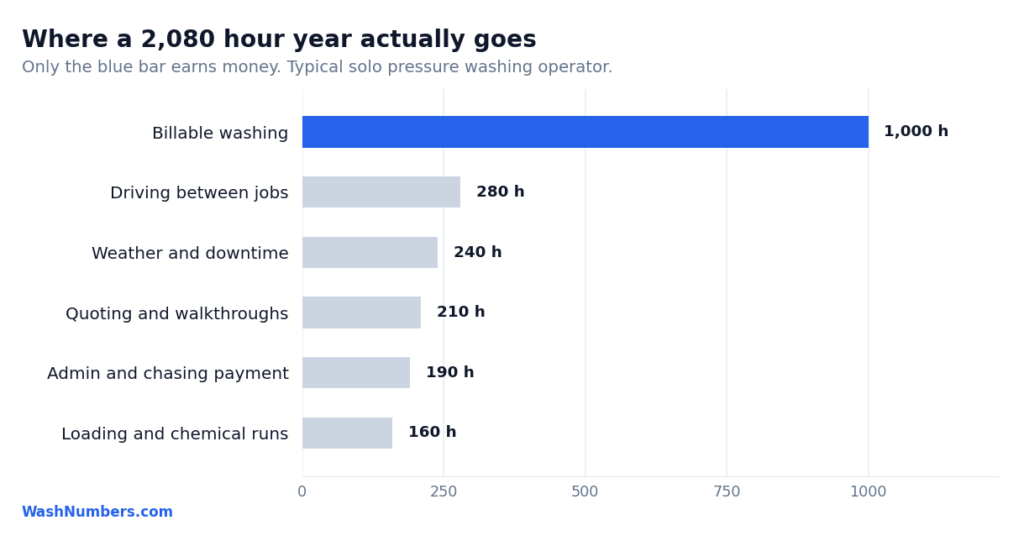
At 1,000 billable hours, that $14,200 of overhead is $14.20 per billable hour, not $6.83. You just doubled your cost basis by counting honestly.
Working out your rate
Working out how much to charge for pressure washing comes down to three numbers, in this order.
1. Overhead per billable hour
Total annual costs divided by realistic billable hours. In the example above, $14.20.
2. What you need to earn
Not what you hope for. What you need. If you want $60,000 in your pocket, that is $60 per billable hour on top of the overhead. Add self-employment tax before you decide that number is enough.
3. Profit on top
Profit is not your wage. It is what funds the second rig, covers the pump that dies in July, and pays you when you are sick. Twenty percent is a reasonable floor.
Run those together and the example operator needs $92.75 per billable hour, not the $55 he has been quoting because that is what the guy across town charges. He breaks even at $74.20. Everything between those two numbers is the margin, and it is the only part of the rate that is his to keep.
Turning an hourly rate into a square-foot price
Customers do not buy hours, they buy a clean driveway. So the hourly rate is your floor, not your quote.
Time a few jobs and work out your real production rate per hour for each surface. Then divide.
One thing to be clear about before you use the table: these are job hours, not spray hours. The figures already carry setup, masking, dwell, rinse and teardown, because that is what you are billing. Set against the trigger-time rates in our production rates guide they look slow, and they should. A surface cleaner covering 2,000 square feet in an hour of spraying covers roughly half that across a full billable hour.
| Surface | Sq ft per hour | Rate needed |
|---|---|---|
| Flat concrete, 20 in surface cleaner | 900 – 1,400 | $0.07 – $0.10 |
| Driveway with oil spotting | 600 – 900 | $0.10 – $0.15 |
| House wash, single story | 500 – 800 | $0.11 – $0.18 |
| Deck or fence | 300 – 500 | $0.18 – $0.30 |
| Roof soft wash | 350 – 600 | $0.15 – $0.25 |
| Dumpster pad with grease | 150 – 300 | $0.30 – $0.59 |
Notice that dumpster pads and roofs look expensive per square foot and are not especially profitable per hour. Slow work with high chemical cost and a lot of setup eats the premium. Meanwhile flat concrete with a 20 inch surface cleaner is where the money hides, because production rate is everything.
If you take one number from this page, take that one: price by the hour internally, quote by the square foot externally.
What contractors actually charge
Published ranges, for context rather than as a target. Your own cost calculation beats any of these.
| Basis | Published range | What it usually reflects |
|---|---|---|
| Hourly | $50 – $150 | Wide because it mixes solo operators and crews |
| Residential flatwork, per sq ft | $0.10 – $0.50 | Surface and condition drive most of the spread |
| Commercial flatwork, per sq ft | $0.08 – $0.40 | Volume pulls the rate down, containment pushes it up |
| House wash, whole job | $190 – $834 | Home size and number of stories |
| Minimum service charge | $175 – $300 | Established operators. Newer ones set it too low |
These figures come from published industry sources. We are currently replacing them with rates collected directly from working contractors, state by state. If you want the numbers on this site to reflect what you actually charge instead of what a lead-generation company reports, the pricing survey takes three minutes and contributors see the results a week early.
Every figure we publish, with its source, is listed in the 2026 pressure washing pricing data.
Per square foot, hourly, or flat rate
Per square foot
The default for flatwork, and the right call most of the time. You know the number before you start and the efficiency gains are yours to keep. Measure the cleanable area, not the lot.
Hourly
Fine for restoration work and anything genuinely unpredictable. Bad as a default, and not for the reason people think. The problem is not that customers dislike it. The problem is that hourly pricing caps your income at the speed of your hands. Buy a faster surface cleaner and you finish quicker and earn less. Every efficiency you gain, you hand to the customer.
Flat rate
Best for repeat commercial and anything you have done twenty times. Once you know a strip center takes four hours, quote the number and stop measuring.
Minimum charge
Non-negotiable, and most contractors set theirs too low.
A job is never just the wash. It is drive out, setup, wash, breakdown, drive back. Even a fifteen minute clean costs you two hours of the day. If your rate is $92.75 an hour, a minimum below $185 means small jobs are subsidised by your good ones.
Most established operators sit between $175 and $300. If yours is $99 because it sounds friendly, you are paying customers to hire you.
Pricing mistakes that quietly kill margin
- Matching the cheapest quote in the group chat. You have no idea whether that person is profitable. A lot of the cheapest operators in any market are two seasons from quitting.
- Forgetting chemical on soft wash jobs. A housewash at 1.5% SH burns real money in hypo and surfactant. Guys who price soft washing like a rinse lose on every job.
- Not charging for access. Second story, no water source, gated community, tight side yards. All of it is time. Ten to twenty percent, stated up front.
- Quoting from a satellite image. Fine under 2,000 square feet. Above that you will eat the difference between the picture and the site.
- Free add-ons to close the sale. Throwing in the walkway costs you forty minutes and teaches the customer your time is free.
- Never raising prices. Hypo, fuel and insurance all moved. If your rate is the same as two seasons ago, you took a pay cut and called it loyalty.
Chemical is the line most operators guess at. The SH mix calculator gives you the gallons per batch, which is the only way to put a real number on it.
When to walk away
Nobody writes this part, so here it is.
Walk when the drive is over 45 minutes and the job is under your minimum times three. Walk when the customer opens with what the last guy charged. Walk when they want a written guarantee that every stain comes out, because oxidation and etching do not. Walk when a commercial site has no drain plan and no interest in paying for one, because that liability lands on you.
An empty afternoon costs you fuel. A bad job costs you the afternoon, the chemical, the callback and sometimes the reputation.
Raising prices on customers you already have
Tell them before the season, not on the invoice. One line, no apology: rates go up about 6% this year, your housewash moves from $340 to $360.
Some leave. The ones who leave over 6% were the ones calling you at nine on a Sunday. In practice most contractors who finally raise prices report losing under one in ten customers and earning more from the ones who stay.
Setting a price is only half the arithmetic. The other half is what the rig cost you in the first place, because a $5,700 tailgate setup and a $53,000 hot water build need very different numbers to stay profitable. We broke that down line by line in what a pressure washing setup actually costs to build.
Working out the price is one job. Getting it onto a document the customer cannot argue with afterwards is a different one, and it is where most of the money leaks back out. We laid out the twelve lines and the exclusions block in our guide to writing the estimate itself.
Questions
How much to charge for pressure washing per hour?
Published rates run $50 to $150 an hour, but that range is close to useless on its own. Work out your overhead per billable hour, add the wage you need and a profit margin on top. Most solo operators who do that honestly land between $75 and $110.
One cheap thing that moves that number: the tips. A machine down 30 percent on pressure takes longer on every job, which raises the cost of every hour you bill. The nozzle chart covers how to tell.
Is $0.15 per square foot too cheap?
It depends entirely on your production rate. At 1,200 square feet an hour with a surface cleaner, $0.15 is $180 an hour and it is fine. On a slow surface where you manage 400 square feet an hour, the same rate is $60 an hour and you are losing money.
What should my minimum charge be?
Two hours of your hourly rate, at least. Below that, small jobs are funded by your large ones.
How do I compete with someone charging half my price?
Mostly you do not, and you should not want that customer. Compete on being insured, showing up when you said, and explaining what you are doing. The customer who only wants the cheapest number will leave you for the next cheapest number anyway.
Should I charge more for soft washing than pressure washing?
Usually yes, because chemical cost is real and the surfaces are less forgiving. The soft washing cost breakdown covers where the difference comes from.
How often should I review my pricing?
Once a year, before the season starts. Check what hypo, fuel and insurance actually cost you now rather than what they cost when you set the rate. The insurance line has its own breakdown, including what changes the moment you take a roof or hire somebody: pressure washing insurance cost.
Should I charge more for a two-story house?
Yes. Second story work means ladder time, more setup, and on soft wash jobs you're covering more surface from a worse angle. Ten to twenty percent is typical, stated up front rather than added at the end.
Do I need insurance before I start quoting?
General liability, yes, before the first job. A wand at 4,000 PSI can strip mortar, force water behind siding and injure someone. Commercial clients will ask for a certificate anyway, and the ones who don't ask are the ones you'll regret working for.
Two things that might help
The contractor pricing calculator runs the same math as this page from your own costs and target margin.
And if you want the calculator on your own website, the free embeddable version is there to take. It gives homeowners a realistic number before they call, which cuts down the conversations that start at eighty dollars. Keep the credit line and it is yours.
For the homeowner side of these numbers, the cost per square foot guide and the commercial pricing guide show what your customers are reading before they call you.
Tools for your business
Contractor Pricing Calculator
Build a quote that still leaves a margin after chemicals and drive time.
Production Rate Calculator
The hours a job takes, before you can price it.
Startup Cost Calculator
What a rig costs to build and how many jobs pay it back.
Add Your Rates to the Survey
Seven questions. You get the state-by-state results first.
 Written by Diego Hernández, founder of WashNumbers. Cost models are built from published contractor rates and public price observations. See how we build these numbers.
Last reviewed: August 2026