
Ask what it costs to get into this trade and you get a range from $2,000 to $50,000, which is another way of saying nobody wants to commit. The spread is real. It is not random.
It tracks three decisions, and once you have made them the number stops moving much: cold water or hot, tailgate rig or trailer, and whether you already own something that can tow.
What follows is every line behind real pressure washing startup costs, priced with figures you can check on a supplier’s website today. Where a number is a range rather than a fixed price, it says so.
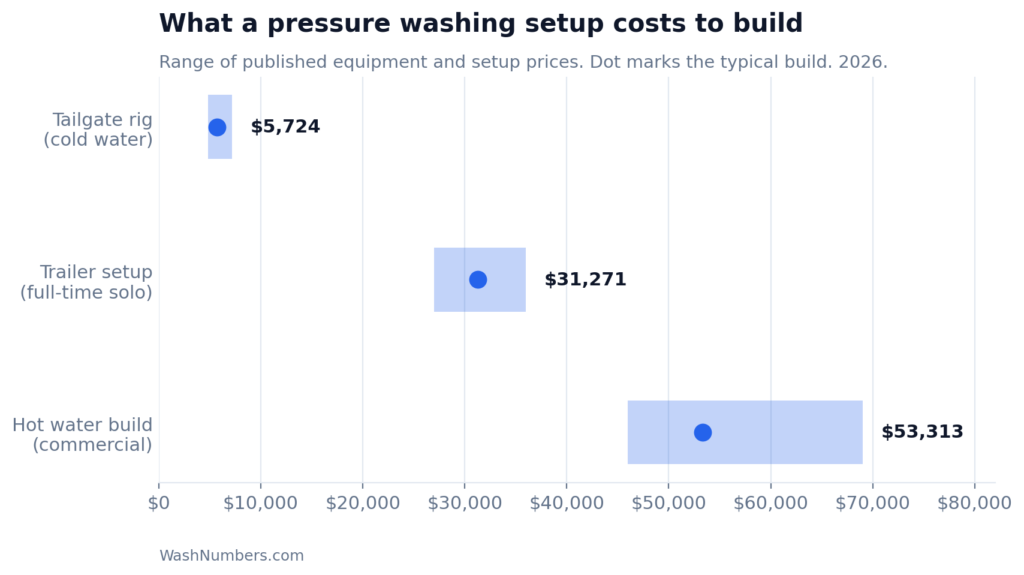
What actually moves pressure washing startup costs
Most guides to pressure washing startup costs open with a list of equipment and stop there. The equipment is the easy part. Three decisions set the floor, and everything else is rounding.
Cold water or hot. A cold water belt-drive unit is the entry point and it sets the floor for pressure washing startup costs. Hot water triples the machine cost and opens up kitchen exhaust, fleet work and grease. If you are washing houses and driveways, hot water is money sitting idle on your trailer.
Tailgate or trailer. A tailgate rig fits in a pickup bed and costs you nothing extra in steel. A trailer adds $3,800 to $6,500 before you put anything on it, and it also adds insurance, registration and a place to park it.
Do you already have a truck. This single item swings pressure washing startup costs by twelve to twenty thousand dollars. Anyone quoting you a startup figure without asking this is quoting a number they made up.
There is a fourth thing nobody counts, and it is the one that bites: the eight to fourteen weeks before the phone rings reliably. Pressure washing startup costs are not only what you spend. They are what you spend before anything comes back.
The three real setups, line by line
These are the three configurations people actually build. Prices are current published figures for contractor-grade equipment, not homeowner units from a big box store.
| Line item | Tailgate rig | Trailer setup | Hot water build |
|---|---|---|---|
| Pressure washer | $1,899 (4 GPM cold) | $3,400 (5.5–8 GPM) | $9,500 (hot water skid) |
| Surface cleaner | $450 (20 in) | $900 (24 in + spares) | $1,600 (multiple heads) |
| Hose, reels, fittings | $600 | $1,100 | $1,400 |
| Injector, tips, accessories | $180 | $340 | $520 |
| Soft wash system | — | $1,800 | $1,800 |
| Buffer tank | $350 (100 gal) | $900 (325 gal) | $1,400 (525 gal) |
| Ladders, PPE, safety | $300 | $520 | $780 |
| Trailer | — | $3,800 | $6,500 |
| Vehicle, used | Already owned | $12,000 | $14,800 |
| Reclaim system | — | — | $4,500 |
| Chemicals, opening stock | $250 | $500 | $900 |
| Insurance, year one | $895 | $3,011 | $5,413 |
| Licensing and registration | $400 | $600 | $1,200 |
| Website, branding, software | $400 | $2,400 | $3,000 |
| Typical total | $5,724 | $31,271 | $53,313 |
| Realistic range | $4,800–$7,200 | $27,000–$36,000 | $46,000–$69,000 |
A note on that first column. The $1,899 machine is a real listed price for a Pressure Pro EB4040HG, 4,000 PSI at 4.0 GPM, belt drive, Honda GX390. I use it as the anchor because it is the most common honest entry point in the trade. Direct-drive units at $700 exist and they are a false economy: the pump is not rebuildable and it will not survive a season of daily use.
If you want to see what the machines themselves sell for across the range, that is covered separately in our breakdown of pressure washer prices.
Work out your own pressure washing startup costs
Put in the quotes your local supplier gives you rather than the figures above. The calculator adds the lines, applies the insurance median for the setup you pick, and tells you how many jobs it takes to get the money back.
Pressure washing startup cost calculator
Enter your own supplier quotes. Insurance defaults to the published median for the setup you pick.
$0
This is payback on the modelled initial investment, not on equipment alone: the total includes the vehicle, insurance, licensing and setup. It does not pay you a wage, it does not cover recurring costs or tax, and it does not include the eight to fourteen weeks before the phone rings reliably.
Insurance is the line most people guess wrong
Every guide to pressure washing startup costs I have read either skips insurance or writes “$500 to $1,000” and moves on. That is not what operators pay.
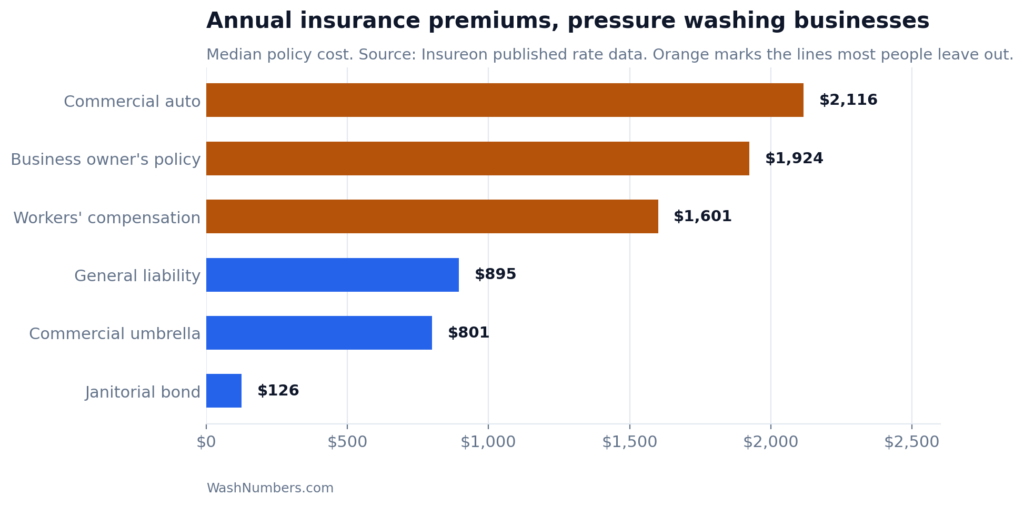
These are median annual premiums for pressure washing businesses, from Insureon’s published rate data:
| Policy | Median per month | Median per year | When you need it |
|---|---|---|---|
| General liability | $75 | $895 | Before your first paid job |
| Commercial auto | $176 | $2,116 | The moment you tow or use a work vehicle |
| Workers’ compensation | $133 | $1,601 | The moment you hire anyone |
| Business owner’s policy | $160 | $1,924 | Bundles liability and equipment cover |
| Commercial umbrella | $67 | $801 | Commercial contracts that demand higher limits |
| Janitorial bond | $11 | $126 | Working unsupervised on client property |
We pulled that line apart on its own page: what pressure washing insurance actually costs, with the published medians from three brokers and why we budget above them.
Read those numbers again with your own setup in mind. General liability on its own is $895 a year. The moment you tow a trailer, commercial auto adds $2,116. The moment you put a second person on the truck, workers’ compensation adds $1,601. A solo operator with a trailer is at roughly $3,000 a year before a drop of water moves, and a two-man crew is closer to $4,600.
That is not a line item you can leave out of pressure washing startup costs. It is the second biggest number in year one for most people.
The costs that never make the lists
These five lines are missing from almost every published estimate of pressure washing startup costs, and together they add $1,500 to $9,000.
Water. If a customer will not let you draw from their spigot, you are buying it or hauling it. A 325 gallon buffer tank costs $700 to $1,100 and it is not optional on commercial flatwork.
Wastewater. Washing a parking lot or a restaurant pad and letting the runoff hit a storm drain is a violation in most municipalities. The EPA’s stormwater discharge rules sit on top of whatever your city says. A basic reclaim setup runs $3,500 to $6,000, and you do not need it for residential housewash work. You absolutely do need it before you bid your first restaurant.
Chemicals per job, not per year. Sodium hypochlorite at 12.5% runs $3.50 to $5.00 a gallon in bulk. A typical single-storey housewash burns 3 to 5 gallons of mixed solution, which is well under a gallon of concentrate. Surfactant, degreaser and roof mix change that arithmetic, and our SH mix calculator will do the dilution for you.
Licensing. An LLC filing is $50 to $500 depending on the state. Local business licences add $50 to $400. Some counties want a contractor registration on top. The SBA’s licence and permit guide is the least painful starting point.
Software. Invoicing and scheduling runs $30 to $80 a month once you are past the notebook stage. Budget it in year one even if you do not buy it in month one.
Below roughly twenty jobs a month you do not need any of it. A document you fill in yourself does the same work for nothing, and we set out the twelve lines and the exclusions block that keep you out of arguments in our guide to the estimate itself.
How many jobs to get your money back
This is the part every other guide leaves out, and it is the only part that tells you whether your pressure washing startup costs are affordable.
We hold 220 published price observations, of which 134 come from direct service providers and the rest from cost guides, marketplaces and pricing tools. The comparable direct-provider figures give these midpoints: a housewash at $439, a driveway at $202, a roof clean at $574, a deck or patio at $240. Those are described in full in our pricing dataset, including what is excluded and why.
Take the price, subtract the consumables and the fuel, and you get what each job actually contributes toward paying off the metal.
| Job | Price midpoint | Consumables and fuel | Contribution per job | Tailgate | Trailer | Hot water |
|---|---|---|---|---|---|---|
| Housewash | $439 | $38 | $401 | 15 jobs | 78 jobs | 133 jobs |
| Driveway | $202 | $22 | $180 | 32 jobs | 174 jobs | 297 jobs |
| Roof clean | $574 | $55 | $519 | 12 jobs | 61 jobs | 103 jobs |
| Deck or patio | $240 | $26 | $214 | 27 jobs | 147 jobs | 250 jobs |
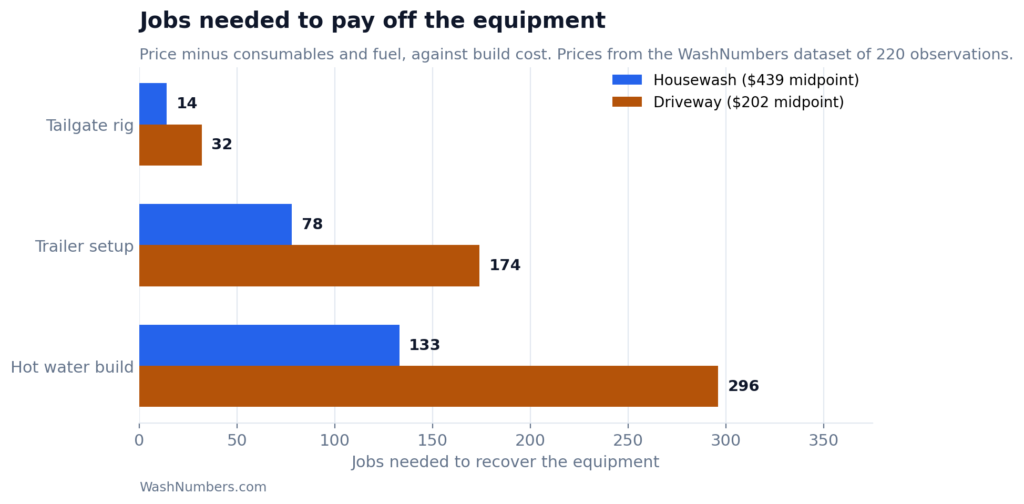
Fifteen housewashes to clear a tailgate rig. Seventy-eight to clear a full trailer setup. A hundred and thirty-three for a hot water build.
One honest caveat, and it matters. Those numbers ignore your own time completely. They tell you how many jobs are needed to recover the modelled initial investment, including equipment, vehicle, insurance, licensing and setup, not how many pay you a wage. A solo operator doing four housewashes a week clears a tailgate rig in under a month of Saturdays and clears a trailer build in about five months of full-time work.
How many you can physically do in a day is a separate question, and the published rates are wildly optimistic. We measured that gap in our production rates guide.
Where new operators overspend
Five mistakes account for most of the difference between a lean build and pressure washing startup costs that run double what they needed to.
Buying hot water first. If your first ten customers are homeowners, hot water is $9,500 of capacity you will not use for a year. Buy it when a commercial contract pays for it, not before.
Buying the trailer before the work. A wrapped trailer parked in a driveway is the most expensive form of optimism in this trade. Tailgate first. Trailer when you are turning work away.
Undersizing the pressure washer to save $600. A 4 GPM unit and a 2.5 GPM unit clean at very different speeds, and the difference shows up on every single job for years. This is the one place where spending more is genuinely cheaper.
Oversizing the surface cleaner. A 24 inch surface cleaner behind a 4 GPM machine will crawl and leave stripes. Match the head to the flow, not to the price tag.
Forgetting the dead months. In most of the country the phone goes quiet from November through February. Pressure washing startup costs that leave you with no cash buffer in October are the reason a lot of one-truck operations do not see a second spring.
When hot water actually pays for itself
Hot water adds roughly $9,500 to the machine line alone, and the reclaim system it usually drags along adds $4,500 more. It earns that back on grease, gum, oil and anything with a food service contract attached.
The break point in my reading of the numbers is a single recurring commercial account. Without one, that upgrade is the fastest way to inflate pressure washing startup costs for no return. One restaurant pad washed monthly at $250 to $400 a visit covers the upgrade inside a year. Without that account, hot water is a very expensive way to clean a driveway slightly faster.
If you are still working out what to charge once you are running, that is a different problem and we cover it in how much to charge for pressure washing.
Frequently asked questions
What are realistic pressure washing startup costs for someone starting solo?
Between $4,800 and $7,200 for a tailgate rig with a contractor-grade cold water machine, insurance, licensing and enough chemical to run for a month. That assumes you already own a vehicle that can carry it.
Can you start with a homeowner pressure washer from a hardware store?
You can start. You will not last. Consumer units run 1.8 to 2.5 GPM with non-rebuildable pumps, and a housewash that takes you four hours instead of ninety minutes destroys your day rate. If money is the constraint, buy a used commercial unit rather than a new consumer one.
Do I need an LLC before my first job?
No, but you need insurance before your first job, and most insurers will quote you either way. The LLC matters the moment you are working on property worth more than you are.
How much should I hold back for the first slow season?
Three months of fixed costs. For a solo trailer operator that is roughly $1,500 to $2,500 covering insurance, software and any equipment financing.
What is the single biggest hidden cost?
Commercial auto insurance at $2,116 a year median. People plan for general liability and get surprised by the vehicle policy.
Is a trailer or a tailgate rig better to start with?
Tailgate, unless you already have commercial work booked. A trailer adds $3,800 to $6,500 in steel plus insurance and registration, and it does not clean anything faster.
How long before the equipment pays for itself?
Fifteen housewashes for a tailgate rig, about 78 for a full trailer build, using the midpoint prices from our own dataset. That is payback on the build, not wages.
Do I need a reclaim system?
Not for residential work. Yes, before you bid commercial flatwork or anything food service, where letting runoff reach a storm drain is a violation.
Before you buy anything
Run your own pressure washing startup costs through the calculator above using real quotes from your local supplier, not the figures in this article. Prices vary by region and by what your distributor will do on a package deal.
And if you are already running a rig, we are building the first pricing benchmark in this trade from figures given directly by working contractors. Seven questions, answered in ranges, no names published. Add your numbers to the survey and you will get the full state-by-state results before anyone else does.
Tools for your business
Contractor Pricing Calculator
Build a quote that still leaves a margin after chemicals and drive time.
Production Rate Calculator
The hours a job takes, before you can price it.
Startup Cost Calculator
What a rig costs to build and how many jobs pay it back.
Add Your Rates to the Survey
Seven questions. You get the state-by-state results first.
 Written by Diego Hernández, founder of WashNumbers. Cost models are built from published contractor rates and public price observations. See how we build these numbers.
Last reviewed: September 2026